Hearth Cult Myth Meaning & Symbolism
A myth of the sacred fire at the world's center, guarded by ancestors, where the soul's eternal flame is kindled against the outer dark.
The Tale of Hearth Cult
Listen. Before the names of nations, before the first stone of the first city was laid, there was the Dark. Not an evil dark, but a deep, cold, and wordless dark, the dark of the unformed world. In this dark, the people were scattered, voices lost to the wind, their stories eaten by the silence. They were cold.
Then, from the great memory of the earth itself, a knowing arose. It was not one person, but a whispering in the blood of many. "Find the center," it said. "Find the navel of the world."
They wandered, these scattered ones, until they came to a place that was no different from any other—a simple clearing, a fold in the land. But here, the air thrummed. Here, the silence had a different quality, a waiting. An elder, her face a map of all their journeys, knelt. With a fire-drill made of the world-tree’s wood, she spun a spark from the heart of the earth itself. It caught on dry tinder, a gasp of light in the vast throat of the dark.
This was no ordinary fire. This was the Hearth Fire. As it grew, its light did not just push back the shadows; it called. From the forests and the plains, from across the whispering rivers, the scattered ones saw its beacon—not with their eyes, but with the bone-deep memory of warmth. They gathered.
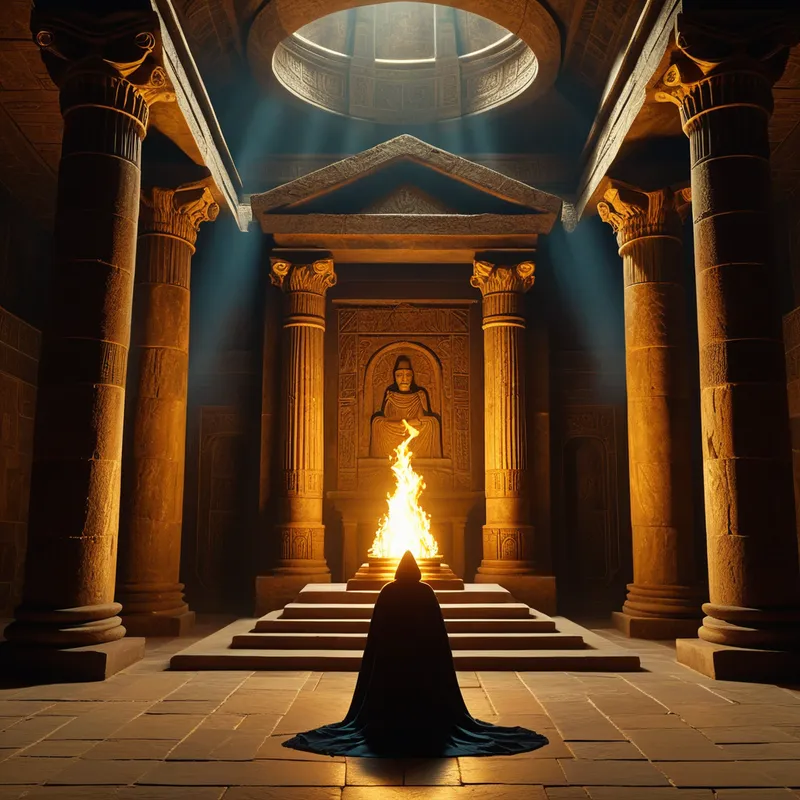
Around the fire, they built a hall. Not with ambition, but with necessity. Four great pillars were raised, carved with the faces of the first ancestors. The roof was thatched with stories. The hearthstone, black and smooth from an ancient river, was set at the exact center. Here, the fire was never to go out. A sacred duty was born: the Fire-Tender.
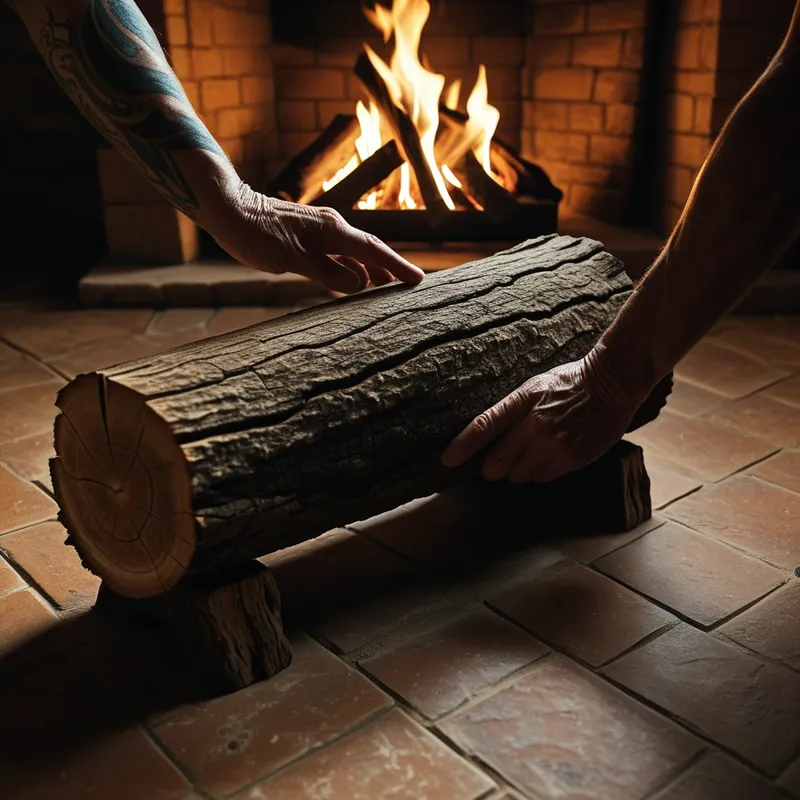
The Tender was no ruler, but a listener. Day and night, they fed the flame with logs of oak, the tree of firmament, and applewood, the tree of heart’s desire. They poured libations of milk and mead onto the stone, which hissed and steamed, sending prayers upward with the smoke. The fire became an eye. It saw the births, the marriages, the quiet deaths. It witnessed the oaths sworn on blades heated in its coals. Its light was the truth-teller.
And the ancestors? They were not gone. They sat in the shadows just beyond the firelight, in the carved pillars. Their presence was a warmth on the back of the neck, a completed thought in a moment of doubt. The fire was their voice; its crackle was their language. To tend the fire was to tend to them. To listen to the fire was to hear their counsel.
The conflict was not a dragon to slay, but the relentless, whispering pressure of the Outer Dark. It was the cold that sought to seep under the door-skin. It was the forgetting that threatened when travelers did not return. It was the chaos of storms that mocked the fragile circle of light. The heroism was in the simple, relentless act of tending. In placing the next log. In sweeping the ash, which was not dirt, but the sacred dust of spent time.
The resolution was not an ending, but a rhythm. The hall became a world in miniature. The hearth was its sun. The people, its orbiting stars. The myth does not conclude with a battle won, but with a scene repeated for ten thousand nights: a figure silhouetted against the eternal flame, ensuring that in the vast, cold cosmos, this one point of warmth, memory, and belonging would endure. The light held. The story continued.
Cultural Origins & Context
This myth is not a story with a single author, but the deep cultural substrate of the Proto-Indo-European peoples. It existed long before it was ever written down, woven into the very fabric of daily ritual and linguistic roots. We reconstruct it not from a single text, but from the astonishing echoes found in the descendant traditions: the Vesta of Rome, the Hestia of Greece, the Agni as the mouth of the gods, and the sacred hearths of Celtic and Slavic folklore.
It was a living doctrine passed from elder to child through the act of tending itself. Its "bards" were the grandmothers stirring the pot, the fathers building the fire at a new homestead. Its societal function was foundational: it encoded the principle of domus—the inviolable sanctuary of the home, the clan, and the social order. The hearth was the axis mundi, the cosmological center where the human, ancestral, and divine realms met. To break hospitality (the law of the hearth) was a cosmic crime. To let the fire die was to risk the unraveling of the world.
Symbolic Architecture
Psychologically, the Hearth Cult myth maps the architecture of the conscious self. The Hearth Fire is not merely warmth; it is the light of consciousness itself—the fragile, flickering awareness that defines "here" from "there," "us" from "other," "meaning" from "chaos."
The hearth is the psyche's center of gravity, the still point around which the chaos of experience must orbit to become a coherent world.
The Hall represents the constructed ego—the identity, traditions, and personal history we build to shelter that precious flame. The Four Pillars signify the essential structures that uphold a psyche: perhaps body, mind, soul, and story. The Ancestors in the pillars are the contents of the personal and collective unconscious—not dead, but living presences in the form of inherited patterns, instincts, memories, and cultural complexes. The Outer Dark is the unintegrated unconscious, the mysterium tremendum, the raw, undifferentiated potential and terror that exists beyond the borders of our known self.
The true protagonist, the Fire-Tender, is the ego in its most sacred role: not as conqueror, but as steward. It is the part of us tasked with the daily, humble work of maintaining consciousness, of integrating new experiences (fuel) into our understanding (fire), and of respectfully acknowledging the deep, often shadowy, influences of our inner ancestry.

The Dreamer's Resonance
When this myth stirs in the modern dreamer, it speaks to a crisis or process of centering. To dream of a hearth is to dream of the Self's core. A roaring, healthy fire suggests a vital, integrated psyche where consciousness successfully transforms experience into warmth and light. A dying fire, or frantic attempts to relight it, signals burnout, depression, or a loss of meaning—the ego’s light is failing.
Dreaming of ancestral figures near a hearth indicates a necessary dialogue with the unconscious. These are not literal ghosts, but personified aspects of one's own history—inherited trauma, family patterns, or innate talents seeking recognition. The outer dark pressing in manifests as dream imagery of encroaching shadows, cold, or formless monsters at the windows. This is the somatic feeling of being overwhelmed, of the structures of the ego (the hall) feeling too flimsy to contain the pressures of life or the upwelling of repressed material.
Such dreams are an unconscious summons to the work of tending. They ask: What in your life is the sacred center? What have you neglected? What ancestral voice (instinct, memory, pattern) needs to be invited to the fire and heard?
Alchemical Translation
The alchemical process modeled here is not the heroic quest outward, but the sacred labor inward—the opus contra naturam of maintaining the inner vessel against the constant entropic pull of the unconscious and the outer world. The transmutation is from scatteredness to coherence, from cold isolation to warm belonging within oneself.
The first stage is Finding the Center (the Nigredo of Orientation): This is the dark night, the feeling of being lost and cold. The alchemical work is to stop wandering and identify, through introspection or crisis, the one true point around which your psyche can organize—a core value, a sacred wound, a non-negotiable truth.
The second is Kindling and Containing (the Albedo of Clarification): Here, one must spin the spark of intention into a sustained flame. This is the discipline of daily practice—journaling, meditation, therapy, creative work—that feeds consciousness. Building the "hall" is establishing healthy boundaries, routines, and a personal philosophy that protects this developing inner life.
The ultimate goal is not to conquer the dark, but to learn its language by the light of your own fire, realizing the ancestors in the pillars are your own forgotten wholeness.
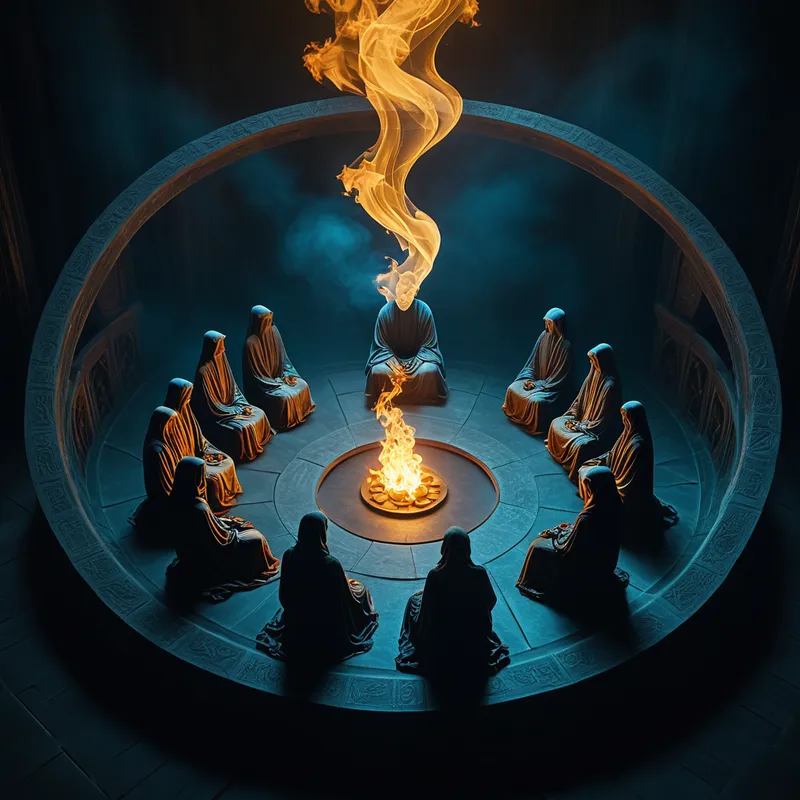
The final, ongoing stage is Tending the Union (the Rubedo of Integration): This is the mature state of individuation. The fire-tender (ego) no longer fears the ancestors (unconscious) or the outer dark (the unknown). Instead, they engage in a perpetual ritual of exchange. Libations are poured—this is the act of sacrificing childish fantasies and offering one's conscious work back to the depths. The fire is fed—new experiences are courageously brought into the light of awareness and digested. The hearth becomes a living mandala, a symbol of the Self where all opposites—light and dark, known and unknown, individual and ancestral—are held in a dynamic, sacred equilibrium. The flame burns eternal because it is fed by the whole of one's being.
Associated Symbols
Explore related symbols from the CaleaDream lexicon: