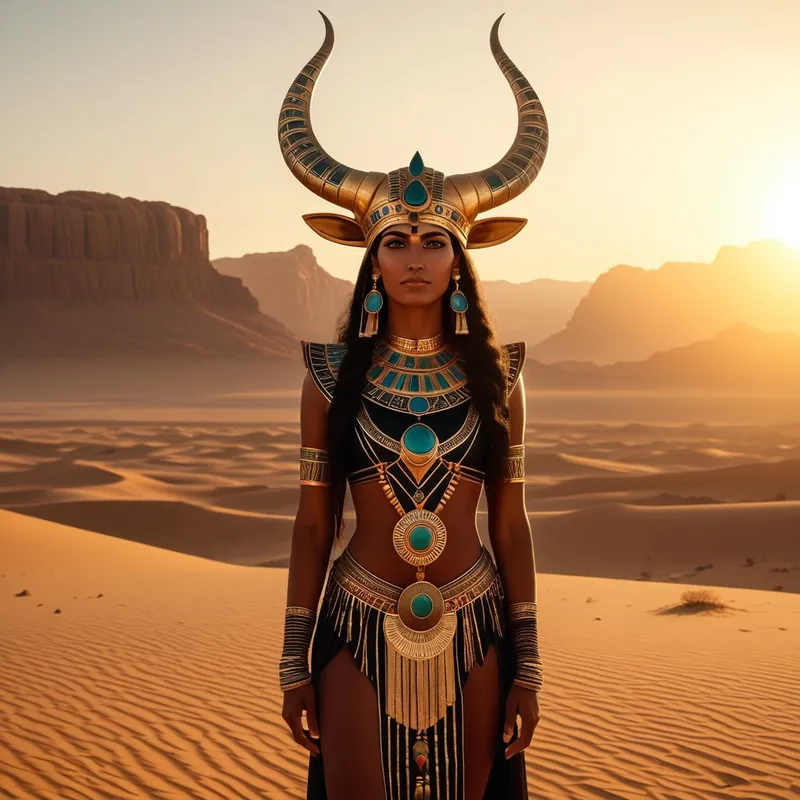
Hathor's Crown Myth Meaning & Symbolism
The myth of Ra sending Hathor as the Eye of vengeance, only to have her bloodlust transformed into life-giving joy through a river of red ochre beer.
The Tale of Hathor's Crown
Hear now the tale from the time when the world was young and the sun-god Ra walked the earth as king. His rule was long, his light was law, but a murmuring rose from the clay of the riverbanks. Humanity, his own creation, grew restless. Whispers coiled in the shadows, plots were spun in the reeds—they spoke of rebellion against the aging god, of casting down his fiery majesty.
Ra, enthroned in his golden barque, felt the tremor of their treachery. A cold, silent fury, older than time itself, kindled in his heart. He did not call his warriors. He did not summon thunder. He turned his gaze inward, to the most potent aspect of his own being—his Eye. And his Eye was the goddess Hathor.
“Go forth, my daughter, my fury, my Sekhmet,” he commanded, his voice the crackle of desert heat. “Let those who dare defy me know the taste of their own blood.”
And so, the gentle cow-eyed goddess of love was unmade. From her form erupted the Sekhmet, a towering lioness of molten bronze and burning breath. Her roar split the sky. She descended upon the fields of humankind not as a goddess, but as a plague, a force of pure, unthinking annihilation. Her claws were scythes, her teeth were white fire. She waded into the cities, and where she passed, only silence remained, stained crimson.
Ra watched from on high. The rebellion was crushed, turned to dust and memory. But Sekhmet did not stop. The taste of blood had awakened a primordial hunger. Her rage, once a tool, became an autonomous force, a whirlwind of destruction that threatened to consume all of creation—to leave not a single soul to worship the gods, to leave Ra alone in a silent, empty world. The cure had become a disease more terrible than the ailment.
A great dread settled over the Ennead. The sun itself seemed to dim with Ra’s regret. They had to stop her, not with force, for she was force incarnate, but with guile. The wise god Thoth devised a plan. He spoke to the swiftest messengers, and they raced to the far south, to the island of Ta-Seti, where the red earth bled a potent ochre.
“Bring it,” Thoth said. “Bring it in abundance.”
Seven thousand jars of this red earth were brought before the gods at <abbr title=""Heliopolis", the major cult center of the sun god Ra">Iunu. There, under Thoth’s direction, the master brewers of the gods mixed the ochre with barley and sweet fruits. They worked through the night, and by dawn, they had filled seven thousand jars not with earth, but with a beer the color of blood—a deep, hypnotic, river-red beer.
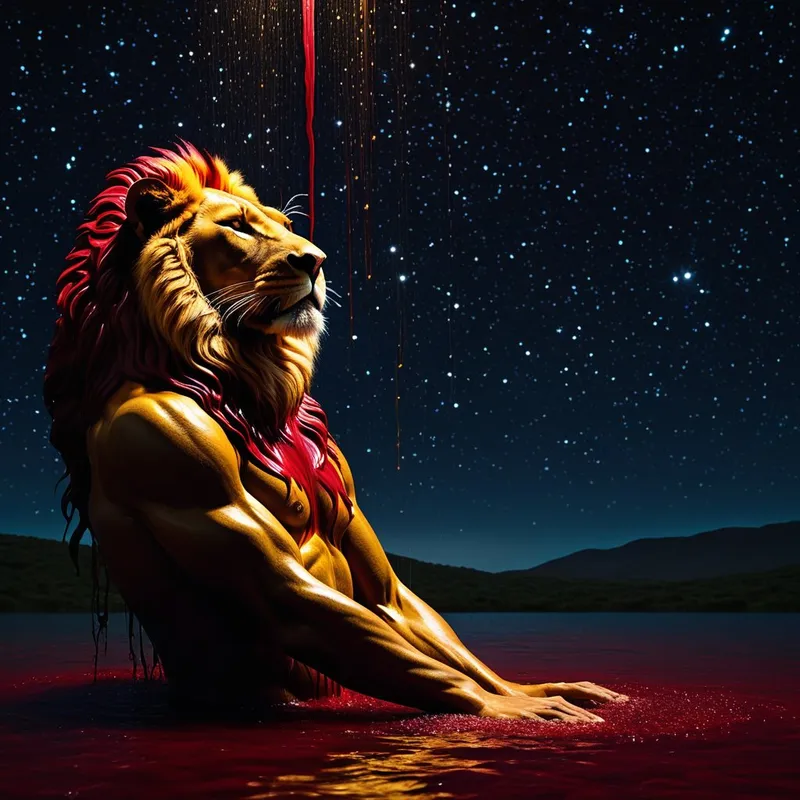
As the searing sun rose, Sekhmet prowled the lands near the planned slaughter. Thoth and the gods poured the libation upon the fields, creating a great, shimmering lake of red. The lioness, parched from her endless killing, caught the scent. She saw the vast, red pool and, in her blood-madness, believed it to be the very essence of her prey. With a mighty roar, she bent her head and drank. She drank until the lake was gone, until the seven thousand jars were empty. The potent, drowsy beer flooded her veins.
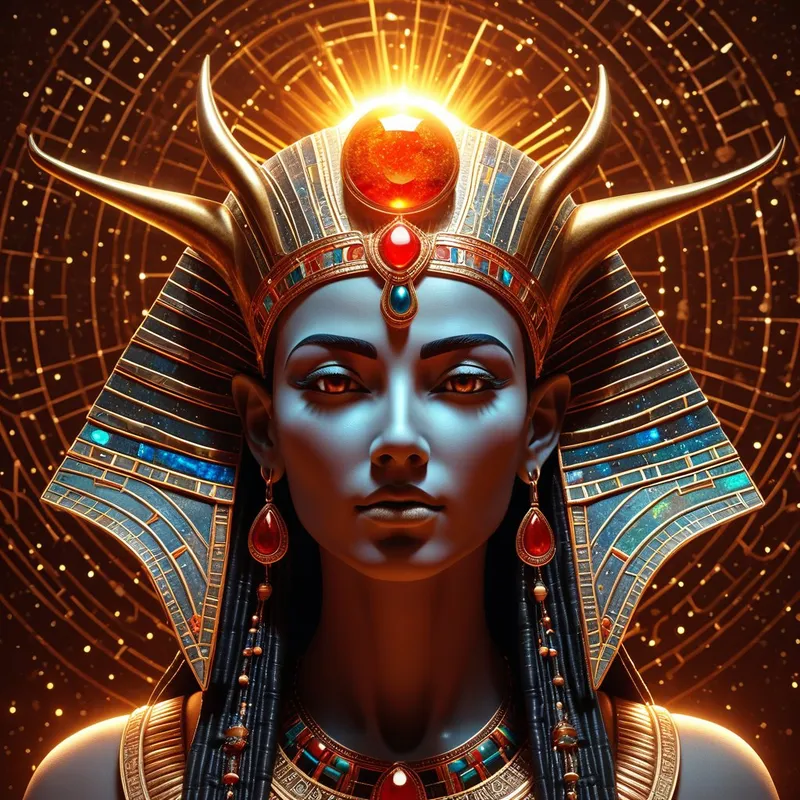
Her furious pacing slowed. The fire in her eyes guttered and softened. The bronze of her coat seemed to melt into gold. The snarl on her lips relaxed into a dazed, then a peaceful smile. The lioness lay down in the field, and when she rose, she was Hathor once more—but a Hathor transformed, her heart full not with rage, but with a profound, sleepy contentment. She returned to Ra, and he placed upon her brow a new crown: the sun-disk held aloft by the horns of the sacred cow, a crown that forever remembered her dual nature—the destroyer who became the joyful life-giver, the wrath that was quenched to become blessing.

Cultural Origins & Context
This myth, often called “The Destruction of Mankind,” is preserved in the tombs of the New Kingdom pharaohs, most completely in the shrine of Hatshepsut at Deir el-Bahari and later in the tomb of Seti I. It was not a folktale for the masses, but a sacred text inscribed in the stone of eternity, meant to accompany the king—the living heir of Ra—into the afterlife. Its tellers were the lector priests, the “keepers of the sacred books,” who would recite it during certain rituals, perhaps those pertaining to royal legitimacy and the pacification of dangerous divine powers.
Societally, the myth functioned on multiple levels. It explained the perceived necessity of the pharaoh’s absolute, sometimes fearsome, authority (as Ra’s deputy on earth). It also provided an etiology for the Inundation of the Nile, sometimes symbolically linked with the red beer. Most importantly, it was a cornerstone of the great Egyptian ethos of Maat. The story dramatizes a catastrophic imbalance (human rebellion) addressed by an over-correction (Sekhmet’s rampage), which is then brought back into perfect equilibrium through divine wisdom (Thoth’s trick). It is a cosmic lesson in the restoration of order, where even the most destructive force can be reintegrated into the cycle of life.
Symbolic Architecture
At its core, this is a myth about the paradox of power and its necessary transmutation. Ra’s Eye represents an autonomous complex of immense psychic energy—in this case, raw, untamed fury. It is the shadow of divine authority, the unthinking weapon that, once unleashed, threatens to consume the very psyche that created it.
The greatest power is not that which destroys the enemy, but that which transforms the destroyer within.
Hathor-Sekhmet embodies the ultimate duality: the mother who nurtures and the mother who devours; the ecstatic joy of life and the terrifying frenzy of death. They are not two goddesses, but one entity seen through different lenses of consciousness. The red ochre beer is the master symbol of alchemy. It is matter (earth/ochre) transformed into spirit (intoxicating beer) through craft (Thoth’s wisdom). Its red color meets Sekhmet in her own symbolic language (blood), but its essence changes the terms of engagement. It does not oppose her; it satiates and alters her from within. This is the essence of sophisticated ritual magic and deep psychology: one does not fight a shadow with force, but by recognizing its need and offering a symbolic, transformative fulfillment.
The Dreamer's Resonance
When this myth stirs in the modern unconscious, it often manifests in dreams of uncontrollable rage or being pursued by a wild beast (often a lion or big cat). The dreamer may feel consumed by a fury that feels alien yet part of them, a “red mist” that descends and obliterates reason. This is the Sekhmet complex activated—a raw, archetypal reaction to perceived betrayal, injustice, or powerlessness.
Somatically, this can correlate with feelings of overheating, tension in the jaw and shoulders, and a pounding heart. Psychologically, it indicates a potent life-force has been corrupted into pure destructiveness, often because it has been denied, repressed, or only expressed in distorted ways. The dream is the psyche’s dramatic presentation of a self-destructive feedback loop. The healing moment in such a dream cycle might be the sudden appearance of a red liquid that is not threatening, a calming presence (a Thoth-figure), or a transformation of the beast into something benevolent. This signals the beginning of the alchemical process, where the somatic energy of rage is seeking a vessel for its transmutation.
Alchemical Translation
For the individual on the path of individuation, the myth of Hathor’s Crown is a precise map for psychic transmutation. The “rebellion of humanity” can be seen as the ego’s legitimate, if clumsy, revolt against an outdated, tyrannical inner authority (a rigid super-ego, a dominant parental complex, or an inflated self-image—the “aging Ra”). The ego’s attempt to dethrone this authority unleashes not freedom, but a terrifying, autonomous shadow—the Sekhmet within.
The conscious mind (Ra) then faces its own creation run amok: a bitter cynicism that destroys all hope, a self-sabotaging anger that burns bridges, or a critical inner voice that annihilates self-worth. To fight fire with fire only increases the conflagration. The Thoth function—the intellect guided by intuition and symbolic wisdom—must intervene.
Individuation requires brewing the red beer: finding the symbolic, creative act that can contain and transform the red heat of rage into the warm glow of creative power.
This is the alchemical translation. The “red ochre” is the base material of our pain, our trauma, our primal anger. The “brewing” is the conscious, often patient, work of therapy, art, ritual, or deep reflection. The resulting “beer” is a new form for that energy: the fierce protectiveness of a caregiver (Hathor), the passionate dedication of an artist, the unwavering justice of an advocate. The crown placed on our head is the hard-won integration where we no longer disown our power or our fury, but wear them as a sacred emblem. We become sovereigns of our own duality, capable of both setting boundaries and offering joy, having transformed the blood of our wounds into the wine of our spirit.
Associated Symbols
Explore related symbols from the CaleaDream lexicon: