Hanging Gardens Myth Meaning & Symbolism
A queen's profound longing for her lost homeland manifests as a miraculous, terraced garden, a testament to love's power to defy nature and memory.
The Tale of Hanging Gardens
Listen, and let the wind from the east carry you to a time of kings and empires, of dust and longing. In the heart of the vast Babylonian plain, where the sun ruled a kingdom of baked earth and the twin rivers were the land’s only veins of life, there lived a king. His name was Nebuchadnezzar II, and his power stretched to the horizon. Yet, his greatest treasure was not gold or territory, but his queen, Amytis.
Amytis was a daughter of the highlands, born where the air was cool and the mountains wore cloaks of cedar and pine. Her homeland was a tapestry of green slopes and rushing streams. Babylon, for all its grandeur, was a cage of flat, ochre stone and relentless heat. The king watched as the color faded from his queen’s cheeks, as her eyes, once bright as mountain lakes, grew dull with a homesickness that no physician could cure. She was withering, a flower transplanted to barren soil.
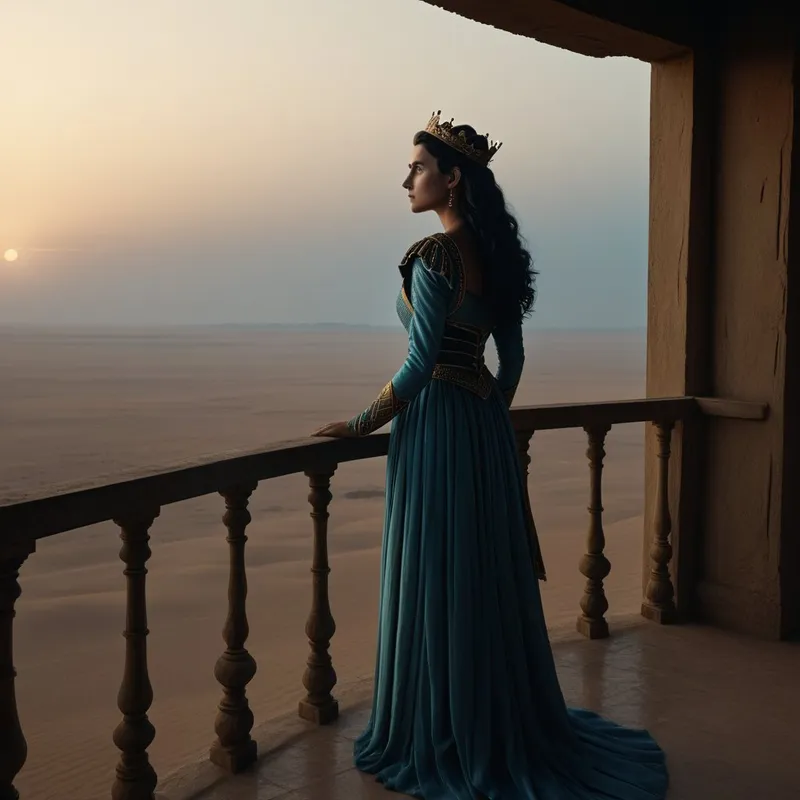
A silent desert grew within her. She would stand on the highest palace terrace, her gaze stretching north, seeing not the bustling city or the fertile riverbanks, but the ghostly peaks of a lost paradise. The wind carried only dust, not the scent of pine. The songs of the city were a cacophony, not the whisper of mountain springs. Her soul was in exile.
Then, the king’s heart, a heart hardened by war and statecraft, cracked with a new resolve. If the mountains could not come to Babylon, Babylon would become a mountain. He summoned architects from the corners of the earth, masters of stone and water. "Build her a memory," he commanded. "Build her the breath of her homeland."
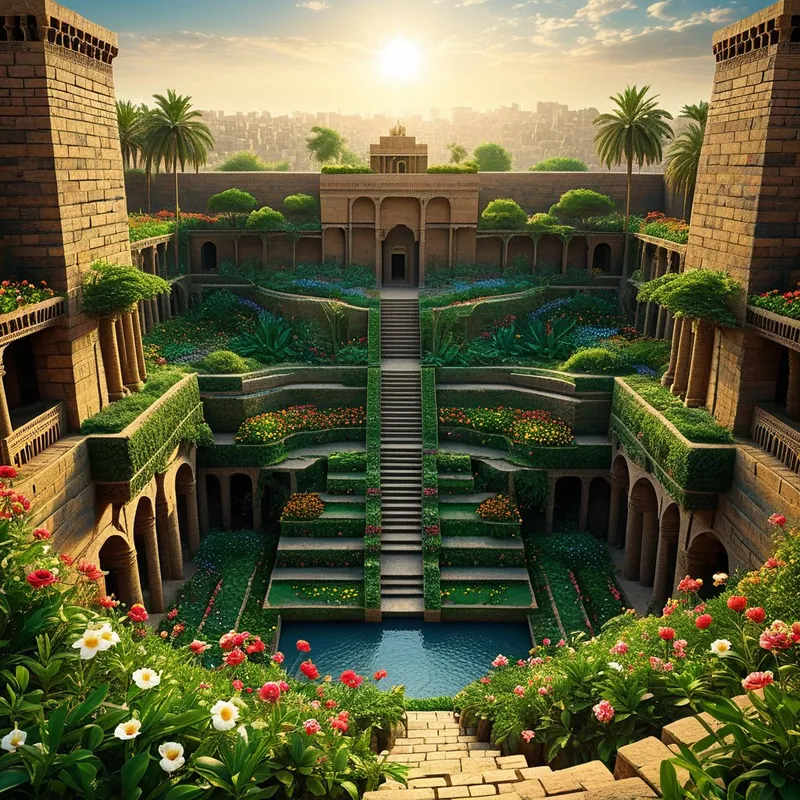
And so, they began. Not with a simple garden, but with a defiance of nature itself. They built a ziggurat not for gods, but for a single human heart. Towering terraces of baked brick rose, tier upon tier, like a stairway to a green heaven. Within these vaulted chambers, they planted the world. They hauled earth from distant valleys, trees whose roots were as old as empires, and flowers whose names were poems. They devised hidden engines, screws of bronze and cunning channels, to draw water from the river far below, letting it weep and sing through the gardens, a perpetual, artificial rain.
When it was done, the king led his queen, her eyes downcast, to the base of this impossible creation. "Look up," he whispered.
She lifted her gaze. Before her rose a living mountain, a cascade of emerald and sapphire, of scarlet blossom and amber fruit. Water sparkled in rivulets down mossy stones. The air was suddenly, miraculously, cool and damp, fragrant with earth and bloom. The sound of the city vanished, replaced by the drip of water and the rustle of leaves. She climbed, and with each step, the weight of her exile fell away. On the highest terrace, surrounded by the whispering trees of home, she wept. The desert in her soul bloomed. The hanging gardens were not just a wonder of the world; they were a sigh of love made stone and leaf, a prayer answered not by gods, but by the relentless will of a human heart.
Cultural Origins & Context
The tale of the Hanging Gardens exists in the liminal space between history and longing. While attributed to classical historians like Berossus and later Greco-Roman writers, its deepest roots are woven into the Persian and Mesopotamian imagination. It is less a verified historical record and more a cultural dream—a story that felt true because it spoke to a core human and environmental reality.
In the arid landscapes of the Iranian plateau and Mesopotamian plain, the garden, the pairi-daeza, was not a luxury but a cosmological act. It was a sacred microcosm, a symbol of order, fertility, and divine favor imposed upon chaos. The Hanging Gardens myth amplifies this to a royal, epic scale. It is a story told not of common folk, but of the pinnacle of society, demonstrating that even the most powerful are subject to the soul's deepest needs—the need for belonging, for beauty, for the specific scent of home.
The myth functioned as a testament to imperial capability and profound personal devotion. It showcased the Babylonian (and by cultural absorption, Persian) mastery over the two most vital and elusive elements: water and growth. It also served a poignant societal function: it personalized the king. Nebuchadnezzar becomes not just a conqueror, but a lover; his greatest achievement is not a battlefield victory, but a act of healing creation. The story was passed down as a parable of what love and resources, when combined with absolute will, could manifest—a paradise built not for the afterlife, but for the here and now, to mend a broken heart.
Symbolic Architecture
At its core, the myth is a profound map of the psyche's response to profound loss. Amytis represents the ego in a state of exile, severed from its native soil—the collective unconscious or the authentic Self. Her homeland is the lush, mountainous inner landscape of instinct, memory, and belonging. Babylon is the flat, arid realm of duty, persona, and conscious adaptation, where the soul feels parched.
The gardens themselves are the ultimate symbol of the transcendent function. They do not deny the reality of the desert (the present circumstance), nor do they magically transport her back to the mountains (the irretrievable past). Instead, they create a miraculous third thing: a synthesis.
The Hanging Garden is the psyche’s masterpiece: a bridge built not between two places, but between memory and presence, between loss and life.
It is an act of active imagination. Nebuchadnezzar, in this reading, can be seen as the focused, determined power of the conscious will, acting in service of the soul's deepest need. The complex irrigation—the hidden screws and channels—symbolizes the intricate, often unconscious psychological processes that draw nourishment (libido, psychic energy) from the deep river of the unconscious and lift it into the daylight of consciousness, where it can finally make the inner landscape bloom.
The Dreamer's Resonance
When this myth pattern stirs in the modern dreamer, it signals a profound somatic and psychological process: a creative mourning. The dreamer may not dream of literal gardens, but of constructing impossible, beautiful structures in barren places, of finding ways to make water flow uphill, or of tending to a specific, nostalgic plant in an unlikely environment.
The somatic sensation is often one of a deep, aching longing—a "homesickness" for a part of oneself that feels lost or inaccessible. This could be a lost passion, a cultural identity, a sense of childhood wonder, or a connection to nature. The psyche is announcing that adaptation alone is no longer sufficient; the soul is withering in the current "Babylon" of one's life.
The dream is the first blueprint of the gardens. It is the psyche’s declaration that the old solution—yearning for a literal return—is impossible, but that a new, creative synthesis must be engineered. The emotional tone can shift from the despair of Amytis on the balcony to the determined focus of the builders, indicating the dreamer is moving from passive suffering to the initial stages of active, psychic creation.
Alchemical Translation
The alchemical journey modeled here is the transformation of nigredo (the blackening, the queen's melancholia, the desert of the soul) into albedo (the blossoming garden, the illuminated self). The process is not one of escape, but of radical integration.
First, the solutio: the queen's tears, her dissolution into grief, which softens the hardened king (the rigid conscious attitude). Then, the coagulatio: the gathering of materials—the diverse earth, seeds, and waters from the depths (unconscious contents). The arduous construction is the coniunctio, the marriage of mountain and plain, memory and present, feminine longing and masculine execution.
Individuation is the building of one’s own Hanging Gardens: a conscious structure that allows the lost, native parts of the soul to live and flourish within the reality of one’s current life.
For the modern individual, the myth instructs: Your deepest longing is not a flaw to be cured, but the architect’s plan. The "Babylon" of your life—your responsibilities, your location, your limitations—is not the enemy, but the necessary site for construction. The alchemical work is to become both Nebuchadnezzar and Amytis: to feel the profound ache of exile with the queen’s sensitivity, and to respond with the king’s relentless, creative will. You must design the hidden irrigation systems—the daily practices, the therapy, the art, the study—that draw life from your own deep river and use it to water the terraces of your being. The paradise you seek is not behind you in time or over there in space. It is the living, breathing edifice you build, tier by tier, in the very place where you once felt you would perish.
Associated Symbols
Explore related symbols from the CaleaDream lexicon: