Hamlet's Soliloquies Myth Meaning & Symbolism
A prince, haunted by a ghost, is torn between action and thought, his private soliloquies mapping the soul's torment on the path to a tragic destiny.
The Tale of Hamlet's Soliloquies
Hark, and listen to the tale of the Prince of Shadows, he who walked the crenellated stone of Elsinore. The air was thick with the scent of deceit and old murder, a poison seeping from the very stones. The young prince, Hamlet, was a man cleft in twain. His world had frozen when his father, the old king, fell—not in honorable battle, but felled by a brother’s venom in the orchard.
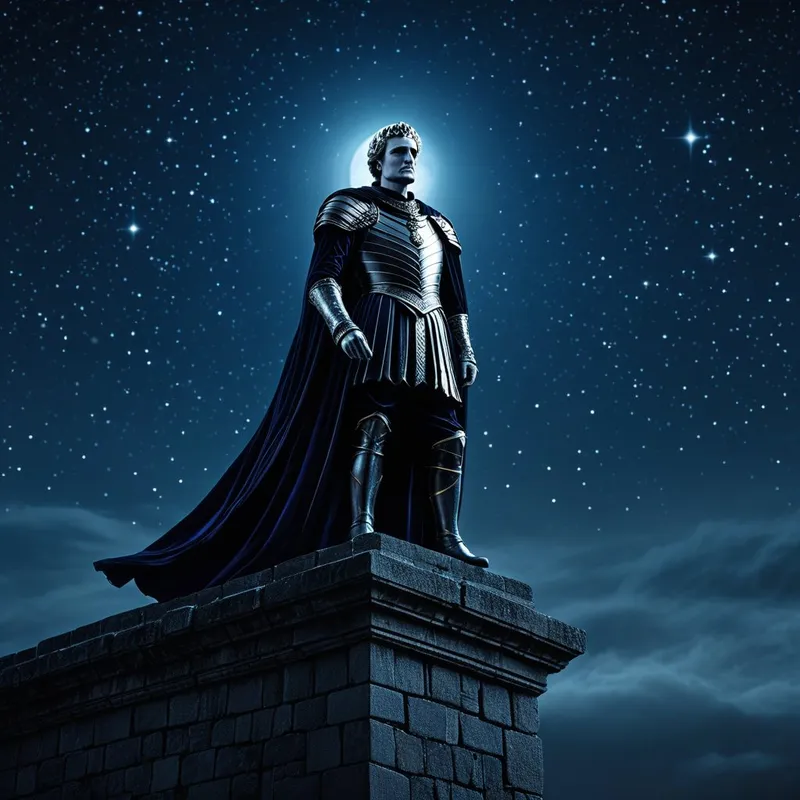
Then came the Watcher in the Cold. On the midnight ramparts, a figure armored in remembered glory, a face pale as the forgotten moon. It was the Ghost, and its words were not of comfort, but of a terrible, sacred charge: “Revenge.” The seed was planted in the prince’s soul, but it was a seed of fire and ice.
And so began the great unspoken war, fought not on fields but in the vaulted chambers of a single mind. You would see him, a figure of black against the grey stone, his voice a low thunder heard only by the walls and the indifferent stars. “To be, or not to be…” The question hung in the air like a blade. To act was to plunge into a sea of blood and certainty; to not act was to drown in a bog of thought and shame. He wrestled with self-slaughter, with dreams, with the dusty end of all ambition.
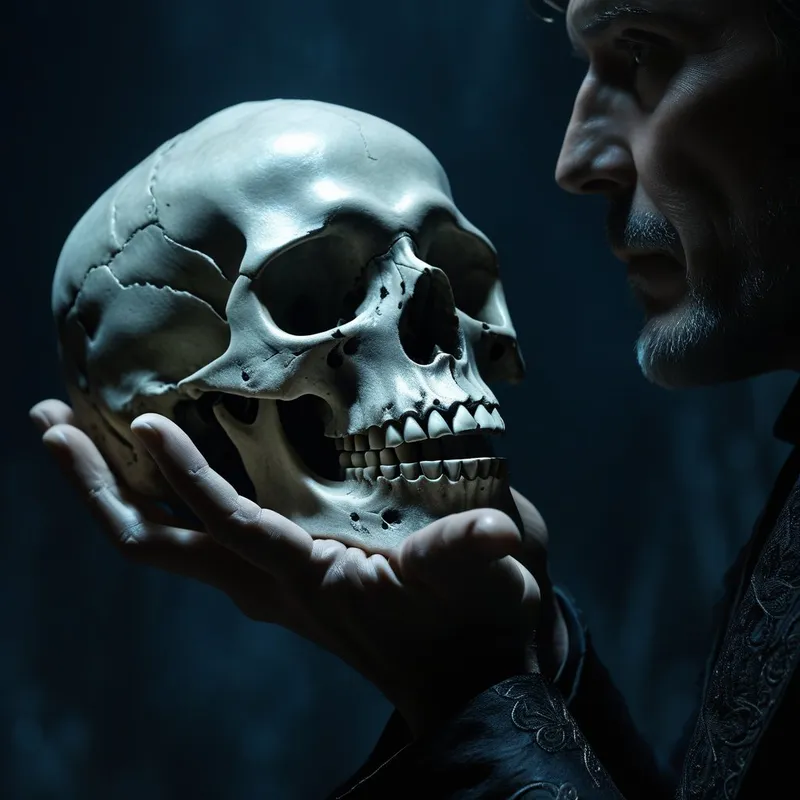
He feigned a madness that became a second skin, a mirror held up to the genuine rot in the court. He watched the players weep for Hecuba, and wondered at the power of a fiction to stir the soul, while his own reality left him paralyzed. He held the jester’s skull, Yorick, and tasted the absolute democracy of the grave—king and clown alike reduced to grit and bone.
The climax was not a clash of armies, but a failure of hesitation. In a curtained room, he saw the usurper king at prayer and stayed his hand, his thought overmastering his will. This pause sent fate spiraling into tragedy. Poisoned wine, unbated foils, a final carnage in the hall. The prince, his mother, his uncle, his love—all fell, not from a clear stroke of justice, but from the chaotic fallout of a soul’s protracted civil war. His last breath was not an answer, but a release from the question, leaving the kingdom to a foreign soldier and the tale to the eternal whisper of the wind.
Cultural Origins & Context
This is a myth born in the twilight of the Elizabethan age, a product of the Globe Theatre and the mind of the Bard. It was not scripture, but spectacle, passed down not by priests but by actors—the King’s Men. Its societal function was complex: a mirror for a nation grappling with political instability, the divine right of kings, and the rise of a new, introspective humanism. The audience, from groundling to noble, witnessed not a simple revenge play, but an anatomy of melancholy, a public dissection of a private consciousness. The soliloquy was the revolutionary device, breaking the “fourth wall” to make the crowd complicit in the most secret thoughts of a prince, transforming political drama into universal psychology.
Symbolic Architecture
The myth’s core is the soliloquy itself—not merely a speech, but a sacred space. It represents the birth of the modern interior self, a chamber where the world is suspended and the soul holds its own trial.
The skull of Yorick is the memento mori made fleshless; it is the absolute democratization of being, where the king’s jest and the jester’s truth are rendered identical by time.
Hamlet is the archetype of the intellectual avenger, a man whose weapon is thought, which proves useless against the brute fact of murder. The Ghost represents the burden of the past, the unintegrated Father Complex that demands a bloody, archaic justice the modern soul cannot comfortably deliver. Ophelia is the innocent anima, drowned by the chaotic, unresolved storms of the masculine consciousness. The entire court of Elsinore symbolizes the corrupted Self, a kingdom of the psyche ruled by a usurping shadow, where truth must wear the mask of madness to be spoken.

The Dreamer's Resonance
When this myth stirs in the modern dreamer, it manifests as the paralysis of profound choice. You may dream of standing at a threshold—a door, a bridge, a career change—but your feet are rooted to the spot. You hear a commanding voice (the Ghost) giving clear instruction, but your own voice (the Soliloquy) argues, dissects, and deconstructs it into meaninglessness. You might dream of holding an object—a letter, a key, a weapon—and being utterly unable to decide whether to use it, give it, or destroy it.
Somatically, this is the experience of cognitive flooding—the mind racing while the body is frozen, the tension often felt in the jaw, the shoulders, the gut. Psychologically, it is the process of confronting a shadow so large (a familial duty, a moral absolute, a life-altering decision) that the ego cannot find a way to act without feeling it will be annihilated. The dream is not about indecision, but about the terrifying weight of consequence that true consciousness brings.
Alchemical Translation
The alchemical journey in this myth is not of successful transformation, but of the nigredo—the blackening, the putrefaction—stretched to its existential limit. Hamlet’s psyche is the sealed alembic. The poison of the murder (the prima materia) is introduced by the Ghost. The soliloquies are the slow, torturous heat applied, the constant rotation of the matter of his soul.
The goal is not to create the revenge, but to transmute the base impulse of vengeance into the gold of conscious, ethical action. The tragedy is that the vessel shatters under the pressure.
For the modern individual, the myth models the agonizing but necessary stage where one must hold the tension of opposites: action vs. thought, justice vs. mercy, duty to others vs. duty to self. The “ghost” of our past—parental expectations, old traumas, societal scripts—demands a primitive, often destructive, resolution. Individuation requires listening to that ghost, but not obeying it blindly. It requires the soliloquy: the ruthless, self-reflective interrogation that seeks to integrate the demand into the whole of the conscious personality. We may not, like Hamlet, succeed. The process may be messy and tragic. But the myth teaches that to engage in that interior debate is the hallmark of a soul attempting to become responsible for its own destiny, moving from the role of a scripted actor to the author, however flawed, of its own fate.
Associated Symbols
Explore related symbols from the CaleaDream lexicon: