Habaek the River God Myth Meaning & Symbolism
A myth of a river god's sovereignty tested by a mortal king, exploring themes of power, sacrifice, and the sacred covenant between humanity and nature.
The Tale of Habaek the River God
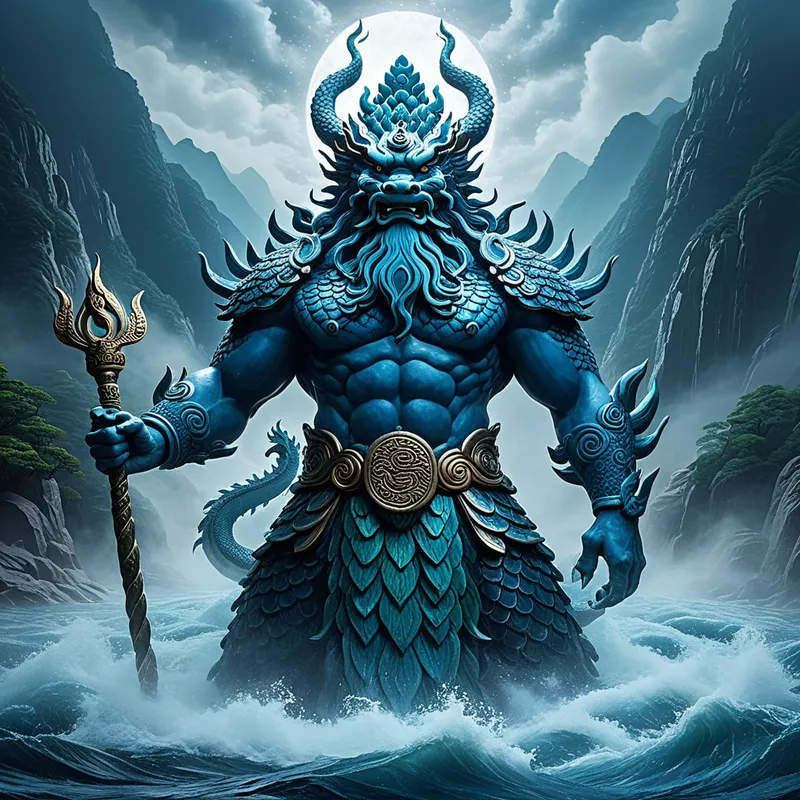
Listen, and hear the tale whispered by the reeds along the great river’s bend. In the time when gods walked the earth in the guise of beasts and kings were born of heaven, there flowed the mighty Amnokgang. Its waters were not mere water; they were the veins of the land, the breath of the mountain, the domain of a sovereign. His name was Habaek, the River God, a being of immense and ancient power who wore the form of a great dragon-serpent, his scales the color of deep river stone and storm cloud.
To this god came a man, a king in the making. King Dongmyeong, founder of a kingdom yet unborn, stood upon the riverbank. His need was dire, his purpose forged in celestial fire. He sought passage, a covenant, a blessing for his people from the spirit of the waters themselves. But a god does not treat with mortals lightly. From the churning depths, Habaek’s voice rose like the roar of rapids. "You who would be king! Cross my waters without my leave, and you shall be drowned. Approach my court without offering, and you shall be devoured."
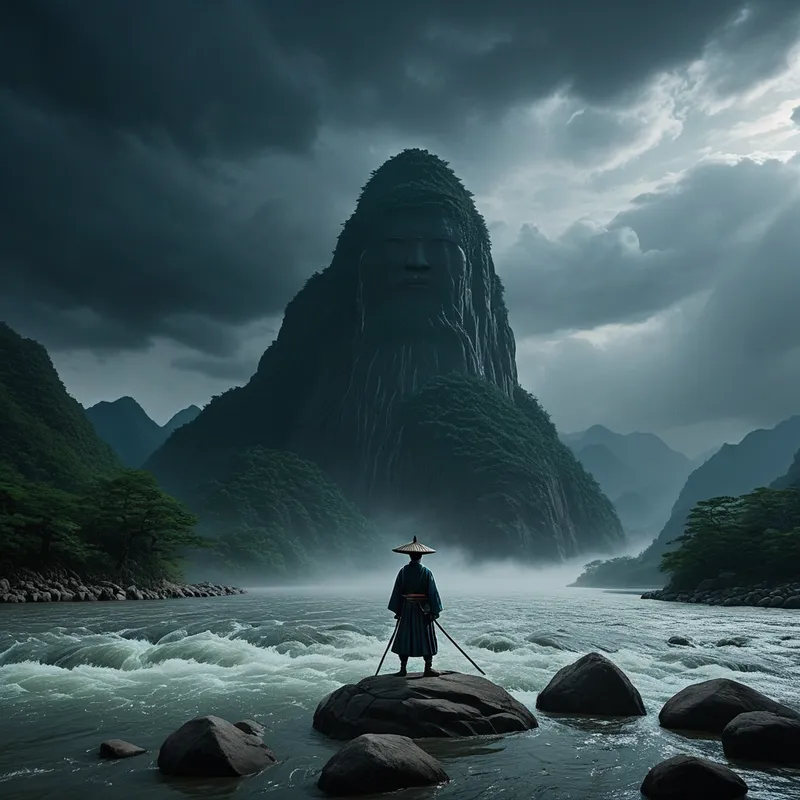
But Dongmyeong was no ordinary supplicant. He was the son of heaven, his bow strung with destiny. He did not cower. He commanded his men to build a bridge of arrows across the torrent, a path of defiance and precision. He stepped onto the midstream rock, a sacred stone that broke the river’s heart, and there he stood, a solitary figure against the liquid might of the god.
The river surged. The waters darkened, coiling into the formidable shape of the deity. Habaek emerged, not in full terrifying glory, but in a test—a challenge of sovereignty. "Prove your right," the waters seemed to say. "Prove you are more than a man who takes." And so, the contest was set not with armies, but with archery, the art of the focused will. Arrow against current, human skill against primordial force. The king drew his bow, his aim true, his spirit unbroken. He did not seek to slay the god, but to meet him as an equal force of order.
Witnessing this courage, this unyielding claim to kingly virtue, Habaek was moved. The raging waters stilled. The god saw not an invader, but a partner worthy of the land. And from the river came forth Habaek’s daughter, Yuhwa, her grace like a willow bending to the water. In her, the river offered its most profound gift: not just passage, but union. The marriage was consecrated there, upon the stone, a sacred bond between the flowing, wild soul of the land and the ordering, civilizing spirit of kingship. The river god gave his blessing, and the waters parted, allowing the future to flow into being.
Cultural Origins & Context
This myth is a foundational narrative for the Goguryeo</aburyeo kingdom, one of the Three Kingdoms of Korea. It is preserved in texts like the Samguk Sagi and the Samguk Yusa. Unlike more personal folktales, this story functioned as a myth of legitimacy for the ruling dynasty. It was told not merely for entertainment, but to sanctify political power, rooting the authority of the Goguryeo kings directly in the divine landscape itself.
The storytellers were likely court historians and ritual specialists. The myth served a crucial societal function: it explained and justified the royal lineage (claiming descent from the river god through Yuhwa), and it articulated a sacred ecology. It taught that sovereignty over people is inseparable from a right relationship with the sovereign forces of nature. A true king does not conquer the river; he enters into a respectful, marital covenant with it, ensuring the land's fertility and the kingdom's stability.
Symbolic Architecture
At its core, this is a myth about the confrontation and integration of two types of power. Habaek represents the raw, unconscious, and autonomous power of nature—the deep, emotional, and instinctual currents of the psyche. He is the chthonic force that must be acknowledged, never ignored.
King Dongmyeong represents the emerging consciousness, the ego, and the cultural principle of order. His journey is the hero’s task of confronting the immense, seemingly chaotic power of the unconscious (the river) and establishing a working relationship with it.
The bridge of arrows is not a weapon of war, but a symbol of directed consciousness—a fragile, human-made structure of intention spanning the abyss of the unknown.
The sacred stone in the midstream is the pivotal point of transformation, the temenos or sacred space where the meeting occurs. The marriage to Yuhwa symbolizes the fertile union of these two realms. She is the mediating element—the willow that thrives at the water's edge, the divine feminine principle that translates the raw power of the father (the river) into a form that can nourish and sustain a civilization (the kingdom).
The Dreamer's Resonance
When this mythic pattern stirs in the modern dreamer, it often signals a profound encounter with one's own inner Habaek. You may dream of a raging flood threatening your home, a deep, dark river you must cross, or a powerful serpentine presence in the water. These are somatic metaphors for a surge of unconscious material—a long-suppressed emotion, a primal instinct, or a deep-seated complex rising to challenge your conscious identity and control.
The feeling is one of being tested by a force greater than oneself. The dream-ego, like Dongmyeong, stands on shaky ground. The psychological process underway is one of confrontation with the autonomous psyche. The dream asks: Can you hold your ground? Can you face this depth without being swept away by fear or inflation? Can you find the "bridge of arrows"—your focused skill, your truth—to engage with this power?

Alchemical Translation
The individuation process modeled here is the transmutation of raw power into legitimate sovereignty. We all contain an inner Habaek: a torrent of potential, passion, creativity, and shadow that can feel chaotic and overwhelming. The immature ego either tries to dam it up (repression) or is flooded by it (possession).
The myth instructs us to take the king's journey. First, we must approach the riverbank—acknowledge the existence and power of this inner force. Then, we must stand on the stone—establish a conscious standpoint (through reflection, therapy, or art) in the midst of the turmoil. We do not run.
The act of drawing the bow is the act of conscious differentiation, aiming one's will and attention directly at the core of the challenge.
The "contest" is the inner work of engaging with this content, not to destroy it, but to prove our own consciousness worthy of relationship. The successful outcome is not domination, but sacred marriage. It is the integration of the unconscious power into the personality in a life-giving way. The inner Yuhwa is the new attitude, the creative function that blossoms from this union—the ability to let the deep, flowing energies of the soul inform and enrich our conscious lives, creating a fertile inner kingdom where both order and depth can coexist.
Associated Symbols
Explore related symbols from the CaleaDream lexicon:
- River — The central symbol of the myth, representing the flow of life, time, destiny, and the deep, often unconscious currents of the psyche that must be navigated.
- Snake — Embodies the transformative, chthonic, and instinctual power of Habaek, a symbol of the primal life force and the wisdom of the depths.
- God — Represents the autonomous, numinous power of nature and the unconscious that demands recognition and relationship, not submission or denial.
- Goddess — Manifest in Yuhwa, she symbolizes the mediating, fertile, and connective principle that allows the raw power of the god to be integrated into human reality.
- Bridge — The structure built by consciousness (the arrow-bridge) to span the unknown, enabling a dialogue between the ego and the unconscious.
- Stone — The sacred, immovable point of encounter and transformation in the midst of the flowing river, symbolizing the Self as the center of the psyche.
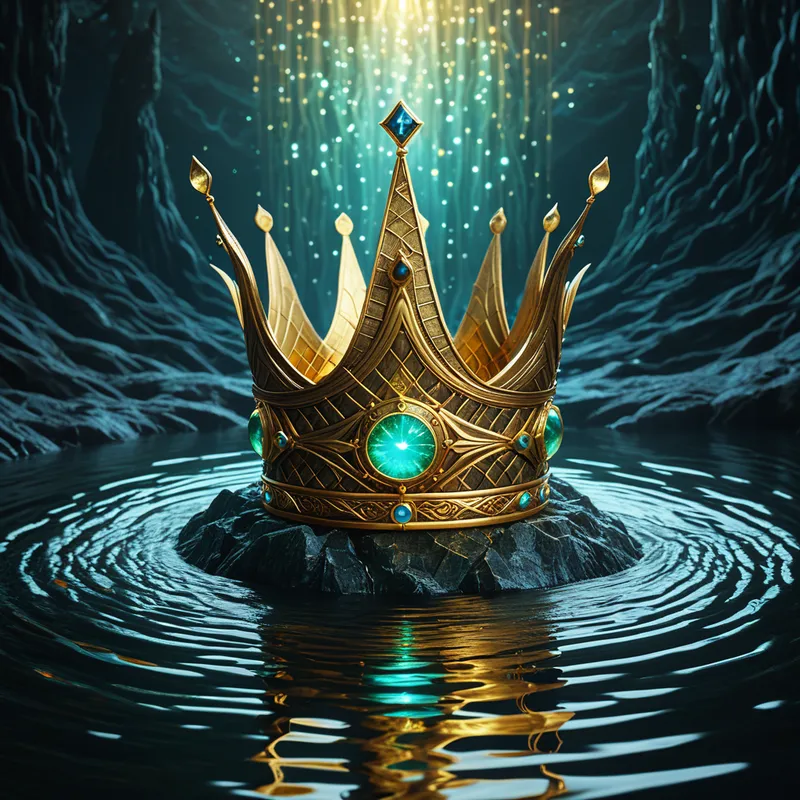
- Crown — The earned symbol of inner sovereignty that results from successfully engaging with the divine challenge, representing integrated authority.
- Marriage — The alchemical union of opposites—conscious and unconscious, human and divine, order and chaos—that creates something new and fertile.
- Sacrifice — Not of blood, but of the old attitude; the king sacrifices his assumption of dominance to enter into a covenant, a respectful exchange.
- Raging River Flood — The specific manifestation of the god's power as a test, representing overwhelming emotional or instinctual upheaval that threatens the ego's stability.
- Riverside Shrine — The sacred space of this covenant, the psychological attitude of reverence and ritual needed to maintain a relationship with deep inner forces.
- Moonlit River — The reflective, feminine aspect of the waters, hinting at the intuitive and receptive wisdom required to understand the river god's nature.