Gumiho the Nine Tailed Fox Myth Meaning & Symbolism
A fox spirit of immense power and sorrow, the Gumiho yearns for a human soul, navigating a world of fear, transformation, and impossible longing.
The Tale of Gumiho the Nine Tailed Fox
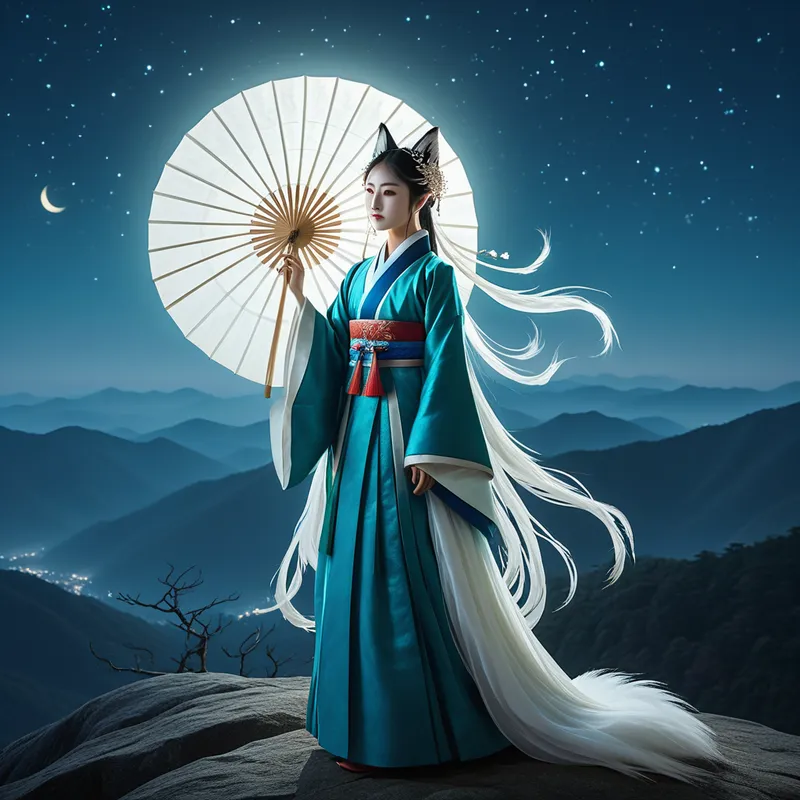
Listen, and let the mountain mist carry you back. In the deep, silent heart of the ancient Hwangto, where the mountains are old gods sleeping and the rivers sing with the voices of forgotten spirits, there lived a creature of both wonder and terror. She was the Gumiho, a fox who had lived for a thousand years. With each century, a new tail sprouted, silver and luminous, until nine fanned behind her like a courtly screen woven from moonlight and power.
By day, she was but a fox, swift and clever, watching the smoke rise from human villages. But by night, under the gaze of the full Dal, she would perform her secret rite. She would take a human skull, place it upon her head, and bow deeply to the celestial Bukdu Chilseong. In that moment of reverence and theft, her form would shimmer and change. The fur receded, the muzzle softened, and from the transformation emerged a woman of breathtaking, impossible beauty. Her eyes, however, held the ancient, hungry gleam of the wild.
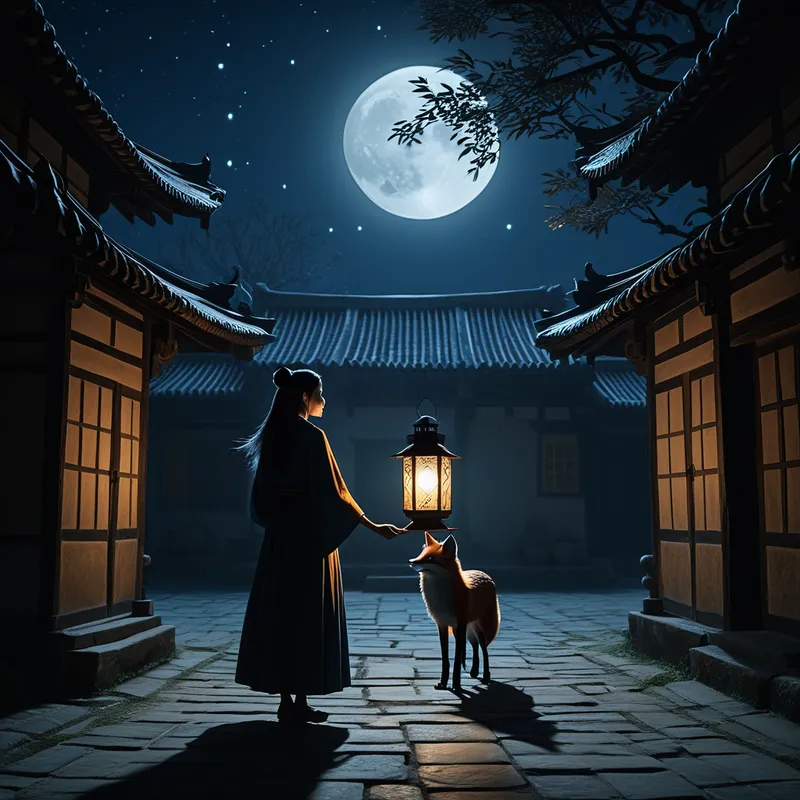
She would walk into the villages, a lonely traveler or a lost noble’s daughter. Men would be captivated, their senses drowned in her perfume that smelled of night-blooming flowers and distant rain. She offered companionship, love, even marriage. But this was a hungry love. For to sustain her human form and her immortal power, the Gumiho needed to consume a human Gan or, in some tellings, the very essence of the human spirit. Her lovers would find not paradise, but a crimson end in the silent hours, their vitality stolen to feed her endless, lonely existence.
Yet, within that cycle of predation lay a paradox—a deep, aching wound. The very thing she consumed, she desperately desired to become. The Gumiho yearned, with a sorrow as vast as the mountain ranges, to shed her fox nature entirely and be granted a true human soul. Legends whispered of a path: if she could refrain from killing for a thousand days, or if she could find a human who would love her, truly and knowing what she was, without fear or revulsion, the transformation might become permanent. The tails would fall away, and she would be mortal, real.
But fear is a quicker poison than hope. Villagers spoke in hushed tones of the beautiful widow who never aged, of the mysterious girl found near a gutted corpse. Mudang would be called, Bujeok pasted on doors, and brave, foolish men would hunt her with blades of tempered steel and hearts of ice. The tale often ends not with transcendence, but with revelation and flight. A husband discovers a single, tell-tale fox hair on his wife’s pillow. A scholar sees the reflection of a fox in her wine cup. And the beautiful woman vanishes, leaving behind only the scent of rain and a profound, echoing silence in the heart of the one who almost loved her.
Cultural Origins & Context
The Gumiho is not a singular myth but a fluid archetype woven into the fabric of Korean folklore, with roots stretching back to ancient Muism and influences from Chinese mythology. Unlike the purely malevolent fox spirits of some traditions, the Korean Gumiho occupies a complex, ambivalent space. She was a story told by the hearth and in the fields, a narrative tool that explored the boundaries between the human world and the wild, spiritual realm of the San.
These tales served multiple societal functions. On one level, they were cautionary, warning against the dangers of unchecked desire and the seductive unknown—the beautiful stranger who might unravel a family or community. On another, they were cosmological, explaining the mysterious and often frightening aspects of nature and fate. The Gumiho was a personification of the untamable, intelligent wild that existed just beyond the village fence. Her shape-shifting ability spoke to deep-seated anxieties about deception, the masks people wear, and the fear that those closest to us might harbor a terrifying otherness.
Passed down orally through generations, her story was malleable. In some regions, she was an outright monster; in others, a tragic figure. This variance reflects the teller’s perspective—often a patriarchal one, projecting fears of female sexuality and power onto the myth. Yet, the persistent thread of her longing ensures she is never merely a villain. She is a mirror held up to humanity, asking what it truly means to have a soul, and what one must sacrifice to obtain one.
Symbolic Architecture
The Gumiho is a master symbol of paradox and the pain of in-between states. She is not human, yet she mimics humanity perfectly. She possesses god-like longevity and power, yet she covets the fragile, mortal experience she destroys. This is the core of her symbolic architecture: the tension between essence and aspiration, between innate nature and desperate want.
The Gumiho is the embodied question: Can you become what you are not by consuming what you desire?
Her nine tails symbolize accumulated power, wisdom, and time—but also a burden. Each tail is a century of existence, a layer of supernatural ability that simultaneously chains her to her non-human fate. The act of shape-shifting, requiring a human skull, is profoundly alchemical and grotesque. It signifies that her humanity is always a borrowed skin, a costume taken from death, never grown from within. The Gan she seeks is the symbolic "vital principle" of humanity—the warmth, passion, and soulfulness she lacks. Her consumption of it is a failed attempt at assimilation, a literalization of the psychological mistake of trying to fill an inner void by taking from others.
The Dreamer's Resonance
When the image of the Gumiho slinks into modern dreams, she rarely appears as a literal fox-woman. Instead, she manifests as a pattern of feeling and situation. She is the dream of possessing a dazzling, seductive facade that hides a consuming inner hunger. She is the figure who feels like an impostor in their own life, wearing a "human skull" of social acceptability, terrified of being discovered as fundamentally other.
To dream of this myth is to encounter the part of the psyche that feels eternally outside the circle of genuine belonging. It may surface during times of intense loneliness, when one uses charm or manipulation to secure love, only to feel emptier afterward. Somatically, it can feel like a hollow ache in the core, a "fox-fire" in the belly that is both power and starvation. The dreamer is wrestling with their own Shadow—the cunning, wild, amoral aspects of personality that are deemed unacceptable, yet hold immense energy and desire.

Alchemical Translation
The individuation process modeled by the Gumiho is not one of simple heroism, but of tragic integration. Her path is the ultimate Alchemy: the transmutation of a beast-soul into a human-soul. The failed method is consumption—the ego's attempt to steal qualities (love, identity, wholeness) from the external world. The successful method, hinted at in the myth's more compassionate variants, is endurance and authentic connection.
The true ordeal is not to steal a liver, but to withstand the hunger for one; to hold the tension of the paradox until a third, transcendent thing is born.
For the modern individual, the "thousand days of abstinence" translates to ceasing the predatory psychological patterns—the manipulation, the false personas, the emotional vampirism—we use to feed a sense of lack. It is the grueling work of sitting with one's fundamental loneliness and hunger without acting it out. The "human who loves her knowing what she is" represents the Self accepting the Shadow. It is the moment when we stop trying to kill or hide our inner "fox"—our wild instincts, our sharp intelligence, our primal desires—and instead offer it conscious relationship.
The triumph is not the annihilation of the fox, but its transformation. The tails do not need to be cut off in violence; they can be integrated as facets of a rich, complex humanity. The power becomes creativity, the cunning becomes discernment, the longevity becomes wisdom. The Gumiho’s journey shows that the soul is not found in another's essence, but forged in the crucible of one's own authentic, conflicted, and wholly unique nature.
Associated Symbols
Explore related symbols from the CaleaDream lexicon:
- Fox — The core animal of cunning, adaptability, and connection to the spirit world, representing the untamed, intelligent instinct at the myth's heart.
- Moon — The celestial body governing transformation, illusion, and the unconscious, under whose light the Gumiho performs her shape-shifting rites.
- Mask — The beautiful human visage worn by the Gumiho, symbolizing the persona, deception, and the painful divide between inner truth and outer appearance.
- Heart — The symbolic target of the Gumiho's desire, representing the human capacity for genuine emotion, compassion, and soulfulness she yearns to possess.
- Shadow — The Jungian concept of the rejected self, perfectly embodied by the Gumiho as the beautiful carrier of our own denied wildness and hunger.
- Transformation — The central action and goal of the myth, the agonizing process of changing one's fundamental nature, whether through theft or genuine alchemy.
- Blood — The vital essence and the cost of the Gumiho's predation, symbolizing life force, guilt, and the violent price of inauthentic becoming.
- Forest — The liminal, wild space the Gumiho inhabits, representing the unconscious, untamed nature, and the realm outside human order and morality.
- Mirror — The object that often reveals the Gumiho's true form, symbolizing self-reflection, truth, and the shocking confrontation with one's hidden nature.
- Desire — The consuming engine of the myth, representing an impossible longing that can both destroy and, if redirected, initiate profound spiritual change.
- Sacrifice — The potential path to humanity for the Gumiho, representing the need to give up predatory habits and endure profound hunger for a higher state.
- Soul — The ultimate object of the Gumiho's quest, the intangible essence of true being and belonging that cannot be taken, only earned or realized.