
Guinevere's Ruby Myth Meaning & Symbolism
A myth of a queen's sacred jewel, a king's gift, and a knight's devotion, revealing the alchemy of love, betrayal, and sovereign wholeness.
The Tale of Guinevere's Ruby
Listen, and I will tell you of a stone that was not a stone, but a captured sunset, a frozen drop of dragon’s blood, a heart that beat outside the body. It was the days of Arthur Pendragon, when the world was woven from magic and iron. On the day of their crowning, as Guinevere stood beside Arthur, the High King placed in her palm a jewel of such profound crimson it seemed a living ember. “This is the Heart of the Kingdom,” he whispered, his voice echoing in the silent hall. “As it is pure, so shall your reign be. As it is strong, so shall Camelot stand. It is yours, and you are its guardian.”
For years, the Ruby rested against the Queen’s breast, a constant, cool weight. It drank the light of council fires and the pale sun of Britain. It witnessed treaties and triumphs. But it also witnessed the slow, silent fracture growing between the throne and the marriage bed, between the ideal of the king and the yearning of the man. And it witnessed Lancelot du Lac, whose eyes, when they met the Queen’s, held a tempest the Ruby seemed to reflect.
One evening, in a secluded garden where jasmine choked the air, the unspoken thing became flesh. In a moment of passion or despair—the bards never agree—the clasp of the necklace gave way. The Ruby fell from Guinevere’s throat and tumbled into the dewy grass, unseen. It was not until the cold dawn that she realized her loss. Panic, cold and sharp, pierced her. The loss of the stone was not merely the loss of a jewel; it was the unraveling of her sacred charge, the physical proof of her betrayal.
The Ruby lay in the grass, its fire dimmed by dew. It was found not by a queen or a knight, but by Mordred, whose serpentine mind saw not a symbol of sovereignty, but a weapon. He secreted it away, and the shadow of its absence began to spread through Camelot like a chill. The land itself seemed to sicken. Crops faltered, mists lingered, and a whisper of corruption threaded through the halls of the Round Table. Arthur, feeling the discord but blind to its source, grew stern and distant. Guinevere, wrapped in guilt and fear, became a ghost in her own court.
Driven by a love now twisted into desperate atonement, Lancelot undertook a silent quest. He forsook his armor for a pilgrim’s cloak and sought the Ruby not as a knight reclaiming treasure, but as a penitent seeking a lost fragment of a world’s soul. His search led him beyond the maps of men, to the oldest forest, where the trees were pillars holding up the sky. There, in a glade where time pooled like water, he confronted Mordred. No epic duel was fought. Instead, Lancelot offered the only currency he had left: his honor, his name, his place at the Round Table, in exchange for the stone. Mordred, savoring this corruption more than any battle-victory, agreed.
Lancelot returned to the walls of Camelot not as a savior, but as a thief in the night. He could not return the Ruby to Guinevere’s hand, for that would seal their guilt. Instead, in the deepest dark before dawn, he entered the empty throne room. Before the great chair where Arthur sat in daylight, and before the smaller, empty chair of the Queen, he knelt. He placed the Ruby upon the stone floor, exactly at the midpoint between the two thrones. He did not speak a word. Then he was gone, into exile, his part in the tale ended.
The Ruby was found by a servant at first light. Its crimson heart, cleansed by dew and sacrifice, blazed with a renewed fire. It was returned to the King. Arthur, holding it, felt the chill lift from the stone and from his own spirit. He understood the message in the placement. The heart of the kingdom was not the property of the king or the queen alone, but of the sacred space between them—the fragile, living tension that held the realm together. He returned it to Guinevere without accusation, and she received it without excuse. The Ruby rested once more against her breast, heavier than before, its fire now holding the memory of shadow, its purity not innocence, but a hard-won wholeness forged in fracture. The land breathed again, but the crack in the world, though sealed, remained as a hairline fracture in the gem and in their souls, a warning and a testament.

Cultural Origins & Context
The tale of Guinevere’s Ruby is a later accretion to the Arthurian cycle, emerging not from the early Welsh chronicles or Chrétien de Troyes, but from the rich soil of the high medieval romances and subsequent folk traditions. It belongs to the era when the Arthurian mythos was being refined from a chronicle of battles into a complex allegory of courtly love, Christian piety, and political theology. The tellers of this tale were likely minstrels and storytellers in noble courts, using the symbol of the jewel to explore tensions the older legends only hinted at.
Its societal function was multifaceted. On one level, it was a cautionary tale about the personal cost of betraying sacred oaths, reflecting the feudal and marital contracts that bound society. On another, it served as a metaphysical explanation for the decline of Camelot, attributing the realm’s fall not just to human failings, but to the misalignment of a sacred, almost talismanic object. The Ruby becomes a hierophany—a manifestation of the divine in an object—whose fate is inextricably linked to the moral and spiritual health of the kingdom. It allowed audiences to contemplate the idea that sovereignty is not merely a political office, but a psychic and symbolic condition, vulnerable to the hidden currents of the heart.
Symbolic Architecture
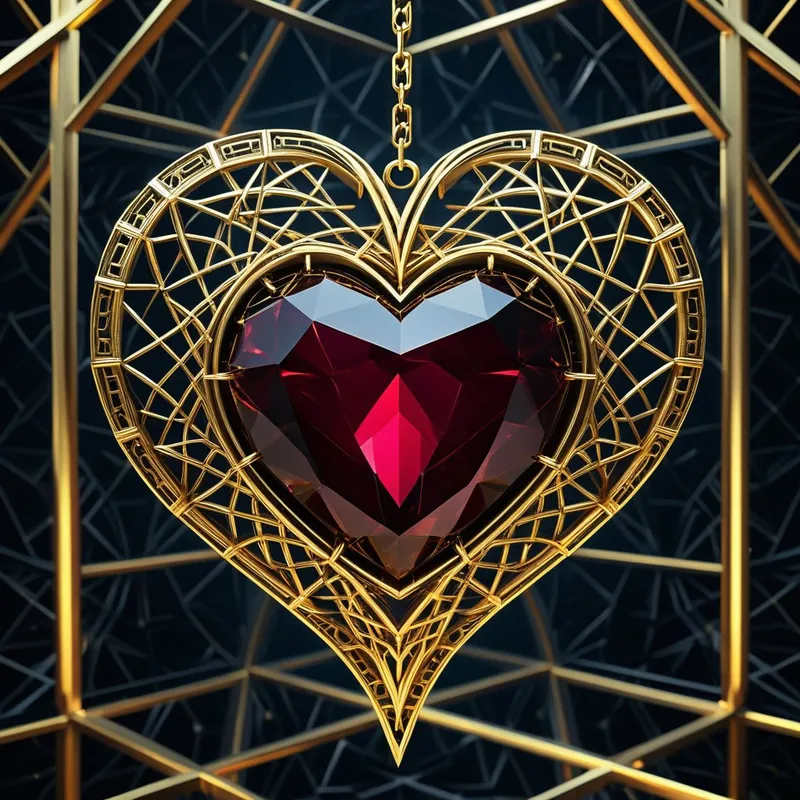
The Ruby is the central symbol, a multifaceted jewel reflecting multiple truths. It is the Anima Mundi, the World Soul, of Camelot, its vitality directly tied to the integrity of the royal union. It represents the sacred container of love and power—the Coniunctio or mystical marriage—that ideally exists between ruler and realm, and between king and queen.
The true throne is not the chair of oak and gold, but the vulnerable, beating heart suspended between two solitudes.
Guinevere embodies the Anima of the kingdom—its soul, its fertility, its capacity for relatedness. Her loss of the Ruby symbolizes the alienation of the soul from its sacred purpose, a state of profound psychological disorientation. Lancelot represents the transcendent function of the Hero, but here his heroism is inverted. His quest is not to conquer, but to surrender; not to gain glory, but to restore a balance he himself shattered. His exile is the necessary sacrifice of the conscious ego that has trespassed into the realm of the archetypal.
Arthur’s final act—returning the Ruby without accusation—signifies the evolution of the Ruler into the Sage. He understands the stone now holds the shadow, and that a wholeness that includes the knowledge of brokenness is stronger than a purity that denies it.
The Dreamer's Resonance
To dream of Guinevere’s Ruby is to encounter a symbol of one’s own sacred contract or deepest value that feels lost, stolen, or tarnished. The dreamer may be in a state where a core relationship (to a partner, a vocation, a creative spirit, or one’s own self) has been violated, leading to a profound sense of inner corruption and “sickness in the land” of their own life.
Somatically, this can feel like a hollow ache in the chest, a literal heaviness, or a chilling sense of disconnection. Psychologically, it is the process of confronting a betrayal—whether one has betrayed oneself or feels betrayed by another. The Mordred figure in the dream is the shadowy, opportunistic aspect of the psyche that capitalizes on this loss, turning grief into cynicism or despair. The dream may task the dreamer with the Lancelot-work: the humble, often shame-filled journey to retrieve what was lost, not to restore a naive past, but to re-consecrate it with full awareness of its cost.
Alchemical Translation
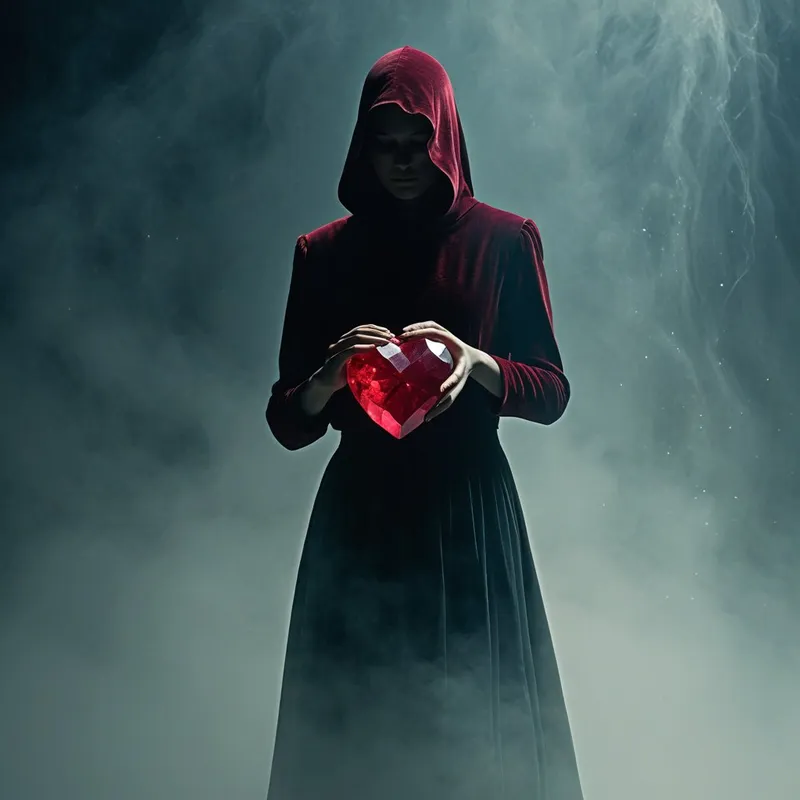
The myth models the alchemical process of Solve et Coagula—dissolution and coagulation. The perfect, untested Ruby (the prima materia) is dissolved in the acid of betrayal and desire (the nigredo, the blackening). It is lost in the grass (the unconscious), where it is claimed by the shadow (Mordred). This is a necessary descent.
The gem cannot become a true talisman until it has been buried in the mud of human failing.
Lancelot’s quest represents the albedo, the whitening. It is the penitential work of acknowledging one’s role in the dissolution, of confronting the shadow not with violence but with negotiation (offering up one’s old identity). The return and placement of the Ruby between the thrones is the rubedo, the reddening. This is the culmination: the creation of a new, conscious synthesis. The Ruby is not merely replaced; it is transmuted. Its redness now contains the memory of the blackness. The sacred center is no longer a naive ideal, but a conscious tension held between opposites—king and queen, duty and desire, persona and shadow.
For the modern individual, this is the individuation process. We all possess a “Ruby”—a core value, talent, or capacity for love. Life inevitably leads to its tarnishing or loss through failure, compromise, or trauma. The myth teaches that redemption lies not in denying the failure or in magically erasing it, but in undertaking the humble, excruciating work of recovery. We must offer up our old, prideful self-image (the knight in shining armor) to retrieve our heart. When we finally reclaim it, we place it not back in a fantasy of perfect innocence, but in the sacred, charged space between who we were and who we have become, between our ideals and our lived experience. It is there, in that conscious, painful, and vibrant tension, that we find a sovereignty far more resilient than any untested purity.
Associated Symbols
Explore related symbols from the CaleaDream lexicon: