Geser Khan Myth Meaning & Symbolism
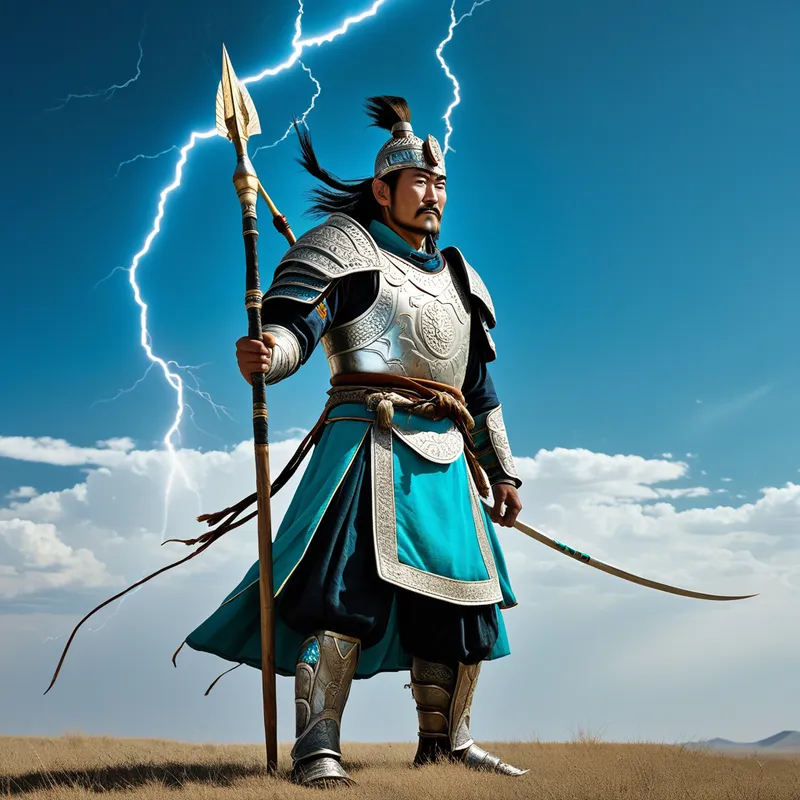
A divine hero, born to restore cosmic order, descends to a troubled world to battle monstrous evils and heal the land through cunning, strength, and sacred purpose.
The Tale of Geser Khan
Hear now, and listen well, to the tale spun when the world was young and the sky pressed close to the earth. In the celestial realm of the Tengri, a sickness festered. Below, on the Middle World, the human realm, a shadow had fallen. The land was choked by the tyranny of monstrous Mangus—beings of greed, spite, and chaos. Rivers ran backwards, the sun hid its face, and the people’s hearts were heavy with fear.
The high gods convened, their council fire casting long shadows. The great Qormusta Tengri spoke, his voice the rumble of distant thunder. “The axis of the world tilts. The bond between sky, earth, and humankind frays. A hero must descend, a son of heaven born of earth, to bind what is broken.”
And so it was decreed. The youngest and most radiant of the celestial khans, Bühe Beligte, accepted the perilous charge. He would be reborn in the Middle World, stripped of his divine memory, to grow from mortal struggle. He was sent down, not with a legion, but as a single, potent seed of light.
In the land of the sun’s rising, to a chieftain and his noble wife, a child was born. But he was no ordinary babe. He entered the world not crying, but silent and wise-eyed, a lump of gristle and bone that frightened his mother. Cast out, this strange flesh was placed upon a dung heap. Yet, that very night, under the watchful eye of the moon, the lump transformed. From it emerged a radiant boy, strong-limbed and clear-gazed. They named him Geser.
He grew not by years, but by deeds. As a youth, he was a trickster, a wild force upsetting the stagnant order of his tribe. He played the fool, yet his foolishness exposed corruption. He won his heavenly steed, a horse born of wind and fire, in a race against destiny itself. He was tested, scorned, and finally recognized. The people, sensing the power that hummed beneath his antics, anointed him Khan.
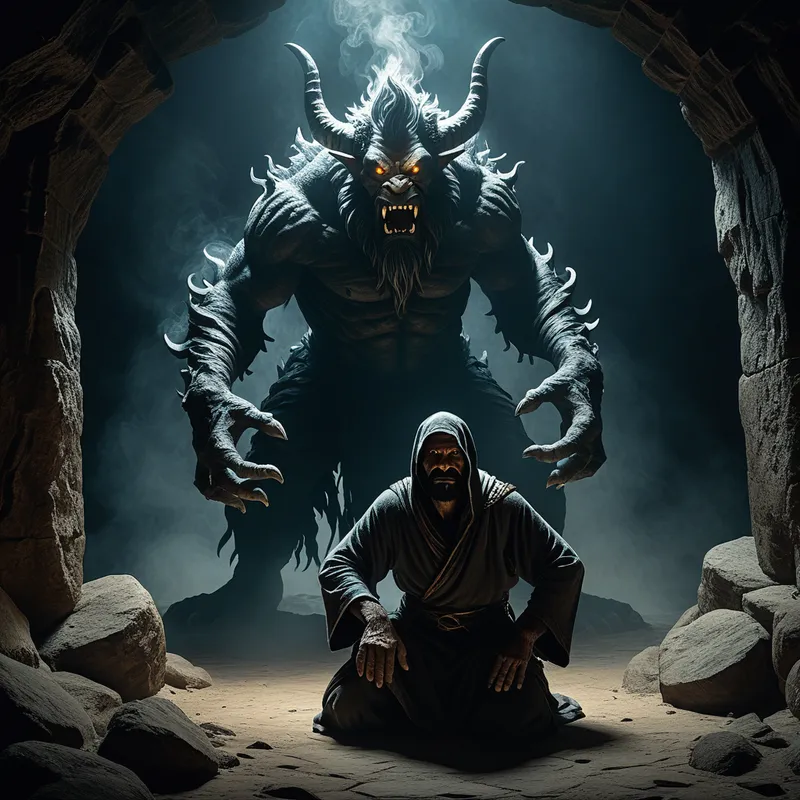
His true work then began. Geser Khan rode out, his spirit a compass pointing toward discord. He faced the three great Mangus, each a manifestation of a primal sickness. He journeyed to the lair of the Lobsogoldoi Mangus, a creature of gluttony who devoured the land’s bounty. Geser did not merely fight; he outwitted, transforming himself into a sickly boy to be swallowed, then burning the demon from within. He descended into the underworld to rescue his stolen wife, battling the sorceress Mongoldai Nogon, mastering the arts of shape-shifting and spiritual combat. He confronted the black Mangus of the North, a being of pure, chilling malice, in an epic clash that shook the mountains.
Each victory was not a slaughter, but a restoration. Where a Mangus fell, a river would spring forth. Where its fortress crumbled, grasslands would bloom. Geser healed the chieftains he defeated, turning enemies into allies, weaving the scattered tribes into a harmonious whole. He did not rule from a distant throne, but from the saddle, a perpetual mover on the boundary between order and chaos, forever guarding the fragile peace of the world.
Cultural Origins & Context
The Epic of Geser is not merely a story; it is the living breath of the steppe, one of the world’s longest oral epics. Its roots intertwine with the ancient, animistic-shamanic worldview of Tengrism, later absorbing threads from Tibetan Buddhism and other regional influences as it traveled. For centuries, it was not written but performed by specialist bard-singers, the Geserchi, who would recite its thousands of verses over days, entering a semi-trance state to channel the narrative. The epic served as a nomadic encyclopedia—containing codes of honor, ecological knowledge, historical memory, and spiritual law. Its primary function was one of cosmic and social maintenance: to ritually recount the hero’s victories was to participate in the ongoing restoration of balance (tengeri zarim) in the community and the natural world. It was a performative act of healing for the land and the people.
Symbolic Architecture
At its core, the Geser myth is a grand allegory for the individuation process—the journey of the psyche toward wholeness. Geser represents the Self, the divine spark of order and purpose sent into the chaos of the unconscious and the complexities of life.
The hero is not born in a palace, but on a dung heap; the divine Self emerges not from perfection, but from the rejected and forgotten parts of our own nature.
His initial form as a “lump” symbolizes the prima materia—the unformed, potential self that must be endured and transformed. His trickster phase is essential; it is the disruptive, creative energy that breaks down rigid, outworn structures of the personal and collective psyche (the corrupt tribe) to make way for authentic authority. The monstrous Mangus are not external monsters but the magnified, personified shadows of the human world: insatiable appetite, soul-stealing enchantment, and cold, nihilistic evil. Geser’s methods are instructive. He rarely uses brute force alone; he employs cunning, disguise, and strategic descent (into the beast’s belly, into the underworld). This symbolizes the necessity of engaging with the shadow on its own terms, of being willing to be temporarily swallowed by our complexes to transform them from within.

The Dreamer's Resonance
When the pattern of Geser stirs in the modern dreamer, it signals a profound call to psychic arms. One may dream of a landscape blighted and barren, a home invaded by a grotesque, consuming presence, or of being tasked with an impossible, Herculean journey. Somatic sensations often accompany this—a weight in the chest, a feeling of being bound or poisoned.
This is the psyche’s recognition that a Mangus has taken root. It may manifest as a toxic pattern of gluttony (for food, status, distraction), a complex that has “stolen” one’s vital energy or relationships (like the kidnapped wife), or a cold, internal critic that withers hope. The dreamer is in the “middle world,” where the divine mandate—the call to a more authentic life—is felt as a disruptive pressure. The initial stage often feels like being the “lump on the dung heap”: rejected, alien, and full of potential one cannot yet access. The psyche is preparing for a heroic act of reclamation and integration.
Alchemical Translation
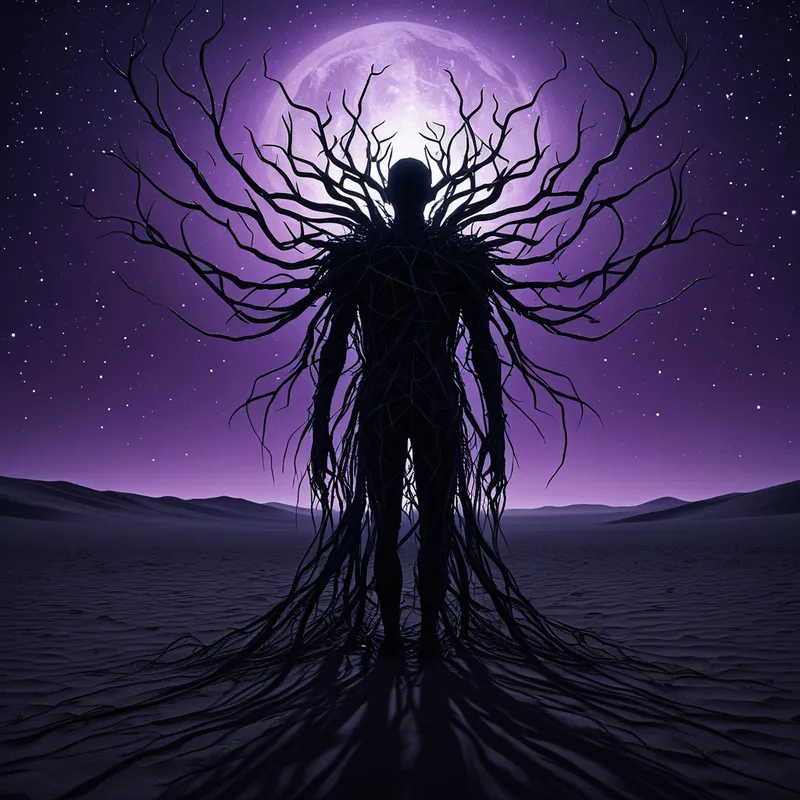
The alchemy of Geser models the complete cycle of psychic transmutation. The nigredo, the blackening, is the descent of the celestial hero into mortal ignorance and the bleakness of the plagued world. The albedo, the whitening, is his rebirth from the lump and his early trials, where the pure, silver purpose begins to clarify.
The ultimate goal is not to kill the shadow, but to defeat its tyrannical autonomy and reclaim its energy for the sovereignty of the Self.
The citrinitas, the yellowing, is his active engagement with the Mangus. Here, the “gold” is won through the cunning of consciousness (disguise, strategy) applied to the raw material of the unconscious (the demon’s lair). Finally, the rubedo, the reddening, is the healing outcome: the restoration of the stolen wives (anima), the healing of the rival khans (other parts of the psyche), and the flourishing of the land. Geser does not retire; he remains vigilant. This translates to the modern individual’s ongoing process of consciousness—the understanding that individuation is not a final state but a perpetual, dynamic guardianship of one’s inner kingdom against the inevitable resurgences of chaos. We are all asked to become the Geser of our own inner realms, to ride the steed of our instinctual energy toward the places where order has broken down, and to restore flow, life, and connection.
Associated Symbols
Explore related symbols from the CaleaDream lexicon:
- Hero — The archetypal pattern of the divine mandate incarnate, representing the ego's journey to align with the greater Self and undertake the necessary trials for wholeness.
- Horse — The instinctual, spiritual energy and unwavering loyalty that carries the hero on his journey, symbolizing the vital life force required for the psychic quest.
- Mountain — The enduring, timeless realm of challenge and spiritual ascent where the hero confronts ultimate adversaries, representing the lofty, difficult goals of the individuation process.
- Shadow — The personified Mangus demons, representing the autonomous, destructive complexes within the unconscious that must be faced and integrated.
- Journey — The core structure of the epic, a perpetual movement across inner and outer landscapes to restore balance, mirroring the lifelong path of psychological development.
- Lightning — The sudden, illuminating power of divine insight or intervention, often associated with Geser's weapons and birth, symbolizing moments of transformative clarity.
- Healing — The ultimate purpose of Geser's victories, where defeating chaos results in the restoration of land, water, and community, representing the integrative outcome of confronting the shadow.
- Sky — The realm of the Tengri and divine order (Tenger), representing the transpersonal consciousness and the source of the hero's sacred mandate.
- Earth — The Middle World of mortal struggle and manifestation, the realm where the divine purpose must be worked out through action and engagement.
- Trickster — Geser's early, disruptive persona necessary for breaking stagnant order, representing the creative, chaotic force that precedes the establishment of a more authentic structure.
- Dream — The medium through which celestial plans are communicated and the liminal space where battles with shadow entities often begin, symbolizing the guidance of the unconscious.
- Destiny — The inescapable, heaven-sent task that defines the hero's life, representing the pull of the Self toward its own unique realization and contribution.