Gelede Masquerade Myth Meaning & Symbolism
A Yoruba ritual myth where artful masquerade appeases the primal feminine power of the 'Great Mothers' to restore harmony between the human and spirit worlds.
The Tale of Gelede Masquerade
Let the drums speak first. Let their deep, talking rhythm call you back to a time when the world was thinner, when the veil between the village and the wild, between the waking and the dreaming culture."), was but a breath. In the land of the Yoruba, there was a silence that was not peaceful, but pregnant with a terrible power. The rains withheld their blessing. The soil grew hard and resentful. Children fell ill with fevers that had no name, and women suffered in childbirth, their wombs becoming chambers of shadow.
The elders gathered, their faces maps of worry. They consulted the Ifá oracle, casting palm nuts and listening for the whispers of Orunmila. The message that came was clear, and it chilled the blood. The disturbance came not from a lack, but from an excess of power—the raw, untamed, creative-destructive force of the Awon Iya Wa, the "Our Mothers." These were not merely ancestors; they were the elemental feminine principles of the earth itself, the witches who could build a life in the morning and unravel a destiny by nightfall. They were offended. They felt unseen, unhonored in their terrible majesty.
A great fear settled over the people. How does one honor a force that can as easily create as consume? How does one sing to a storm? The answer did not come as a weapon, but as a vision. It came to a man named Yemoja, who in a dream was shown the path of appeasement not through fear, but through beauty; not through suppression, but through spectacular, deliberate display.
He awoke with a sacred charge: to create a spectacle so captivating, so utterly devoted to the essence of the feminine—in all its facets—that it would catch the eye of the Great Mothers and turn their wrath into favor. He instructed the carvers to take up their tools. "Do not carve masks of warriors," he said. "Carve the market woman with her child tied to her back and her basket balanced on her head. Carve the wise elder woman who knows all herbs. Carve the beautiful young bride, and the powerful queen." He instructed the dancers to learn steps that were not aggressive, but fluid and grounded, steps that mimicked the graceful, powerful movements of women at work and in ceremony.
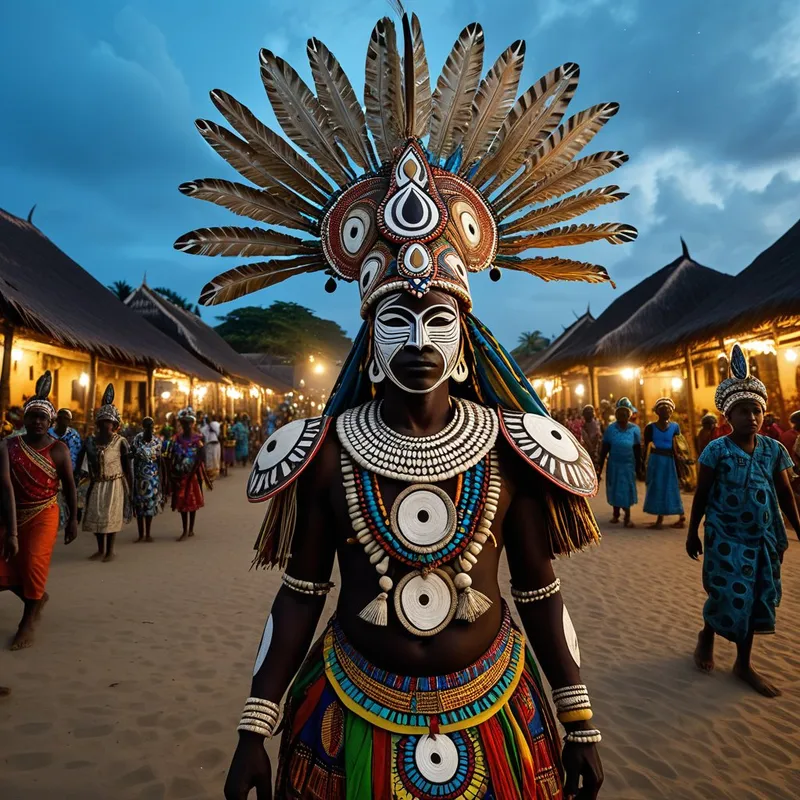
On the appointed night, as the moon hung like a polished calabash, the village square transformed. The air hummed with anticipation and the scent of burning ewe. Then, from the sacred grove, they emerged. The Gelede figures, towering under immense, painted headpieces, moved with a slow, hypnotic gravity. They did not leap like warriors; they processed like visiting royalty. Their masks, illuminated by torchlight, showed serene, exaggerated faces, scenes of daily life, animals, and cosmic symbols. The drums spoke in the language of the mothers, the songs praised their strength, their wisdom, their indispensable role from birth to death.
And the Mothers watched. From the shadows of the forest, from the depths of the earth, they turned their gaze. They saw their own power reflected back at them—not mocked, but magnified; not feared, but celebrated in intricate detail. The anger, which was born of invisibility, began to soften. The withheld rains began as a gentle patter on the carved heads of their own effigies, then became a life-giving pour. The fever broke. The harmony between the human world and the primal, feminine source of all life was restored. Not by force, but by the most profound offering: the art of seeing, and of showing what one sees.
Cultural Origins & Context
The Gelede masquerade is not a forgotten myth but a living, breathing ritual tradition primarily among the Yoruba-speaking peoples of southwestern Nigeria, Benin, and Togo, with its epicenter in the Ketu region. Its practice is sustained by the Gelede Society, a primarily male institution that exists for the explicit purpose of honoring and placating the Awon Iya Wa, who are understood as the elderly women—and by extension, the primordial feminine forces—who possess ase (spiritual authority and potency) to bless or to curse.
The myth is the charter for this annual (or biennial) festival, typically held at the start of the rainy season or during times of crisis. It is passed down not just through oral recitation, but through embodied practice: the secret knowledge of the carvers who shape the superstructure, the choreography of the dancers, the specific rhythms of the drums, and the satirical, educational songs sung by the female chorus. The society functions as a critical social regulator, using humor, spectacle, and reverence to comment on social issues, uphold moral order, and ultimately ensure communal well-being by maintaining a sacred balance with the most powerful forces recognized in the cosmos.
Symbolic Architecture
At its core, Gelede is a profound psychological and cosmological operation concerning the integration of power, specifically feminine power, which in a patriarchal social structure often resides in the cultural shadow—feared, misunderstood, and thus potentially destructive.
The mask does not hide the self; it reveals the Other. In honoring the Other, the self finds wholeness.
The Awon Iya Wa symbolize the unconscious, creative-destructive ground of being itself. They are the life-giving womb and the tomb, nurturing love and terrifying rage. They represent all that is taken for granted yet is fundamental: fertility, intuition, nature’s cycles, and the unspoken emotional fabric of the community. The myth acknowledges that to ignore or suppress this power is to invite chaos. The solution is not conquest, but conscious, artistic engagement.
The masquerade itself is the symbolic act of making the invisible visible, of giving form to the formless forces that govern fate. The dancer, always a man, becomes a vessel. He does not impersonate a woman; he becomes a conduit for the principle of the feminine. This is a sacred cross-dressing, a ritualized integration of the psychic opposite. The elaborate, static mask atop the dynamic male body is the perfect symbol of this synthesis: the eternal archetype expressed through temporal, physical action.
The Dreamer's Resonance
When this myth stirs in the modern psyche, it often manifests in dreams of overwhelming feminine figures—goddesses, giants, witches, or vast natural forces like oceans or storms—that feel both awe-inspiring and threatening. The dreamer may feel paralyzed, hunted, or that the very ground of their life is unstable.
This is the somatic signal of the unintegrated "Great Mother" complex within. It may represent a denied creative force (the artist refusing their craft), a repressed intuitive knowing, a toxic relationship with the actual mother, or a disconnection from the body and its natural cycles. The feeling of being "cursed" by this power—through creative block, emotional numbness, or repetitive life failures—mirrors the barrenness in the myth. The psyche is demanding recognition of this foundational power it has been taught to fear or devalue.
Alchemical Translation
The Gelede myth provides a precise model for psychic transmutation, moving from a state of being persecuted by unconscious forces to one of empowered collaboration with them. The process is one of sacred display, not analytical dissection.
Individuation is not the hero slaying the dragon, but the artist carving the dragon’s likeness so truthfully that the dragon sees itself and agrees to breathe fire for the forge.
First, one must acknowledge the disturbance (the societal barrenness) as stemming from a disowned power, not an external enemy. The "conflict" is internal. Then, following Yemoja’s vision, one must engage in the creative act of giving form to the formless. This is the alchemical opus: painting the shadow, writing the unspeakable emotion, dancing the repressed energy, or in therapy, giving words to the silent wound. This is not done to control the power, but to honor it—to "sing its praise names."
The final stage is the ritual performance—the integration into daily life. The insights gained from creative engagement must be "danced" in the public square of one’s relationships and choices. The once-threatening power, now seen and honored, transforms from a curse into a source of fertility, creativity, and grounded strength. The individual no longer fears the depth of their own soul but learns to move in rhythm with its profound, ancient tides, achieving a personal Gelede—a harmonious balance where the conscious self and the great, unconscious Mothers co-exist in respectful, life-giving dialogue.
Associated Symbols
Explore related symbols from the CaleaDream lexicon: