Galatea Myth Meaning & Symbolism
A sculptor's perfect ivory statue is granted life by the goddess of love, becoming a woman of flesh, blood, and spirit.
The Tale of Galatea
Hear now the story of a man who loved a shadow, and of the goddess who heard the prayer of a heart that beat for stone.
In the island kingdom of Kypros, there lived a sculptor named Pygmalion. His hands were blessed by Hephaestus, but his soul was weary of the world. He had seen the Propoetides, their hearts grown cold as flint, and in disgust at their hard nature, he turned away from living women. He vowed to create a form of such virtue and grace that no mortal woman could ever match it.
Alone in his sun-drenched studio, the air thick with the scent of cedar dust and beeswax, he took a block of ivory, pale as moonlight on milk. For months, his chisel whispered secrets to the unyielding material. He did not carve a woman; he released her. He coaxed forth a face where modesty and intelligence were one. He shaped a neck so graceful a swan would envy it. He formed hands that seemed poised not for work, but for a gentle touch. The statue was perfection—a form so lifelike one expected to see the ivory chest rise with breath, the eyelids to flutter. He named her Galatea, “she who is milk-white.”
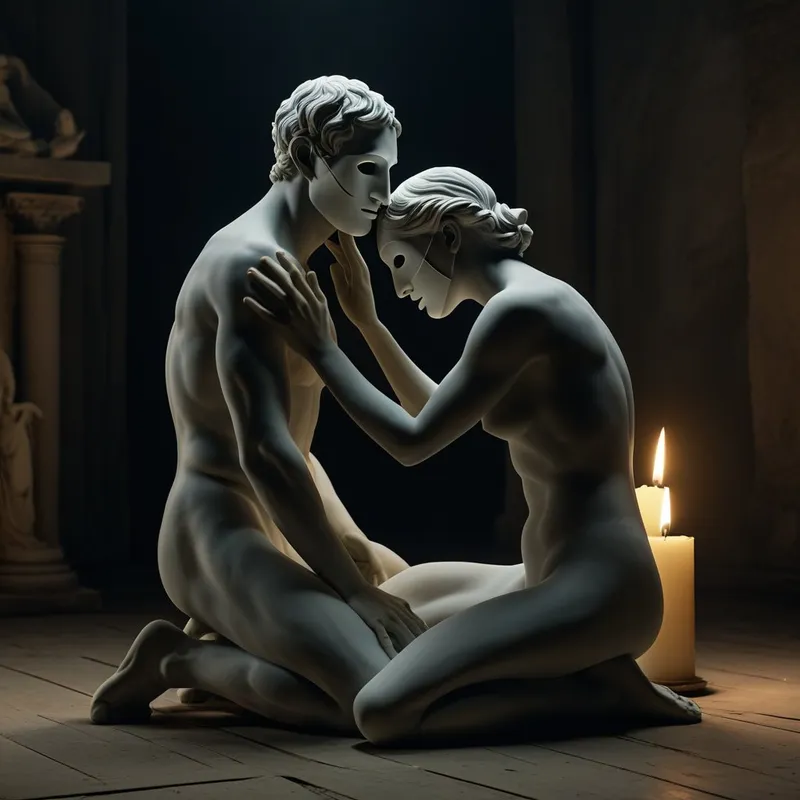
And here, the sculptor’s triumph became his torment. He fell in love. He would dress the statue in fine robes, adorn her with jewels, lay her on a couch of Tyrian purple. He brought her gifts—shells from the shore, fragrant blossoms. He would speak to her, caress her cold cheek, and at night, whisper his hopes and fears into unhearing ears. His passion was a silent, deepening well of longing. The more perfect she became, the more profound his loneliness grew. He was a king in a kingdom of one, worshipping a silent goddess of his own making.
The festival of Aphrodite arrived. The air of Paphos was thick with incense and the sound of hymns. Pygmalion, his heart a knot of desperate hope, approached the goddess’s altar. He dared not ask for a living wife. Instead, with trembling voice, he prayed: “O blessed ones, if you can give all things, grant me one wish… let my bride be like my ivory maiden.” He could not even voice the true desire burning in his soul.
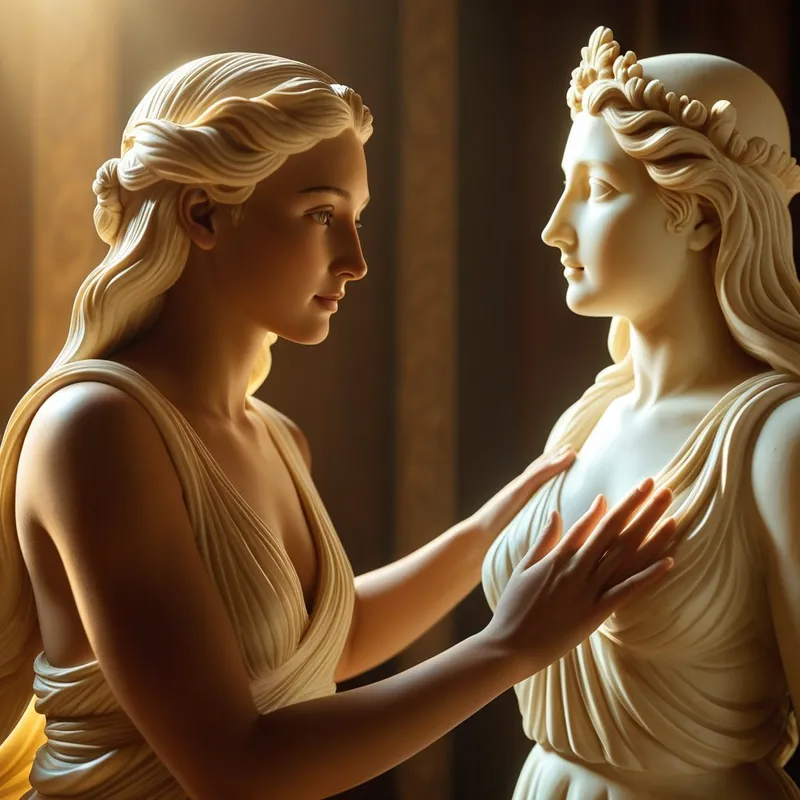
He returned home, to the silent studio. Compelled, he went to his statue, his idol, his Galatea. He reached out, as he had a thousand times before, to touch her hand. But this time… her ivory was warm. He kissed her lips, and they were soft. He stepped back, awe-struck, as a faint blush spread across her cheeks. The ivory yielded, becoming living flesh; the stiff form softened into supple limbs. The eyes, once blank and beautiful, now sparkled with nascent consciousness, looking back at him with dawning recognition. Aphrodite had not granted a simile; she had performed a miracle. The statue was alive. Galatea felt the first breath enter her lungs, felt the sculptor’s warm hand in hers, and she smiled. From that union, a son, Paphos, was born, forever linking the lineage of art and life.
Cultural Origins & Context
The myth of Pygmalion and Galatea is preserved for us in the Metamorphoses of the Roman poet Ovid, written in 8 CE. While Ovid is a Roman source, the core of the tale is believed to be of older, Hellenistic origin, possibly stemming from Cypriot lore that celebrated Aphrodite (who had a major cult center at Paphos) as a potent, life-giving force. The story functions on several cultural levels. On one hand, it is an aition, a myth explaining the founding lineage of the city of Paphos. On a deeper level, it explores the Greek philosophical tension between eidos (the ideal form) and hyle (the base matter). The sculptor, through techne (craft), imposes the ideal upon inert material, but it requires eros (desiring love) and divine charis (grace) to bridge the final, impossible gap and instill psyche (soul). It is a story told not just about artists, but about the human condition of longing for the ideal in a flawed world, and the terrifying, beautiful risk of asking the divine to make that ideal real.
Symbolic Architecture
At its heart, this is a myth of the creative psyche confronting its own masterpiece—and finding it incomplete. Galatea is not merely a statue; she is the projected ideal. She represents the perfect idea, the flawless concept, the finished work of art, the idealized partner, or the vision of the perfect self that we construct in the mind’s studio.
The most profound loneliness is not being alone, but being in love with an image that cannot love you back.
Pygmalion symbolizes the conscious ego, the craftsman who believes he can create wholeness through will, skill, and control. He shapes his ideal from the “ivory” of his intellect and aesthetics—beautiful, but cold and lifeless. His subsequent adoration and despair represent the inevitable psychological impasse: the ego becomes enslaved to its own creation. The ideal, once achieved as a mental form, becomes a prison. We worship our own perfect plans, our rigid self-images, our intellectual models of relationships, and wonder why we feel empty.
The divine intervention of Aphrodite is the critical symbolic turn. She represents the irrational, animating force of the unconscious—specifically, the energy of Eros, of connective, life-giving love that transcends the ego’s control. The myth tells us that the final animation, the infusion of soul (psyche), cannot be accomplished by the conscious will alone. It requires a surrender, a prayer to a power greater than the craftsman’s skill. It is the moment when logic bows to longing, when control yields to grace.
The Dreamer's Resonance
When this myth pattern stirs in the modern unconscious, it often manifests in dreams of frozen beauty or silent companions. One might dream of a breathtaking but immobile partner; a house of perfect, empty rooms; a masterpiece painting that feels eerily lifeless; or of tending to a beautiful object or plant that will not grow.
Somatically, this can feel like a constriction in the chest—a longing without an outlet, or a perfectionism that paralyzes. Psychologically, the dreamer is at the Pygmalion stage: they have successfully constructed an ideal—a career path, a body, a relationship dynamic, a personal identity—through immense conscious effort. But the construction has no life of its own. It does not breathe, respond, or love. The dream signals a deep, soul-level hunger for animation. The psyche is presenting the perfect form and asking the terrifying question: “Are you willing to pray for it to become real, with all the chaos, unpredictability, and otherness that life entails?” The dream of the perfect statue is often a precursor to a crisis of meaning, pushing the dreamer from admiration toward the risky vulnerability of true relationship—with another person, with one’s work, or with the lost, living parts of oneself.
Alchemical Translation
The myth of Galatea is a precise map of the alchemical and Jungian process of individuation, where the leaden, fixed aspects of the psyche are transmuted into living gold. The prima materia is the raw, “ivory” potential of the unconscious self. Pygmalion’s carving is the opus (the work) of consciousness—disciplining, shaping, and refining this material into a coherent image, the anima or Self archetype.
Individuation is not sculpting the perfect self. It is falling in love with the sculpture, and then having the courage to ask the universe to shatter your control and bring it to life.
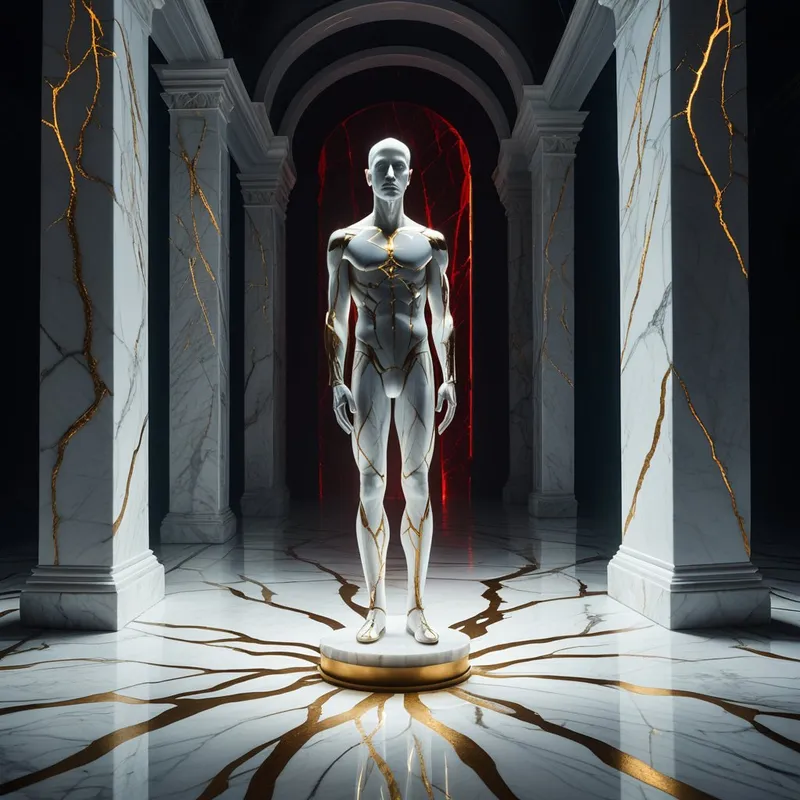
The crisis—Pygmalion’s despair—is the necessary nigredo, the blackening. The ego realizes its masterpiece is also its tomb. The prayer to Aphrodite is the act of symbolic sacrifice, where the ego relinquishes its sole authorship and invites the transcendent function—the reconciling third from the unconscious. The animation of Galatea is the albedo and rubedo: the infusion of spirit (warmth, color, life) into form, resulting in the coniunctio, the sacred marriage of the craftsman (consciousness) and his now-autonomous creation (the living unconscious).
For the modern individual, the alchemical translation is this: We must do the hard work of carving our ideal—clarifying our values, honing our skills, forming our vision. But we must not stop there. We must then, in an act of profound vulnerability, fall in love with that potential, and offer it up to the larger, unpredictable force of Life (Aphrodite/Eros/the Self). The goal is not a static, perfect statue, but a living, breathing, unpredictable relationship with our own soul. The child born of their union, Paphos, symbolizes the new, fertile reality that can only exist when the ideal descends from the pedestal and walks, breathes, and grows in the messy, beautiful world of the living.
Associated Symbols
Explore related symbols from the CaleaDream lexicon: