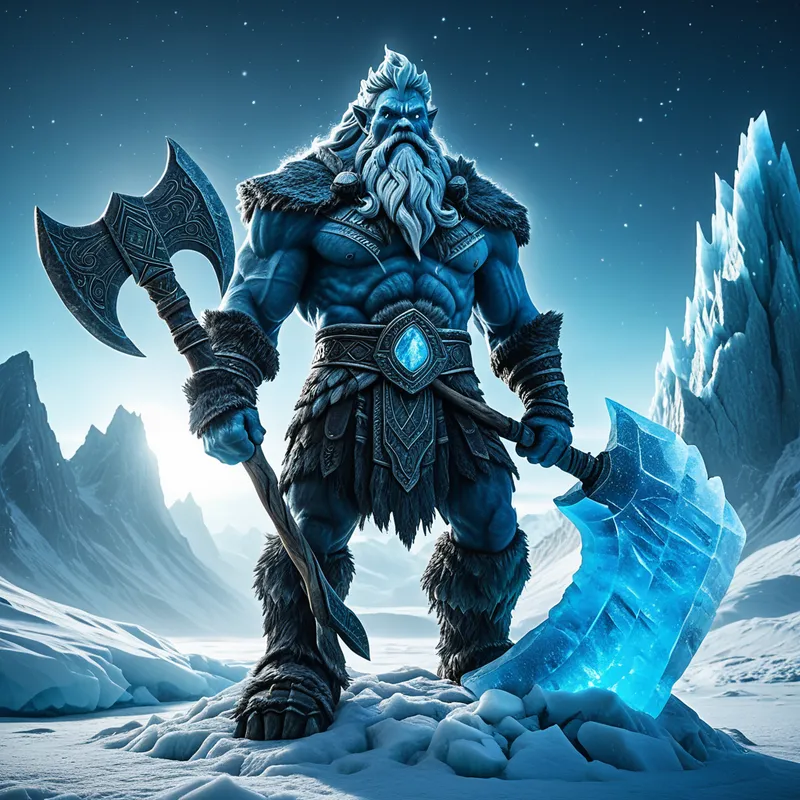
Frost Giants Myth Meaning & Symbolism
Primordial beings of ice and chaos, the Frost Giants embody the untamed world the gods must confront to forge cosmos from the void.
The Tale of Frost Giants
Listen. Before the sun knew its path and the moon its cycle, there was only the great, yawning chasm: Ginnungagap. To its north lay Niflheim, a realm of grinding ice, freezing fog, and silence so profound it was a presence. To its south roared Muspelheim, a land of dancing flames, ember-storms, and unbearable heat. And in the emptiness between them, a meeting. The fiery winds of the south licked at the frozen rivers of the north. The ice hissed, it steamed, it wept. And from that weeping rime, from the living sweat of the meeting of fire and frost, life stirred.
It coalesced, this life, into a form of immense and terrible power: Ymir, the first of the Jotnar, the Frost Giant. He was not born of love or thought, but of elemental reaction. As he slept, more giants sweated from his armpit, and a male and female grew from his legs. This was the first family, born of ice and chaos. And from the melting frost also came Audhumla. Her milk was rivers that fed Ymir. As she licked the salty ice-blocks, she freed another form: Buri, whose son Bor would wed a giantess.
From Bor came three brothers with a fire in their eyes that was not from Muspelheim, but from a new kind of will: Odin, Vili, and Ve. They looked upon the sprawling, snoring form of Ymir and the teeming, chaotic brood of giants and saw not a family, but a prison. The world was formless, a canvas of brute matter and instinct. A great loathing and a greater necessity rose in them. They fell upon the sleeping Ymir. It was not a battle, but a slaughter, a foundational act of violence. His blood gushed forth in such a torrent that it drowned all the Frost Giants save one, Bergelmir, who escaped with his household in a hollowed-out tree.
Then, from the corpse of the primordial one, the brothers built the world. Ymir’s flesh became the earth, his unbroken bones the mountains, his teeth and jaw-cliffs the stones. His blood and sweat became the seas and lakes. They took his skull and set it aloft to be the dome of the sky, held by four dwarfs at the cardinal points, and lit it with sparks from Muspelheim to be the stars. They fashioned Midgard, the middle enclosure, from his eyebrows, a fortress-yard for the children to come. From the maggots that writhed in his flesh, they made the dwarves. And from two pieces of driftwood on a shore, they breathed spirit into the first humans, Ask and Embla. Order was carved, literally, from the body of chaos. But the Frost Giants, diminished, exiled to the edges of the world in Jotunheim, did not forget. Their cold breath still whispers at the walls of the gods’ creation, a perpetual reminder of the price of the world, and of the debt that is yet to be paid in full at Ragnarok.
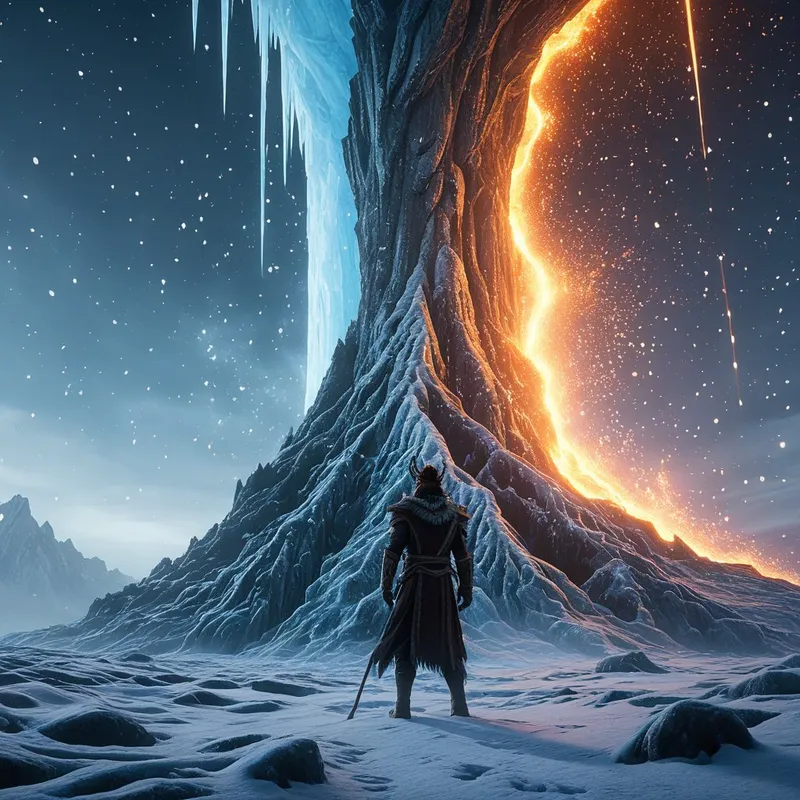
Cultural Origins & Context
These stories were not scripture, but living breath in the longhouses of the Viking Age and the centuries preceding it. They were the province of skalds—poet-historians who held the lineage of the world in their memory. Passed down orally, these myths were the foundational code of a people intimately acquainted with a hostile, sublime environment. The encroaching ice of winter, the volcanic fury of the earth, the vast, unforgiving sea—these were not metaphors for chaos; they were chaos. The Frost Giants personified this ever-present threat.
The myths served multiple societal functions. They were an etiological narrative, explaining the origin of the world's geography in a way that mirrored the Norse understanding of it: hard-won, sacrificial, and inherently violent. They established a cosmic hierarchy and identity: humans are the protected children of the gods (Aesir and Vanir), living in a middle realm besieged by outer chaos. The stories also reinforced cultural values of courage, cunning, and vigilance. The gods are not omnipotent moral paragons; they are flawed, powerful beings who must constantly use their wits and strength to maintain their creation against the giants' relentless pressure. This reflected a worldview where survival was not guaranteed, but earned through constant struggle against overwhelming natural forces.
Symbolic Architecture
Psychologically, the Frost Giants represent the primal, undifferentiated unconscious—the chaotic, formless potential from which consciousness itself is born and against which it must constantly define itself. Ymir is not evil; he is pre-moral, the "thing-in-itself," the raw material of existence before the ordering principle of mind imposes structure.
The birth of consciousness is an act of violence against the blissful, amorphic unity of the unconscious.
Odin, Vili, and Ve symbolize the emergent faculties of the psyche: sovereignty (Odin), conscious will (Vili), and the numinous, connecting faculty (Ve). Their murder of Ymir is the archetypal act of separation, the necessary "crime" of individuation. To become a Self, one must slay the undifferentiated mass of latent potential, dismembering it to build an internal world—an ego-structure—from its parts. The flood of Ymir's blood is the overwhelming flood of affect and primal emotion that this process can unleash, threatening to drown the nascent psyche. Bergelmir's escape signifies that the unconscious can never be fully eradicated; it retreats, reforms, and remains a permanent, potent force at the borders of the conscious mind, in the personal Jotunheim of our own shadow.
The Dreamer's Resonance
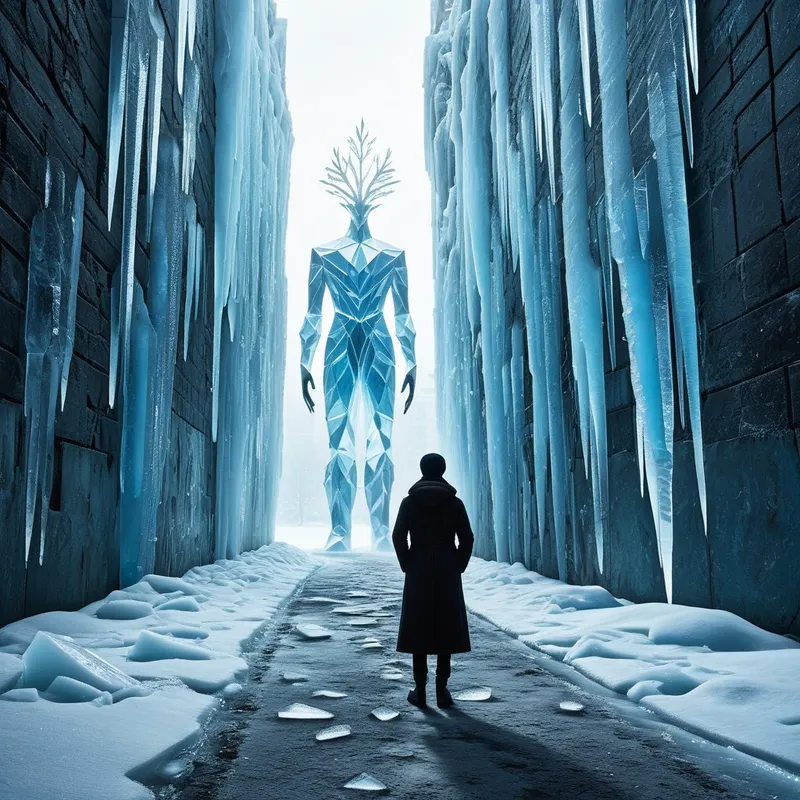
When the Frost Giants stride into modern dreams, they rarely appear as literal figures from myth. They manifest as the dreamer's encounter with vast, impersonal, and chilling forces. It may be a dream of being pursued by an avalanche, of standing before a glacier that is suddenly alive, or of a loved one's face turning to cold, featureless ice. The somatic experience is often one of profound cold, paralysis, or being dwarfed by an immovable object.
Psychologically, this signals a confrontation with a content of the unconscious that is too large, too ancient, and too "other" to be integrated easily. It is the frozen grief one has refused to feel, the icy rage buried for years, or the chilling truth one has avoided. The giant is not just a problem to solve, but an environmental condition to survive. The dream is an indicator that the psyche's usual defenses are insufficient; the walls of the personal Midgard are being tested by something primordial. The process is one of recognition, not necessarily resolution. The dream asks the dreamer to acknowledge the sheer scale and power of this frozen aspect of the self, to feel its cold breath, and to understand that it is a foundational part of their inner landscape, however exiled it may be.
Alchemical Translation
The alchemical journey mirrored in this myth is the opus contra naturam—the work against nature, which is also a work with nature. The primal matter, the massa confusa, is the Ymir-state: a frozen, chaotic totality. The goal is not to destroy it, but to transmute it. The gods perform the first alchemical operation: the mortificatio or killing, and the separatio or dismemberment of the unified whole.
The Self is not found, it is built—fashioned from the dismembered parts of the giant we once were.
For the modern individual, this translates to the painful but necessary process of analyzing one's own primordial patterns—the inherited traumas, the instinctual reactions, the frozen complexes that operate autonomously. One must "slay" their identification with this undifferentiated mass. This is the act of taking responsibility for one's own psyche, moving from being a passive product of chaos to an active shaper of one's inner world.
The building of Midgard from Ymir's body is the stage of coagulatio—giving solid, enduring form to the insights gained. The eyebrows become a protective boundary; the bones become the supporting structure of one's values; the blood becomes the flowing emotional life, now contained in its proper channels. Yet, the exiled giants in Jotunheim ensure the work is never complete. They represent the ongoing need for dialogue with the unconscious, for raids into the wild lands of the psyche to retrieve stolen treasures (like Odin's quest for the mead of poetry). The ultimate alchemy is not victory, but a dynamic, vigilant, and creative tension between the ordered citadel of the conscious self and the wild, frost-giant realms from which it was born, and to which, in the end, it will return to be reborn.
Associated Symbols
Explore related symbols from the CaleaDream lexicon: