
Fornax Myth Meaning & Symbolism
The myth of Fornax, the Roman goddess of the oven, who presides over the sacred heat that transforms raw grain into sustaining bread.
The Tale of Fornax
Listen, and feel the sun on the stones of the early city. Smell the dust of the threshing floor, the sharp scent of green stalks giving way to the hard, golden promise of grain. But this promise is a riddle. The wheat is a treasure that cannot be eaten, a bounty that bites back, a gift that demands a secret to unlock its soul.
In the homes of Latium, the people labored. They harvested the far, they ground it to a pale powder. Yet when they mixed it with water, they created only a cold, dense paste. It lay heavy in the belly and heavier on the spirit. Hunger was not just an empty stomach; it was a dullness in the eye, a slowness in the step, a shadow over the hearth. The people ate to survive, but they did not feast. Their bodies were fed, but their connection to the earth’s generosity felt broken, incomplete.
They did not know they were missing fire’s second kiss. The first fire cleared the forest and hardened the pot. But the second fire, the contained, patient, transformative fire—this was a mystery. It was the fire that did not consume, but revealed. It dwelt not in the wild hearth, but in a chamber of its own: a domed brick belly, a fornax.
And from this necessity, from this silent yearning in every home, a presence gathered. She was not born of thunderous Jupiter or stormy Neptune. She coalesced from the daily hope of mothers, the fatigue of fathers, the whimpering of children. She was the divine answer to a mundane, profound need. They named her Fornax.
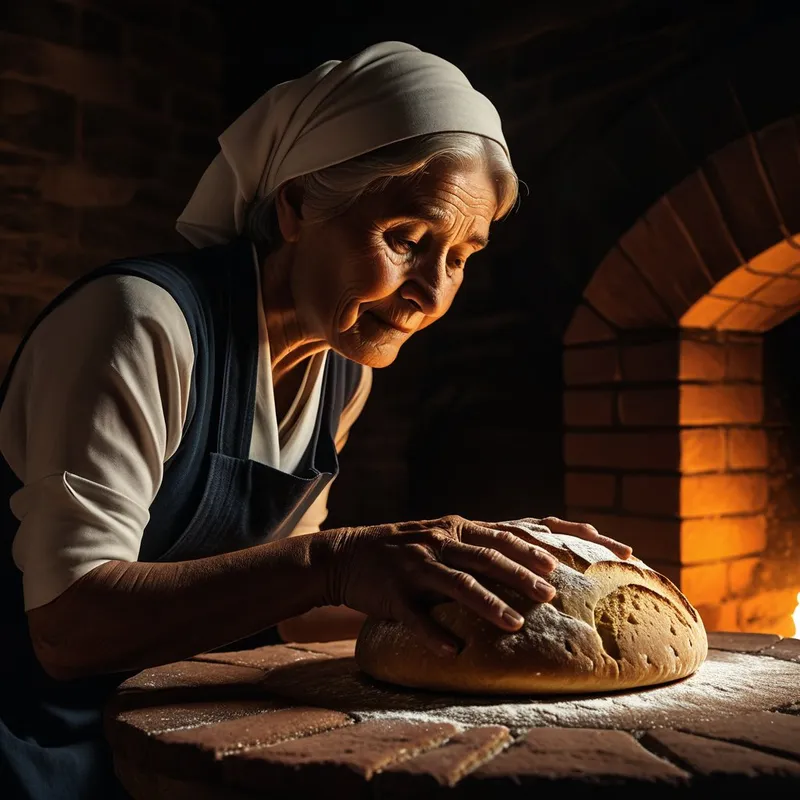
She entered not with a clash of cymbals, but with the first perfect crackle of a well-built fire under clay. She was in the careful stacking of wood, in the waiting for the flames to die to embers, in the moment the baker judged the heat not by sight, but by a felt knowledge in the bones. Her whisper was the hiss of water sprinkled on the oven floor, a cloud of steam that sealed the loaf’s fate.
Then, the raw, shapeless dough—the child of earth and water—was laid upon the hot bricks. The door was sealed. In that dark, holy womb, Fornax worked her silent miracle. The alien spirit of fermentation, the yeast (a mystery itself), breathed and expanded, filled with the goddess’s invisible breath. The fierce, dry heat encircled the loaf, not to burn it, but to embrace it. It crusted the outside into armor, a golden, fragrant shield. Inside, the heat performed its alchemy: it fixed the airy expansion, turning foam into firm, snow-white sustenance.
When the door was opened, the steam carried a scent that was never before known: the smell of baking bread. It was the smell of hunger answered with grace, of labor crowned with triumph. The hard grain had been transfigured. It was no longer merely food; it was a testament. It could be shared, broken, dipped in oil, savored. It filled the body and, for the first time, truly nourished the soul of the community. Fornax had taught them that to be human is not just to eat, but to transform; to take the raw gift of the world and, through applied, sacred heat, make it into a form of love.
Cultural Origins & Context
Fornax is a quintessential example of a functional deity in the Roman pantheon. Unlike the grand, anthropomorphized gods borrowed from Greece, Fornax emerged from the very concrete, daily reality of agrarian life. Her domain was not a mountain or a sea, but a human-made structure central to survival. She represents the Roman genius for ritualizing practical necessity, for embedding the divine into the fabric of domestic and civic routine.
Her worship was organized in the Fornacalia, a movable feast not tied to a specific calendar day but announced by the Pontifex Maximus. This flexibility itself speaks to her nature—her sacred time was aligned with practical readiness, the completion of the harvest’s processing. During the Fornacalia, families, and especially the curiae (political subdivisions), would make offerings of spelt (far) to Fornax at communal ovens. The ritual was a act of collective gratitude and a plea for continued success in the year’s baking, ensuring the staple food was properly transformed and free of spiritual or literal impurity.
The myth, as such, is less a narrative of adventure and more a ritual aetiology. It exists to explain and sanctify the practice of baking. Fornax’s story was passed down not by epic poets, but by mothers to daughters, by bakers to apprentices, embedded in the doing. Her societal function was foundational: she was the divine guarantor of food security and culinary civilization, turning the act of baking from a chore into a sacred technology.
Symbolic Architecture
At its core, the myth of Fornax is a profound map of transformation. The oven, her sacred vessel, is the archetypal womb/crucible. It is a sealed space where raw, chaotic potential (dough) is subjected to controlled, intense energy (heat) to emerge as a new, coherent, and nourishing form (bread).
The oven teaches that true transformation requires both enclosure and fire—a sacred space and a catalyzing force.
The raw ingredients symbolize the unintegrated aspects of the self or experience: our talents, our pains, our memories—potentially nourishing but currently indigestible. The yeast represents the mysterious, animating spirit—the unconscious impulse or inspiration that initiates change from within. Fornax herself is the archetype of the Caregiver, but with a crucial, active dimension. She is not merely the provider culture.") of food; she is the mistress of the process that makes provision possible. She represents the applied, patient intelligence of nurture—the love that knows how to apply the right heat at the right time.
Her fire is not destructive wildfire, but civilized, purposeful heat. This distinguishes her from Vulcan, whose fire shapes metal for war and art. Fornax’s fire shapes sustenance for life. It is the heat of digestion, of incubation, of psychological “cooking” where experiences are metabolized into wisdom.
The Dreamer's Resonance
To dream of an oven, a furnace, or a kiln is to touch the Fornax archetype within. Such dreams often surface during periods of intense internal processing, when raw emotional or psychic material is being “baked” into a new form of understanding.
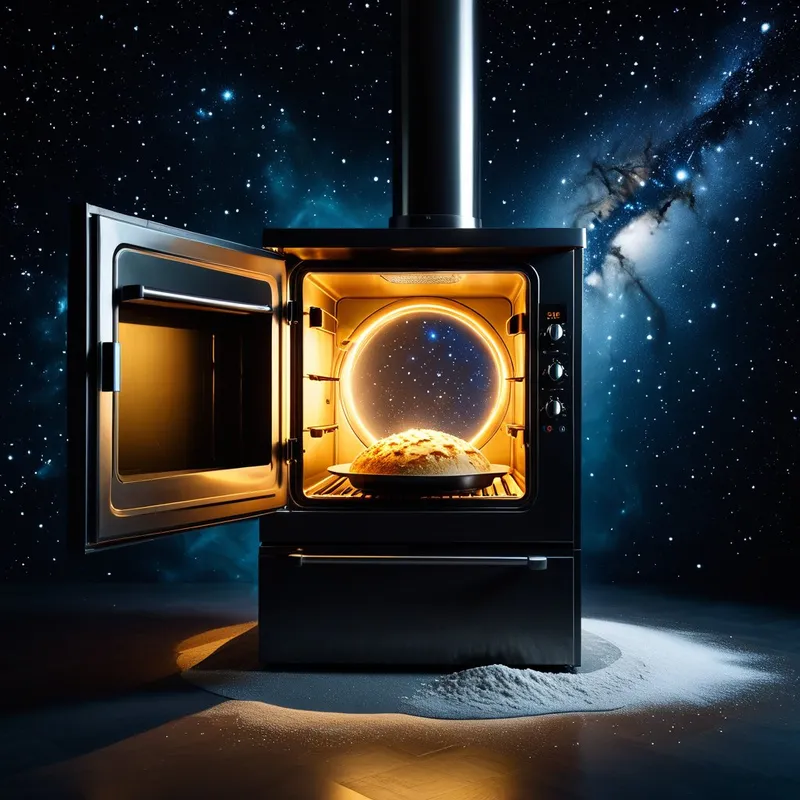
A dream of a cold, empty oven may speak to a feeling of creative or emotional barrenness, a lack of the catalytic “heat” needed for transformation—perhaps depression or stagnation. A dream of an oven overflowing with fire or burning contents signals a process that feels out of control, an intensity that threatens to consume rather than transform (unprocessed rage, obsessive passion). The most potent dream is of peering into a perfectly heated oven to see something transforming—dough rising, clay hardening, metal glowing. This is a somatic signal of integration in progress. The dreamer’s psyche is assuring them that, though they are in a sealed, perhaps uncomfortable period of pressure and heat, a nourishing resolution is being formed in the dark.
The body itself may resonate with this myth during times of convalescence, deep learning, or gestation (literal or creative), feeling itself to be the oven where resources are being alchemized into strength, knowledge, or new life.
Alchemical Translation
The journey of Fornax models the individuation process as one of sacred domestication. It is not about a heroic quest to slay monsters in far-off lands, but about mastering the transformative fire in one’s own hearth. The modern individual is constantly presented with “raw grain”: experiences, information, relationships, emotions.
Individuation is the art of building a psychic fornax—a conscious, contained space where the heat of attention can perform its slow, sure work.
The first step is Gathering the Far—acknowledging and harvesting the experiences of one’s life. The second is Grinding—the often-painful work of analysis and reflection that breaks down hard, defensive structures. The third is Kneading and Leavening—introducing the “yeast” of imagination, reflection, or therapeutic insight, and working it in, allowing time for internal fermentation. The final, critical step is Firing in Fornax’s Oven. This is the conscious, often difficult, period of holding oneself in the heat of consequence, patience, and discipline. It requires sealing oneself off from distracting influences (“closing the oven door”) and trusting the process.
The result is not a dramatic rebirth, but a loaf of bread: something solid, shareable, sustaining. It is the integrated self, where once-raw pain has become compassion, where raw talent has become skill, where raw experience has become wisdom. Fornax’s myth teaches that the goal of the soul’s alchemy is not esoteric transcendence, but grounded nourishment. We are here to build ovens, tend fires, and transform the harvest of our lives into something that can truly feed ourselves and our world.
Associated Symbols
Explore related symbols from the CaleaDream lexicon: