Fons Myth Meaning & Symbolism
The story of Fons, god of springs, embodies the sacred source from which all life flows, symbolizing purity, origin, and the deep, nourishing unconscious.
The Tale of Fons
Listen. Before the clamor of the forum, before the straight roads cut the earth, there was the sound of water. Not the crash of the sea, nor the rush of the river, but a softer, more secret music: the chuckle of a spring finding its way into the light.
In a grove so ancient the oaks remembered the first gods, the earth opened a tender mouth. From between roots like knuckled bones and stones worn smooth by time, a cold, clear breath issued forth. It pooled in a hollow of its own making, a liquid eye staring up at the sky. This was no mere trickle; it was a promise. The locals knew. They called the place Fontinalia, and they knew a god lived there. They called him Fons.
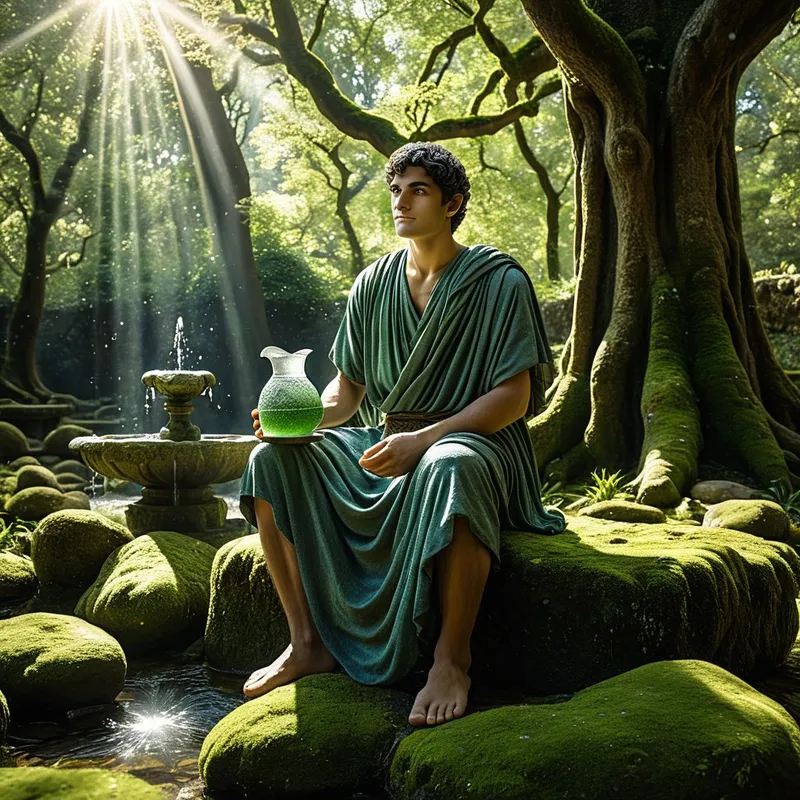
He was not seen in the way men see each other. He was felt in the chill that kissed the skin on a summer’s day, tasted in the impossible sweetness of the water that never failed, even in the driest season. He was the presence in the silence between the water’s song and the rustle of leaves. They said he was a youth, eternal, with hair the color of wet stone and eyes that held the depth of the source itself. He was neither powerful like Jupiter nor wise like Minerva. His power was of a different order: the quiet, relentless power of beginning.
Once, a drought came. The great Tiber grew thin and brown, the fields cracked like old pottery, and dust hung in the air, bitter on the tongue. Prayers rose to the sky gods, but the heavens remained a hard, brass bowl. In despair, an old farmer, his lips parched, stumbled into the sacred grove. He fell to his knees not in prayer, but in exhaustion, his hand sinking into the cool mud at the spring’s edge.
And there, he heard it. Not with his ears, but in his bones. A pulse. A steady, gentle beat-beat-beat from deep within the earth, matching the frantic rhythm of his own heart until his heart slowed, until his breath deepened. The water, which had been a mere murmur, seemed to speak. It did not offer a flood to wash away the drought. It offered only itself—its constant, faithful flow. The farmer cupped his hands, drank, and the water was so cold it hurt, so pure it tasted of nothing and everything. It was not enough to irrigate his fields, but it was enough to irrigate his soul.
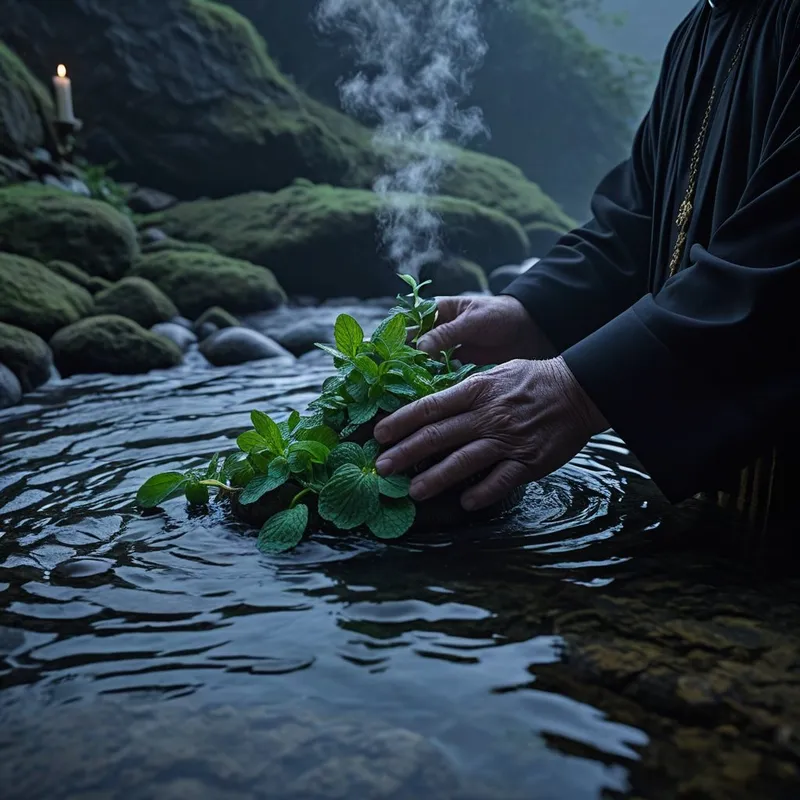
He returned to his village not with a miracle, but with a truth. He led them not to dam or divert, but to honor. On the day that would become the Fontinalia, they came. They threw garlands of mint and violets into his spring, not as a bribe, but as a gift of beauty for beauty. They sang songs not of pleading, but of gratitude for what was already, always given. And as they honored the source, they remembered the other, smaller springs, the forgotten trickles in the woods. They cleaned them, crowned them with flowers. They tended the beginnings.
The drought did not break that day. But something else broke—the spell of scarcity in their minds. By honoring Fons, they remembered how to drink from the world’s quiet, generous veins. And when the rains finally did come, they fell on a people who no longer believed water was only in the sky, but knew it was first, and forever, in the earth.
Cultural Origins & Context
The figure of Fons is a profound example of the Roman numen—the localized, animating spirit of a place. Unlike the grand, anthropomorphized Olympian gods with their complex Homeric histories, Fons is the divine essence of a specific, tangible phenomenon: the spring. His worship was rooted in the very soil of Italy, where access to fresh water was not a convenience but the absolute determinant of life, settlement, and civilization.
His festival, the Fontinalia on October 13th, was a pastoral and communal rite. There were no grand temple sacrifices of bulls. Instead, wells and springs throughout the countryside were adorned with wreaths of flowers. This was a practice of pietas—dutiful reverence—directed at the fundamental sources of nourishment. The myth was not a single, codified epic recited by bards, but a collective understanding enacted through ritual. It was told by farmers showing their children which spring was sacred, by village elders presiding over the simple garlanding ceremony. Its societal function was one of remembrance and reciprocity: to remind a practical, engineering-minded people that before aqueducts, there was the gift; before control, there was the source. It anchored Roman identity not just in martial glory or law, but in a sacred relationship with the land that sustained them.
Symbolic Architecture
At its core, the myth of Fons is an archetypal narrative of the Source. It moves beyond the literal spring to symbolize the origin point of anything vital: consciousness, creativity, emotion, or life itself.
The source is not the river. It is the silent, hidden point from which the river becomes possible.
Fons represents the pristine, pre-conscious state from which the contents of the psyche emerge. He is not the powerful, directed flow of the river-god (Tiberinus), but the quiet, enigmatic beginning of that flow. Psychologically, he symbolizes the deep, nourishing waters of the unconscious, not in their turbulent, shadowy depths, but in their most pure, generative aspect. The drought in the tale is not merely an environmental catastrophe; it is a state of psychic aridity, a disconnect from one’s own inner wellspring of vitality, intuition, and soul-nourishment.
The resolution is profoundly instructive. Salvation does not come from a deus ex machina, but from a return to and honoring of the source. The farmer’s act of listening, of touching the mud, of drinking directly, is an act of reconnection with the instinctual, earthy self. The garlands are not payment, but symbols of attention and beauty offered to that inner, often neglected, fount of life.

The Dreamer's Resonance
When this myth stirs in the modern unconscious, it often manifests in dreams of water in its most elemental, originating form. A dreamer might find a small, forgotten spring in their basement, discover a tap in their home that runs with impossibly cold, clear water, or hear the sound of dripping or bubbling in a silent room.
Somatically, this can correlate with a process of deep, cellular rehydration—a recovery from burnout, emotional exhaustion, or creative block. Psychologically, these dreams signal a critical turning point where the conscious ego, parched by the demands of the outer world (the drought), is being called back to its own Fons. The conflict is between the ego’s desire for a large, dramatic solution (praying to the sky gods) and the soul’s need for the small, constant, and authentic (returning to the spring). The dream is an invitation to tend to what is already quietly flowing within, often ignored in favor of more spectacular, but less nourishing, pursuits.

Alchemical Translation
The alchemical process mirrored in Fons’s myth is the opus of Return to the Prima Materia—the first matter. In the labor of individuation, we often seek complex philosophies, dramatic breakthroughs, or powerful transformations (the great river). Yet the myth teaches that the fundamental work is the return to the origin point of our own being, the uncorrupted spring of the psyche before it was channeled by parental complexes, cultural expectations, and trauma.
Individuation begins not with adding, but with subtracting everything that dams the source.
The farmer’s journey is the ego’s descent to the point of simplicity. The garlanding ritual is the act of valuing this inner source, of devoting conscious attention and respect to the spontaneous, life-giving impulses that arise from the unconscious. This is the alchemical ablutio—the washing in the pure water of the spring. It is not about purification in a moral sense, but in a foundational one: clearing away the debris of inauthenticity to allow the innate, pristine nature of the self to flow unimpeded.
In modern terms, to work with the archetype of Fons is to practice identifying and honoring one’s own “wellsprings”—those activities, relationships, or states of being where we feel most authentically nourished and generative, not from effort, but from overflow. It is the transmutation of scarcity consciousness (“I am in a drought”) into source consciousness (“I am connected to an eternal, inner fount”). The triumph is not in conquering the drought, but in realizing one was never truly separate from the water in the first place.
Associated Symbols
Explore related symbols from the CaleaDream lexicon: