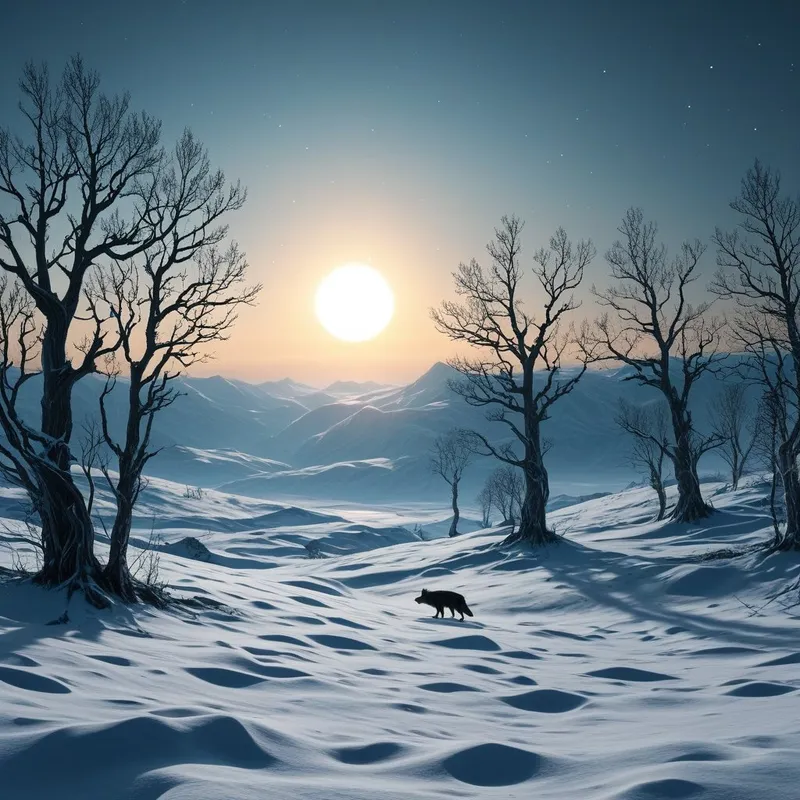
Fimbulwinter Myth Meaning & Symbolism
The great winter that precedes Ragnarök, a time of endless cold, broken bonds, and the necessary collapse before a world's rebirth.
The Tale of Fimbulwinter
Listen, and feel the cold seep into your bones. This is not the gentle winter that blankets the earth in sleep. This is the winter that forgets the spring.
It begins with a betrayal, a murder most foul in a hall of gods. The bright one, Baldr, is slain, and with him falls the world’s joy. The sun, his sister, turns her face away in grief. Her brother, the moon, flees in terror. The wolves Sköll and Hati, who have run since time’s dawn, finally close their jaws. Light is consumed. The stars wink out, one by one, plucked from the sky.
Then the winds awake. Not the playful gusts that fill sails, but the breath of giants, howling from all corners of the world. They carry not seeds, but knives of frost. From the east, the north, the south, and the west they scream, meeting in a whirlwind of absolute cold over Midgard. Snow falls, not in flakes, but in relentless, smothering sheets. It piles against the mountains until they are mere mounds. It fills the valleys until they are plains of white despair.
One winter passes. The rivers groan and become roads of stone-ice. The lakes sing a shrill, cracking song as they solidify to their depths. The people, the children of Ask and Embla, huddle in their longhouses. They burn the last of the summer wood, and the smoke tastes of endings.
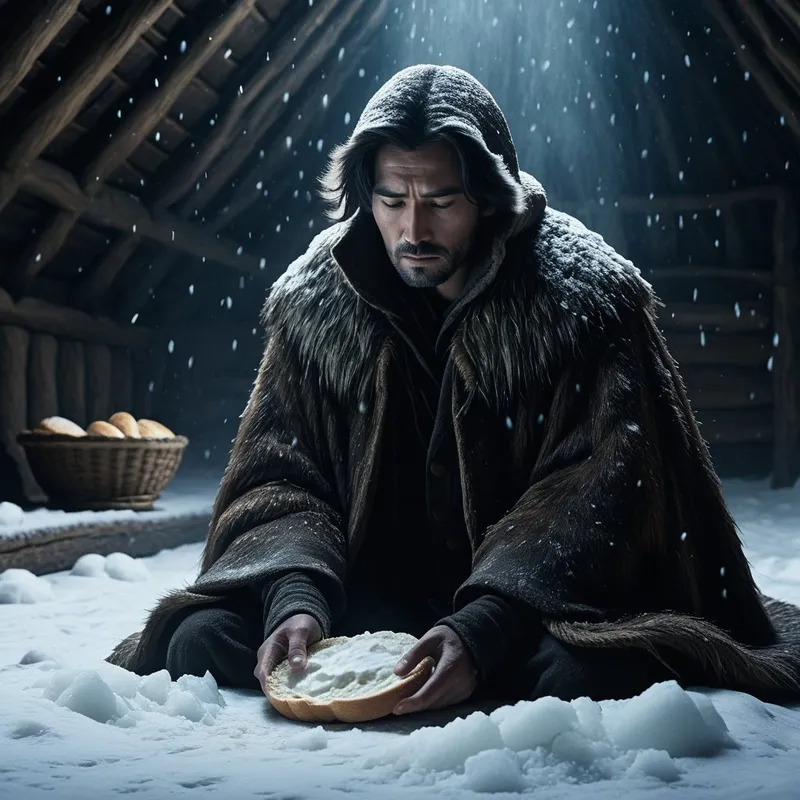
A second winter follows the first without a breath of thaw. The granaries are hollow echoes. The last apples in the storeroom are hard as rock. The bonds that hold kin together—love, duty, shared blood—begin to crystallize. Brothers, driven mad by the gnawing in their bellies and the endless howl outside, raise weapons over the last crust of bread. The old laws of hospitality shatter like ice. Strangers are met at the door with axe, not ale. This is the Fimbulvetr, the Mighty Winter, and its true chill is in the heart.
A third winter descends. This is the winter of silence. The wind has stolen all other sounds. The wolves, grown massive and desperate, stalk the white wastes, but even their howls are swallowed. In the high halls of Asgard, the gods sit in grim council. They feel the tremors in the roots of Yggdrasil. They hear the grinding of the ship Naglfar being freed from its moorings of ice. They know the watchman Gullinkambi has fallen silent. The final act is upon them. The long winter is the overture to the twilight of the gods, to Ragnarök. It is the world holding its breath, frozen in a moment of terrible, necessary anticipation.
Cultural Origins & Context
The prophecy of Fimbulwinter reaches us primarily through the 13th-century Poetic Edda, particularly in the Völuspá (The Prophecy of the Seeress) and the Vafþrúðnismál (The Sayings of Vafþrúðnir). These poems, compiled from older oral traditions, were the preserve of skalds and seers. They were not mere entertainment but a sacred cosmology, a map of time and fate.
In the harsh climate of Scandinavia, winter was a known, intimate enemy. A bad year could mean extinction for a family or a settlement. Fimbulwinter is this existential fear magnified to a cosmic scale. It served as a mythic explanation for societal collapse, a warning of what happens when the sacred order—the covenant between gods, humans, and nature—is broken by acts like Baldr’s death. It functioned as a narrative container for collective trauma, past or anticipated, and reinforced the values of preparedness, kinship, and stoic endurance. To hear this tale around a fire, while a real storm raged outside, was to confront the worst possible outcome, and by surviving the story, to find the courage to survive the night.
Symbolic Architecture
Fimbulwinter is not merely a weather event; it is the archetype of systemic collapse. It represents the point where a cycle—personal, psychological, or civilizational—has exhausted its vitality and must undergo a catastrophic dissolution to make way for the new.
The great freeze is the psyche's defense at its most extreme: a total lockdown, a numbing of all feeling, to survive an unsurvivable pain.
The three consecutive winters symbolize a process of complete saturation. One winter is a trial; two, a despair; three, a transformation of state. The world does not just get cold; it becomes cold. This is the symbolic shift from experiencing depression or crisis to being identified with it, where the temporary state hardens into a perceived permanent reality.
The collapse of kinship—brother fighting brother—is the most devastating symbol. It signifies the fragmentation of the internal family. The inner voices that should cooperate (the responsible ruler, the nurturing caregiver, the creative child) turn on each other in a struggle for the last scraps of psychic energy. The social contract of the self is voided. This is the winter within.
The Dreamer's Resonance
When Fimbulwinter appears in modern dreams, it rarely manifests as literal snowscapes. It is felt as an atmosphere, a somatic reality. The dreamer may find themselves in a house that is increasingly cold, unable to find the thermostat. They may be searching for someone in a blinding whiteout, their calls swallowed by silence. They may be watching a loved one’s face slowly turn away, becoming distant and frost-rimed.
These dreams signal a profound psychological numbing. The individual is in a state of emotional and energetic hibernation. The "three winters" in a dreamer’s life might be three major losses, three failed projects, or three years of a stagnant relationship. The psyche has entered a preservation mode, shutting down non-essential processes to protect a tiny, vital core of life from a perceived existential threat. The dream is both a report on this frozen state and, importantly, the first faint tremor of the ice breaking. To dream of the cold is to begin to feel it, and to feel it is the first step toward thawing.

Alchemical Translation
The alchemical journey mirrored in Norse myth is not of turning lead to gold, but of surviving the nigredo—the blackening, the putrefaction—and the albedo—the whitening. Fimbulwinter is the supreme albedo, a world bleached of all color and life, purified to a stark, unbearable essence. It is the necessary stage of freezing and contraction that must precede the cracking open.
For the modern individual, the Fimbulwinter process is the crisis that forces individuation. It is the burnout that makes continued ego-identification impossible. It is the depression that strips away all the old, false ways of being. The ego, like the society in the myth, fights for its survival with desperate, fratricidal violence ("I should be this, I must be that"). But the winter’s purpose is to end that civil war.
The thaw does not come from fighting the ice, but from enduring it until its own weight creates the fault line. The seed of Ragnarök—of total conflict and rebirth—is contained within the deepest freeze.
The alchemical work during this winter is not action, but profound endurance and observation. It is tending the single, guttering flame of consciousness in the longhouse of the self. It is listening to the silence until you hear the first drip of meltwater, which is also the first note of the Fjalar’s crow, heralding the inevitable, chaotic, and creative battle for renewal. To undergo your Fimbulwinter is to understand that the world must end for your world to begin. The ice, in its utter totality, is the womb for the fire to come.
Associated Symbols
Explore related symbols from the CaleaDream lexicon: