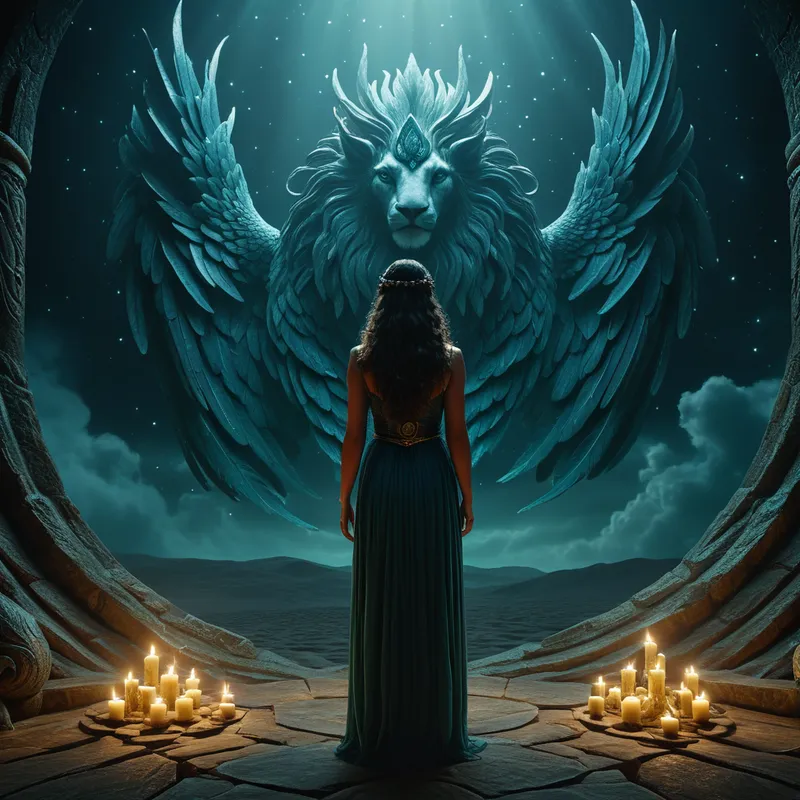
Fenghuang the Chinese Phoenix
The Fenghuang is a mythical Chinese phoenix representing cosmic harmony, virtue, and renewal in Taoist tradition, often depicted with vibrant plumage.
The Tale of Fenghuang the Chinese Phoenix
In the primordial mists before time was measured, when the Tao moved in its first great breath, a song began. It was not a sound for ears, but a vibration for the soul—a melody woven from the harmony of the five elements and the virtues of all living things. From this celestial resonance, the Fenghuang was born. It did not burst from flame, but emerged from the stillness of perfect balance, its form a living tapestry of the cosmos.
Its head symbolized the sky, crowned with the virtue of de (德), moral power. Its back bore the shape of the sun, its wings the wind, and its chest the moon. Its tail feathers were not merely for display; they were the very essence of the five sacred colors: black for water, white for metal, red for fire, green for wood, and yellow for earth. To see the Fenghuang was to witness the universe in avian form, a symphony of creation made flesh and feather.
The Fenghuang did not dwell in a mundane nest. It perched only upon the wu tong (梧桐), the Chinese parasol tree, whose pure wood resonated with its noble spirit, and drank only from the sweetest springs. Its appearance was never an accident, but a profound omen. It was said to descend only in lands governed by benevolent virtue, in eras of sublime peace. When a sage ruler, like the legendary Yellow Emperor, embodied perfect harmony with the Tao, the Fenghuang would grace his court. It would circle three times, its iridescent plumage casting rainbows upon the earth, its call—a sound like the blending of a thousand gentle winds and flowing streams—heralding an age of prosperity and moral clarity. Its flight mapped the patterns of celestial order onto the human realm.
Unlike Western tales of a solitary phoenix cyclically consumed by fire, the Fenghuang’s story is one of enduring, active harmony. It is the ultimate sign that heaven and earth are in accord, that the ruler’s heart mirrors the virtue of the cosmos. Its tale is not one of dramatic death and rebirth, but of the perpetual, graceful dance of renewal that occurs when all things are in their rightful place.
Cultural Origins & Context
The Fenghuang’s lineage is ancient, with oracle bone inscriptions from the Shang Dynasty (c. 1600–1046 BCE) referencing a powerful, auspicious bird deity. Initially, the feng and the huang were considered separate royal birds, male and female, but over time they fused into the singular, majestic entity we know, transcending gender to become an emblem of cosmic unity.
Its integration into Taoist thought deepened its symbolism exponentially. Taoism, with its core principles of yin-yang balance, wu wei, and harmony with the natural order, found in the Fenghuang a perfect natural symbol. The bird became a visual and spiritual representation of the ideal state of being—where opposing forces are not at war, but in creative, dynamic equilibrium. It is the living manifestation of the phrase tian ren he yi (天人合一), the unity of heaven and humanity.
Furthermore, in Confucian ideology, which heavily influenced imperial China, the Fenghuang became inextricably linked to virtue and legitimate sovereignty. Alongside the dragon (representing the emperor), the Fenghuang symbolized the empress, but more broadly, it represented the moral authority and benevolent governance that justified the Mandate of Heaven. Its appearance validated a ruler’s virtue; its absence was a silent, profound critique. Thus, the Fenghuang sat at the intersection of Taoist cosmology and Confucian statecraft, a mythic creature bridging the spiritual and the political, the cosmic and the civic.
Symbolic Architecture
The Fenghuang is not merely a bird of beautiful plumage; it is an intricate symbolic system. Every aspect of its being is a deliberate glyph in the language of cosmic order.
Its body is a map of the universe: the sky, sun, moon, and wind. Its five-colored tail feathers are a direct correspondence to the Wu Xing, the five phases or elements that constitute all matter and process in classical Chinese thought. This makes the Fenghuang a creature of total integration, embodying the endless cycle of generation (wood feeds fire, fire creates earth, etc.) and restraint (water quenches fire, fire melts metal) that sustains the world.
The Fenghuang does not possess harmony; it is the embodiment of the moment when the five elements cease their struggle and sing in perfect chord. It is the visual form of cosmic consonance.
Its association with the wu tong tree and clear springs underscores its purity and selective, righteous nature. It aligns only with what is upright and uncorrupted. Psychologically, this represents the individuated Self in its most integrated form—not engaging with chaotic or toxic energies, but perching steadfastly on the principles of virtue and natural law. Its rare appearances signal that the inner world of a leader, or a culture, has achieved a state of profound inner alignment that then manifests as external peace and prosperity.
The Dreamer's Resonance
To encounter the Fenghuang in dream or vision is to receive a profound message about the state of one’s soul and one’s relationship with the world. It is an archetypal image of the Self, the organizing center that brings coherence to the fragmented parts of the psyche.
When the Fenghuang appears, it may signal that after a period of inner conflict or dispersal, the dreamer is moving toward a state of profound personal integration. The warring elements within—passion and reason, action and contemplation, desire and duty—are finding their balanced expression. The Fenghuang’s serene flight suggests one is acting in wu wei, with effortless efficacy, because one’s actions are now in flawless accord with one’s innate nature and the greater Tao.
Conversely, a Fenghuang that is distant, silent, or with dulled plumage might reflect a deep, intuitive sense that one’s life is out of alignment. It points to a disconnection from one’s virtues, a betrayal of one’s inner truth, or a life forced against its natural grain. The longing for the Fenghuang is the soul’s longing for wholeness, for the peace that comes not from the absence of challenge, but from the graceful mastery of inner complexity.
Alchemical Translation
In the inner alchemy of Taoist practice, the goal is to refine the base substances of body and mind into the golden elixir of spiritual immortality and unity with the Tao. The Fenghuang is a potent symbol of the successful completion of this work.
The five colors of its tail correspond to the refinement and balancing of the five elemental energies within the practitioner’s own body. The harmonious song of the Fenghuang represents the unified voice of the Three Treasures (Jing, Qi, Shen), no longer in discord but flowing as one luminous stream. Its celestial origin mirrors the alchemist’s aim to birth the "immortal fetus" or radiant spirit-body from the crucible of dedicated practice.
To cultivate the inner Fenghuang is to perform the ultimate alchemy: transforming the lead of fragmented desire and ego into the gold of virtuous, harmonious being. Its nest in the wu tong tree is the purified mind, its drink from clear springs is the circulation of untainted Qi.
Thus, the Fenghuang is not an external deity to be worshipped, but an internal potential to be realized. It is the blueprint for the perfected human, who lives as a microcosm in serene reflection of the macrocosm, whose very presence brings order and grace to their surroundings.
Associated Symbols
Explore related symbols from the CaleaDream lexicon:
- Phoenix — The universal archetype of renewal and resurrection, of which the Fenghuang is a uniquely harmonious and virtuous expression.
- Harmony of Opposites — The core dynamic the Fenghuang embodies, representing the serene unity of yin and yang, light and dark, in creative balance.
- Celestial Harmony — The state of perfect cosmic order and alignment which the Fenghuang both signifies and manifests through its presence.
- Virtue — The moral power and righteous conduct that attracts the Fenghuang’s grace, representing the alignment of human action with cosmic principle.
- Rebirth — Not through fiery destruction, but through the continuous, graceful renewal that flows from sustained harmony and virtuous living.
- Dragon — Its celestial counterpart; where the Dragon represents potent, active yang power, the Fenghuang embodies graceful, luminous yin virtue, together completing the cosmic pair.
- Tree — Specifically the wu tong tree, representing purity, resilience, and the sacred, stable foundation necessary for higher spiritual manifestation.
- Sun & Moon — Incorporated into its very body, symbolizing the perfect marriage of the celestial masculine (sun) and feminine (moon) principles within a unified being.
- Taoist Talisman — The Fenghuang itself functions as a living talisman, a concentrated symbol of cosmic forces invoked to bless and stabilize a realm.
- Crown — An emblem of sovereign virtue and legitimate authority, reflecting the Fenghuang’s role as the validator of benevolent, heaven-blessed rule.