Fairy Lights Myth Meaning & Symbolism
A mortal's quest for the elusive lights of the Sídhe reveals the peril and promise of crossing the threshold between worlds.
The Tale of Fairy Lights
Listen, and let the peat-smoke carry you. Not to the world you know, of solid stone and certain sun, but to the betwixt hours, when the veil between the realm of flesh and the realm of spirit is thin as a moth’s wing. Here, in the deep glens and over the lonely bogs of Éire, they appear.
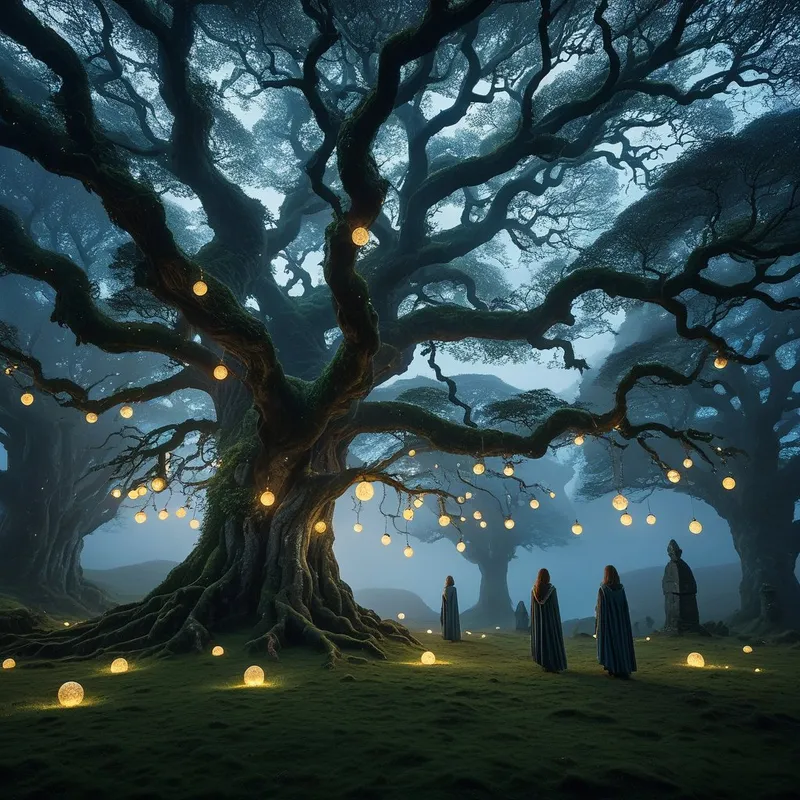
They are not stars fallen to earth, though they gleam with that cold fire. They are the Fairy Lights. Some call them ignis fatuus, the foolish fire, but to name them so is to misunderstand entirely. They are the lanterns of the Sídhe, the Good People, the Keepers of the Hollow Hills. They dance in deliberate, elusive patterns—a promise, a warning, a map to places no mortal foot should tread.
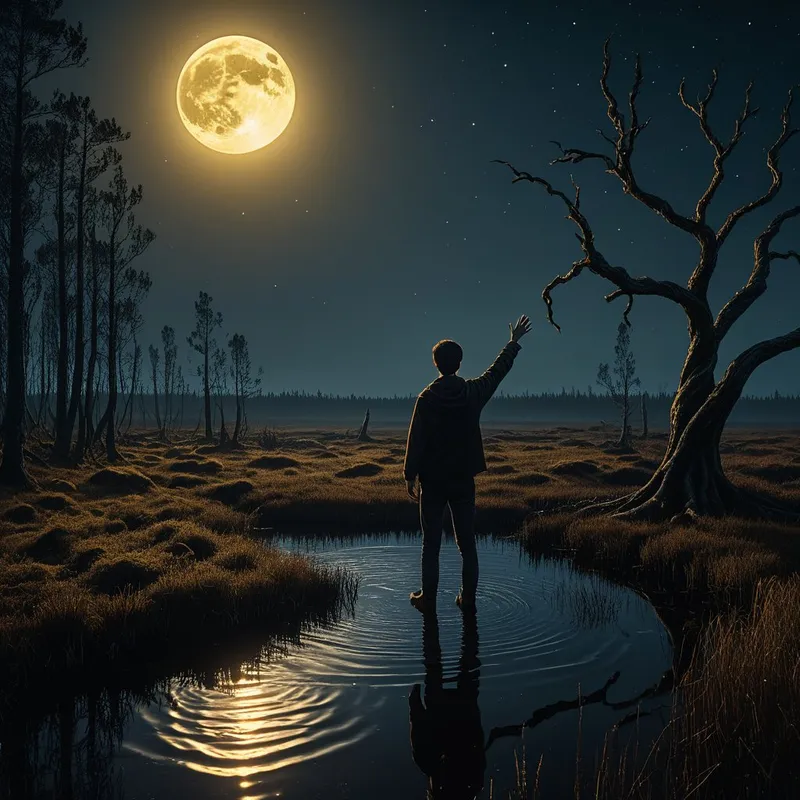
There was a youth, Dáire, whose heart was a cage of curiosity. He had heard the old whispers: follow the lights to find the entrance to the Tír na nÓg, where beauty is eternal and sorrow unknown. One autumn eve, as the Samhain winds began to keen, he saw them. A procession of lights, gold and silver, winding up the side of the sídhe mound at the forest’s heart.
Reason fled. A yearning deeper than hunger pulled him forward. He crossed the fairy ring of toadstools, ignoring the chill that seized his bones. The lights retreated, beckoning him deeper into the thickening wood, where the trees grew twisted and the air tasted of metal and moss. He ran, his breath ragged, his eyes fixed on that glorious, dancing glow. The world of his village—the smell of bread, the sound of his mother’s voice—faded to a dream.
The lights halted in a silent clearing. In their radiance stood the Sídhe. They were terrible in their beauty, tall and pale, with eyes that held the depth of forgotten lakes. No word was spoken, but a question hung in the air: Why have you crossed the threshold? Dáire, his voice a dry leaf, spoke of his desire for their timeless wisdom, their secret joy.
The Sídhe did not smile. One raised a hand, and a single, perfect light—no larger than a hawthorn berry—detached from the host and floated to Dáire’s chest. It did not warm him; it poured into him, a river of ice and starlight. Visions erupted in his mind: not just beauty, but the endless turning of seasons unseen, the weight of ancient memories, the profound melancholy of eternity. It was knowledge, yes, but it was a burden his mortal soul was not built to carry.
He fell to the earth, gasping. When he looked up, the lights and their bearers were gone. The clearing was just a clearing, dark and ordinary. He stumbled home, but home was now a stranger to him. He carried the light within, a cold jewel in his soul. He could see the numina in stones, hear the whispers in the wind, but the simple laughter of children sounded distant and thin. He became a walker of the threshold, forever between, his story a whispered lesson by hearthfires: the Fairy Lights do not guide you home. They show you the price of the road to another.
Cultural Origins & Context
The myth of the Fairy Lights is not a single, codified tale but a pervasive folk motif woven into the fabric of Gaelic (Irish and Scottish) tradition. It belongs to the vast corpus of lore surrounding the Aos Sí, the people of the mounds. These stories were not written in illuminated manuscripts but carried on the breath of the seanchaí (the traditional storyteller/historian) during the long, dark nights.
Their function was profoundly pedagogical and ecological. They were not mere entertainment but a cognitive map for navigating a world perceived as deeply alive and perilously enchanted. The lights served as a literal and metaphorical boundary marker. To see them was to know you were at the edge of the human tír and the Otherworldly fíntí. The stories warned against the hubris of unchecked curiosity and the violation of sacred boundaries, enforcing a cultural respect for the unknown and the territories of the unseen inhabitants of the land.
Symbolic Architecture
At its core, the myth of the Fairy Lights is an archetypal drama of the threshold. The light symbolizes the allure of the unconscious itself—brilliant, captivating, and promising wholeness. It represents the numinosum, the fascinating and terrifying psychic energy that draws us toward what we do not yet understand about ourselves.
The light we chase in the outer darkness is always a reflection of the inner light we have not yet claimed—or feared to bear.
Dáire is the ego, driven by a noble yet naive desire for expansion. The Sídhe are the guardians of the threshold, personifications of the autonomous, archetypal forces of the unconscious. They are not evil, but they are sovereign. They enforce the natural law of the psyche: that one cannot take the treasure of deeper knowledge without undergoing the transformation required to hold it. The "gift" of the light is, in reality, a radical and disruptive initiation. Dáire does not find eternal youth; he is burdened with a consciousness too large for his former life, a classic symbol of the inflation and alienation that can follow an unintegrated psychic experience.
The Dreamer's Resonance
When the motif of the Fairy Lights appears in a modern dream, it rarely manifests as a literal folk tale. Instead, the dreamer may find themselves chasing elusive, beautiful lights in a dark landscape, feeling a mix of wonder and dread. They may be in a liminal space—an airport at night, a deserted hallway—drawn toward a glowing door or object that retreats as they approach.
Somatically, this dream often accompanies a period of intense curiosity or longing in waking life—for a new career, a spiritual path, a deeper relationship. Yet, there is an underlying anxiety, a sense that pursuing this "light" will cost them their familiar world. The dream is a somatic map of the psyche’s warning system. The retreating light mirrors the dreamer’s own ambivalence; the chilling encounter with the guardians reflects the deep, instinctual knowledge that true growth requires a death of the old self. The dream is an invitation to ask: What am I truly seeking, and am I prepared to be changed by it?

Alchemical Translation
The myth models the perilous early stages of the individuation process, what alchemists would call the nigredo—the blackening, the confrontation with the shadow and the unknown. Dáire’s journey is a failed, or partial, alchemical operation. He successfully completes the separatio, separating from his collective identity (his village) to pursue the lumen naturae (the light of nature). However, he fails at the crucial stage of coniunctio (the sacred marriage).
He seeks to possess the light, to take it for his ego’s use, rather than to relate to it and be transformed through that relationship. The true alchemical translation of this myth is not in the chasing, but in the standing. It is in learning to witness the enchanting lights of the unconscious—our creative inspirations, our spiritual yearnings, our complexes—without immediately grasping at them.
The goal is not to capture the fairy light, but to let its illumination reveal the path to your own inner sovereignty, where you are both the seeker and the dignified guardian of your own depths.
The successful modern "Dáire" must learn to approach the threshold with respect, not conquest. The integration occurs when one can hold the tension of the between-state, acknowledging both the allure of the unconscious and the necessity of the conscious world. The transformed individual carries a measured, integrated light—not a cold, alien jewel, but a tempered wisdom that illuminates both worlds without being enslaved by either. They become the walker of the threshold who has earned the right to be there, a bridge between spirit and matter, dream and reality.
Associated Symbols
Explore related symbols from the CaleaDream lexicon: