Ezekiel's Wheel Myth Meaning & Symbolism
A prophet's terrifying vision of a divine chariot, a wheel within a wheel, revealing the inscrutable machinery of a living, moving God.
The Tale of Ezekiel's Wheel
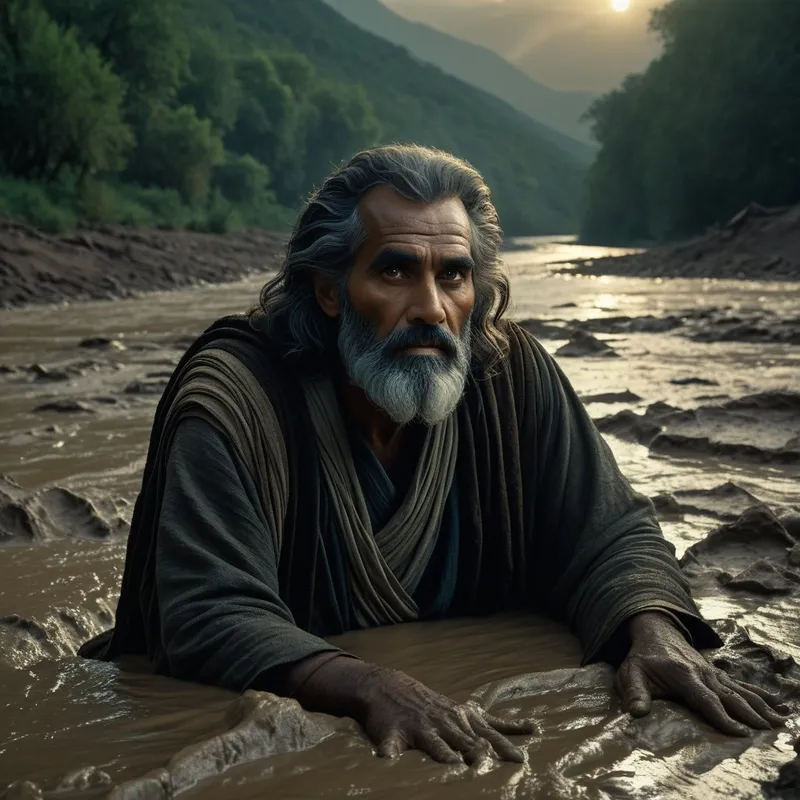
The air by the Kebar River was thick with the dust of exile and the salt of forgotten tears. It was here, in the thirtieth year, as the sun bled into the clay-brick horizon of a foreign land, that the heavens were torn open.
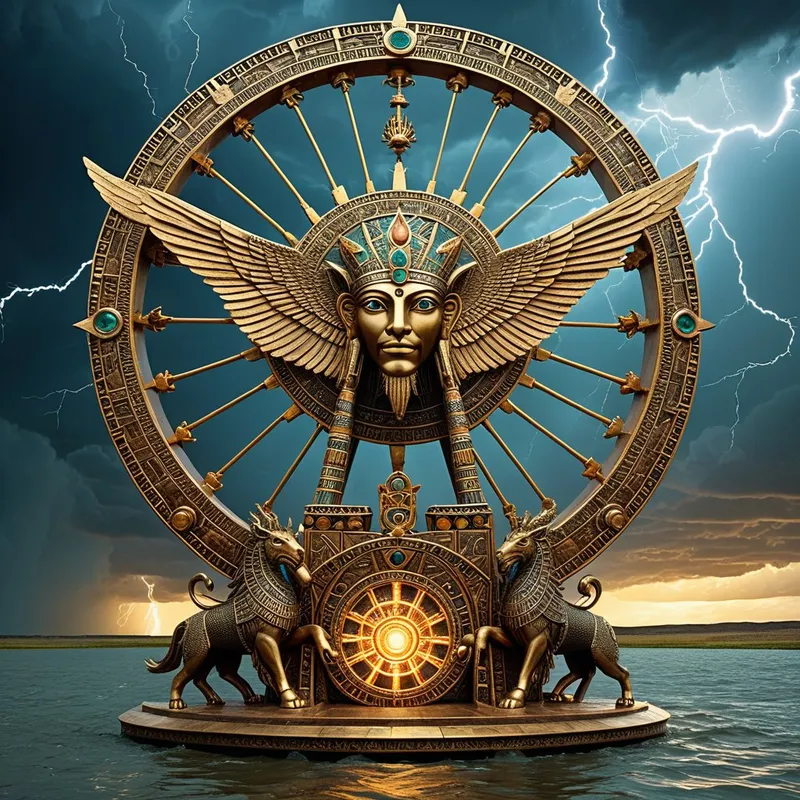
A wind came from the north, a great rushing storm cloud, and within it, a fire flashing continuously. And in the heart of the fire, there was something like gleaming amber. And from within it came the likeness of four living creatures. This was their appearance: they had the form of a human, but each had four faces, and each had four wings. Their legs were straight, and the soles of their feet were like the sole of a calf's foot, and they sparkled like burnished bronze. Under their wings on their four sides were human hands. And the faces: the face of a human in front, the face of a lion on the right side, the face of an ox on the left side, and the face of an eagle at the back. Their wings touched one another. They did not turn as they went; each went straight forward.
Wherever the spirit would go, they went, without turning. And in the midst of the living creatures there was something that looked like burning coals of fire, like torches moving to and fro among the creatures; the fire was bright, and lightning issued from the fire.
Now as I looked at the living creatures, I saw a wheel on the earth beside each of the four. The appearance of the wheels and their construction was like the gleam of beryl, and all four had the same likeness. Their construction being as it were a wheel within a wheel. When they moved, they went in any of their four directions without turning as they went. And their rims were tall and awesome, and the rims of all four were full of eyes all around.
When the living creatures went, the wheels went beside them; and when the living creatures rose from the earth, the wheels rose. Wherever the spirit would go, they went, and the wheels rose along with them, for the spirit of the living creatures was in the wheels.
Over the heads of the living creatures there was the likeness of an expanse, shining like awe-inspiring crystal, spread out above their heads. And above the expanse over their heads there was the likeness of a throne, in appearance like sapphire; and seated above the likeness of a throne was a likeness with a human appearance. And upward from what had the appearance of his waist I saw as it were gleaming metal, like the appearance of fire enclosed all around. Such was the appearance of the likeness of the glory of the YHWH.
When I saw it, I fell on my face, and I heard the voice of one speaking. And the voice said: "Son of man, stand on your feet, and I will speak with you."
Cultural Origins & Context
This vision is recorded in the Book of Ezekiel, a priest living in exile in Babylon following the destruction of Jerusalem in 586 BCE. The setting is critical: the myth emerges not from the secure center of a temple, but from the fractured periphery of displacement. Ezekiel and his people were grappling with a theological catastrophe—their God’s temple was destroyed, and they were subjects of a foreign empire. The function of this myth was not mere storytelling but radical theological reassurance and reorientation.
It was a priestly vision, told to a community in shock, asserting that the divine presence—the Kavod or "Glory"—was not confined to a geographical temple. It was mobile, terrifyingly alive, and present even in the land of their captors. The vision served to re-establish a cosmic order in a world where all human order had collapsed. It was a myth for survivors, a narrative technology designed to process collective trauma and reforge a sense of divine sovereignty that transcended national borders and human constructions.
Symbolic Architecture
The vision is a masterpiece of symbolic architecture, a psychic blueprint of a dynamic cosmos. The Chayot or "living creatures" represent the totality of animate creation—the human (intelligence), the lion (wild nobility), the ox (patient strength), and the eagle (transcendent vision). They are a unified, fourfold expression of life itself, moving in perfect, coordinated harmony.
The wheel within a wheel is the ultimate symbol of a multidimensional order, a machinery that operates in all directions at once, governed by a consciousness beyond spatial limitation.
The wheels themselves, full of eyes, signify omniscient perception and the self-regulating, intelligent motion of divine providence. They are not separate from the living creatures; their spirit is in the wheels, indicating that the natural world and the machinery of cosmic law are infused with the same animating spirit. The crystal expanse and the sapphire throne symbolize the firm, transparent boundary between the manifest world and the utterly transcendent, unrepresentable source—the Shekhinah giving way to the formless Ein Sof.
Psychologically, this is an image of the Self—the central, ordering principle of the psyche in Jungian terms. It depicts a psychic structure that is awe-inspiring, intelligent, multi-faceted, and in constant, purposeful motion, integrating all aspects of being (the four faces) into a coherent whole directed by a central, numinous core.
The Dreamer's Resonance
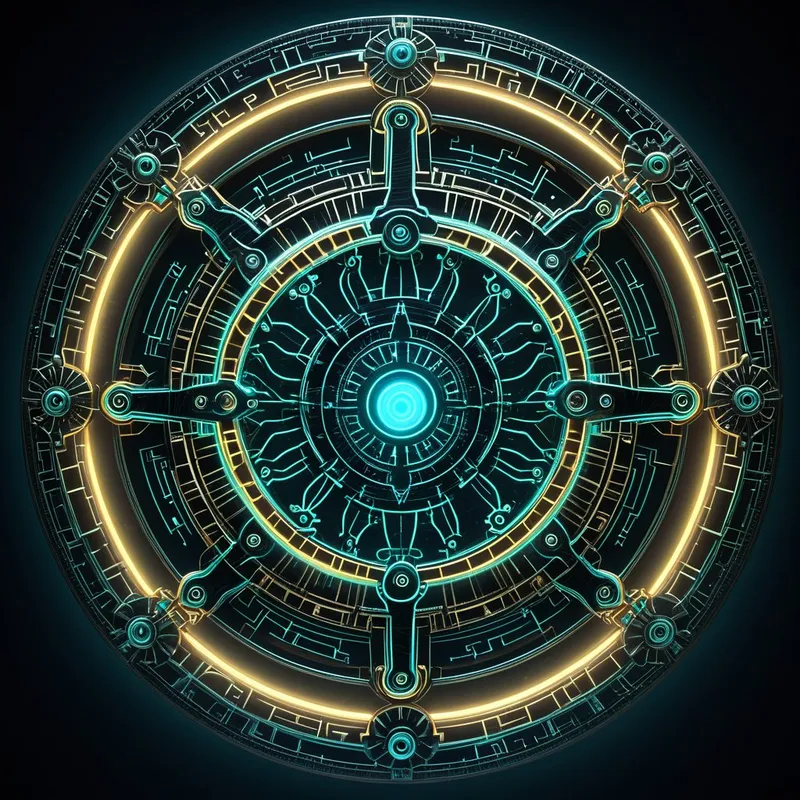
When this pattern erupts into modern dreams, it rarely appears as a biblical pastiche. Instead, the dreamer encounters a vast, incomprehensible, yet perfectly ordered machine—a galactic clockwork, an alien engine, or a silent, rotating mandala of impossible geometry. The somatic experience is key: a profound mixture of awe, dread, and fascination. One feels seen by the apparatus, as if every part of one's life is being observed and catalogued by those silent, spinning eyes.
This dream signals a moment of profound psychic reorganization. The conscious ego, accustomed to linear thinking and simple cause-and-effect, is being confronted by the non-linear, multi-dimensional intelligence of the unconscious Self. It often precedes or accompanies a life crisis where old structures (career, identity, relationships) have broken down. The Wheel announces that a larger, more complex order is at work beneath the apparent chaos. The dreamer is undergoing a process of being re-oriented by a center of gravity they did not know they possessed.
Alchemical Translation
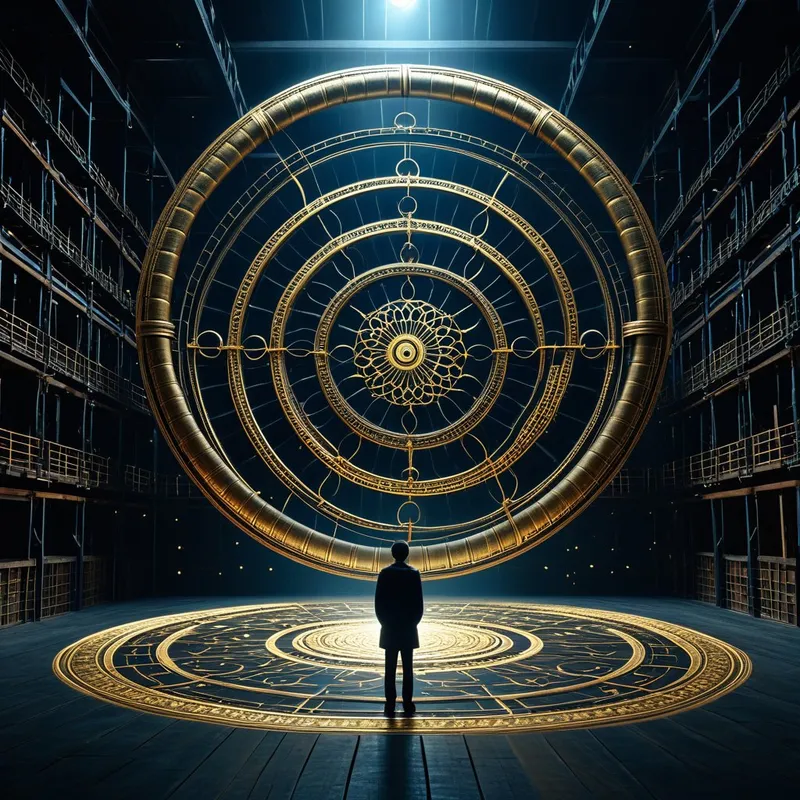
The alchemical process modeled here is the opus of confronting and integrating the numinous, terrifying aspect of the Self—what Jung called the "God-image" within the psyche. Ezekiel’s initial response is to fall on his face, a symbolic death of the ego’s pretensions. The command, "Son of man, stand on your feet, and I will speak with you," is the critical moment of transmutation.
The vision does not grant comfort; it grants orientation. The alchemical gold forged here is not happiness, but unshakable witness-consciousness—the ability to stand in the presence of the ultimate without being annihilated.
For the modern individual, the "Babylon" is any state of alienation, loss, or meaninglessness. The "Wheel" is the shocking, direct experience of a psychic reality so vast and intelligent it reorganizes one’s entire frame of reference. The process involves:
- Nigredo (The Blackening): The exile by the river, the state of despair and dislocation.
- Albedo (The Whitening): The blinding, clarifying vision itself—the revelation of the hidden structure.
- Rubedo (The Reddening): The command to stand and receive the word, integrating this awe into a new, grounded purpose.
The triumph is not control over the Wheel, but the humble, steady courage to perceive its motion, to recognize oneself as a conscious participant in a living, eyed, and endlessly turning cosmos. One becomes, like Ezekiel, a vessel for the message that emerges from the whirlwind: that order is not static, but a dynamic, terrifying, and beautiful journey.
Associated Symbols
Explore related symbols from the CaleaDream lexicon: