Etugen Eeke Earth Mother Myth Meaning & Symbolism
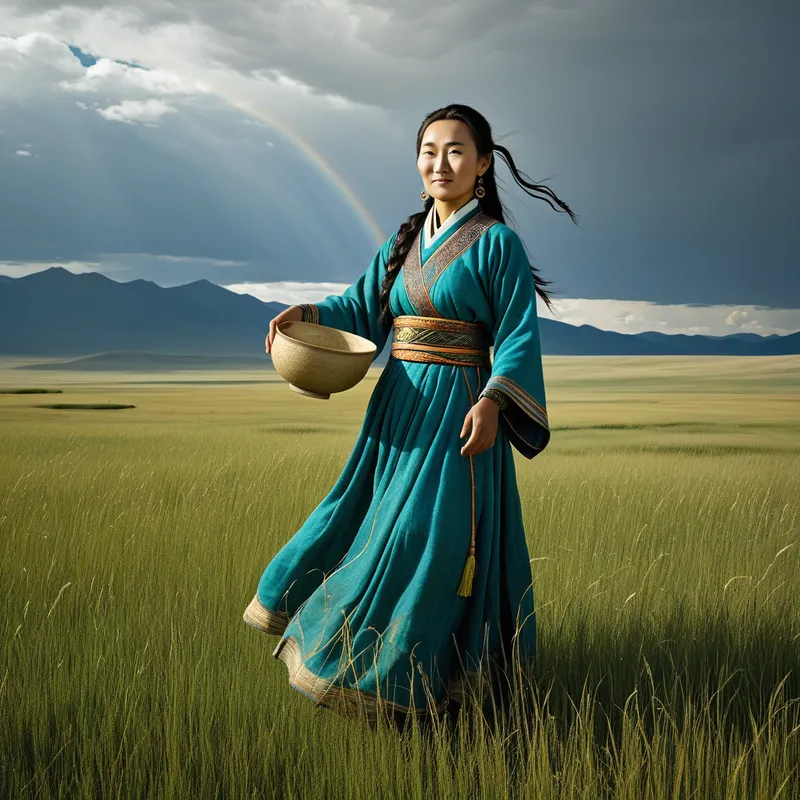
The ancient, enduring spirit of the Earth itself, a foundational goddess of fertility, stability, and the sacred bond between all living things and the land.
The Tale of Etugen Eeke Earth Mother
Before the first horse was tamed and the first ger was raised against the endless sky, there was the Breath and the Bone. The Breath was the Tengri, vast, masculine, and distant, father of light and storm. The Bone was the Earth, silent, deep, and waiting.
But the Earth was not mere stone. In the profound darkness beneath the roots of the saxaul trees and the frozen crust of winter lakes, a presence stirred. She was not born; she was. She was the softness of the riverbank where the first calf would drink. She was the iron grip of the mountain that cradled the eagle's nest. She was the yielding steppe that would someday sigh under the hooves of ten thousand horses. She was Etugen Eeke.
The world above was a chaos of elements. The winds of Tengri scoured the rock without purpose. Rivers, fatherless, ran to nowhere. Life was a shudder, a fleeting spark in the cold. It was Etugen who, from her deep dreaming, felt the first absence—not a lack of things, but a lack of connection. The sky did not know the land. The water did not cherish the soil.
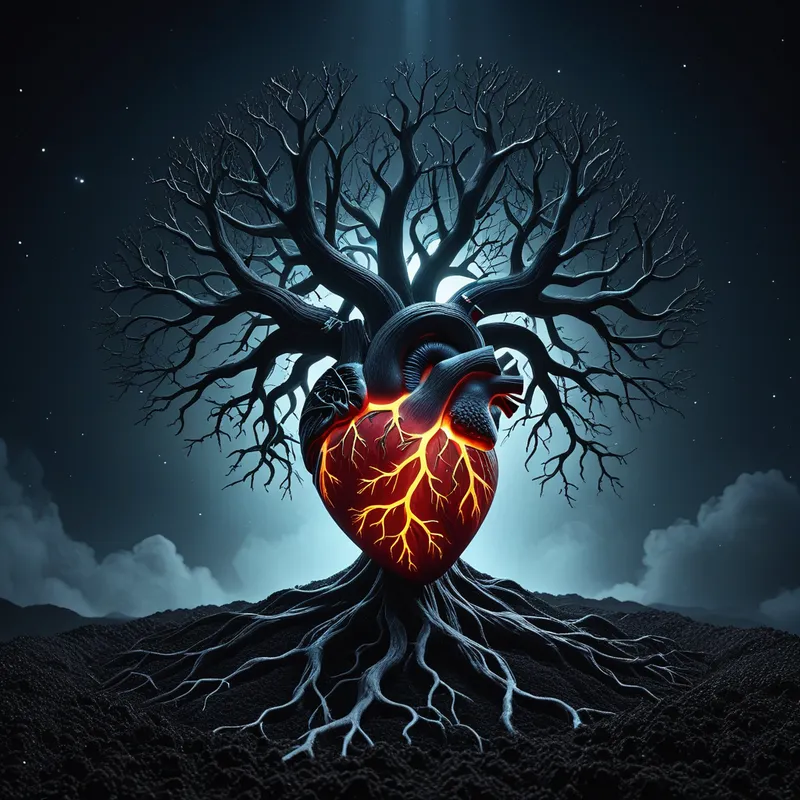
So she drew the first breath from within herself, not upwards to the sky, but outwards, across her own vast body. Where her breath touched, moss crept over stone. Where it pooled, springs bubbled forth, not as orphans, but as children. She offered her own substance, and from it sprouted the Tree, its roots knitting her bones together, its branches a bridge to the sighing winds above.
But a spirit of pure earth is heavy. Creation required a marriage. The myth whispers of a great courtship, not of conquest, but of necessity. The fiery Lightning of Tengri, impatient and brilliant, struck the high places. It could only scorch. The gentle Rain of Tengri, soft and weeping, fell upon the flat stones. It could only run away.
Etugen Eeke, in her deep wisdom, knew the shape of the vessel needed to hold them. She opened herself—not in weakness, but in profound invitation. She formed the valleys to catch the rain, the porous rock to drink it deep. She raised the mountains to meet the lightning, grounding its fury into fertile ore. In her embrace, the celestial forces were transformed. The scorch became warmth in her soil. The runoff became River in her veins.
From this union, the first green fire of grass ignited on the steppe. Animals emerged from her caves and burrows, their spirits shaped from her patience and their vitality from the sky's gift. Humanity, last and most fragile, was molded from her dark clay and animated by a spark of the celestial wind. Etugen did not command them. She sustained them. Her body was their home, her cycles their law, her quiet strength their foundation. She asked for no temples, only awareness. No grand sacrifices, only respect. A spilled cup of milk, a whispered prayer of thanks, the careful return of what was taken—these were the threads that kept the sacred bond whole.
Cultural Origins & Context
The veneration of Etugen Eeke is rooted in the ancient, pre-Buddhist shamanic worldview of the Mongolian and broader Turco-Mongolic peoples. This was an animistic universe, where every mountain, river, and forest possessed a spirit (ejen). Etugen represented the totality of these spirits—the unified, conscious soul of the land itself.
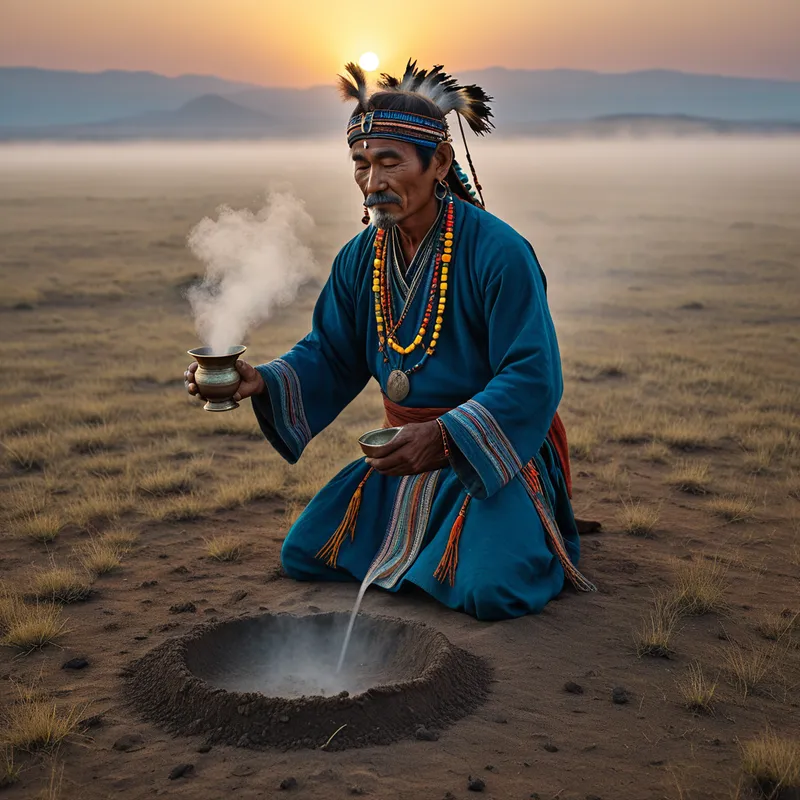
Her stories were not written in books but inscribed in ritual and daily life. They were passed down by böö and elders around the hearth fire. Her myth was enacted every time a nomadic group chose a new campsite, seeking her favor and permission. It was recalled in prohibitions against digging the earth unnecessarily or polluting water sources, actions seen as wounding the Mother. During ceremonies, libations of milk, airag (fermented mare's milk), or tea were poured onto the ground as direct offerings to her. She was the ultimate ejen of the homeland, the psychic and physical ground of existence for a people whose identity was inseparable from the landscape.
Symbolic Architecture
Etugen Eeke is not a goddess on the earth; she is the earthly dimension of being. Psychologically, she represents the archetypal ground of the psyche—the unconscious itself in its nourishing, containing, and foundational aspect.
The Earth Mother does not speak in words, but in the language of growth and decay, of pressure forming diamonds, and of roots finding water in the dark.
She symbolizes the container. Where Tengri represents spirit, consciousness, and transcendent order, Etugen is immanence, matter, and the chaotic, fertile ground from which consciousness springs. She is the somatic self—the feeling, instinctual, and embodied experience often neglected by a sky-bound intellect. The myth of her union with the sky forces is a blueprint for psychic wholeness: spirit must be grounded to be effective, and matter must be inspirited to be alive. Without her, the lightning of insight burns out without effect; the rain of emotion floods without purpose. She is the necessary vessel that translates potential into life.

The Dreamer's Resonance
When the pattern of Etugen Eeke stirs in the modern dreamer, it often signals a profound need for grounding and reconnection to the instinctual self. This may manifest somatically as dreams of falling into rich, dark soil without fear, of drinking deeply from an earthy spring, or of feeling roots grow from one's own feet into the ground.
Psychologically, these dreams surface during times of fragmentation, excessive intellectualization, or "living in the head." The psyche is seeking its own Etugen—a return to the foundational, feeling layer of being. One might dream of a neglected, parched garden (the barren inner landscape) suddenly receiving rain, or of discovering a hidden, warm Cave in a hillside. These are images of the psyche healing itself by re-establishing contact with the nourishing, non-verbal, and patient depths. It is the process of coming home to one's own body and emotional truth.
Alchemical Translation
The individuation process, the alchemical journey toward wholeness, requires the creation of the vas. Etugen Eeke is that vessel. The modern individual's "sky" might be their ambitions, ideologies, or spiritual aspirations—potent but ungrounded. The "earth" is their physical health, their emotional reality, their ancestral history, their relationship with nature.
The alchemical work is not to flee the earth for the sky, but to become the fertile plain where the lightning of revelation can strike and be transformed into nourishing grain.
The myth models this transmutation. First, one must acknowledge the Earth—attend to the body, honor feelings, connect with nature. This is the libation poured onto the soil. Then, one must invite the marriage—allow lofty ideas to be tested in the reality of lived experience, let spiritual insights be digested through somatic practice. This is the rain being drunk by the valley, the lightning grounded by the mountain. The result is not a rejection of spirit, but the creation of something new and sustainable: a personality rooted in reality, where spirit and matter, consciousness and the unconscious, are in sacred dialogue. The individual becomes their own sacred landscape, both the recipient of grace and the ground of its manifestation.
Associated Symbols
Explore related symbols from the CaleaDream lexicon:
- Mother — The ultimate nourishing, containing, and generative principle, representing the source of all physical life and unconditional sustenance.
- Earth — The literal and symbolic ground of being, representing stability, fertility, the body, and the material realm from which all growth emerges.
- Mountain — The enduring, stable aspect of the Earth Mother, representing groundedness, wisdom, and a sacred meeting place between earth and sky.
- River — The lifeblood of Etugen Eeke, symbolizing the flow of nourishment, emotion, and the cyclical, sustaining energies within the psyche and the land.
- Tree — The living bridge between the earthly realm of Etugen and the celestial realm of Tengri, symbolizing connection, growth, and the axis of the world.
- Cave — The womb of the Earth Mother, a place of deep introspection, primal safety, and connection to the dark, fertile origins of the unconscious.
- Hearth — The domesticated, human-scale center of the Earth Mother's warmth and nourishment, representing home, family, and the ritual focus of gratitude.
- Vessel — The core symbol of Etugen as the container that holds, transforms, and gives form to chaotic potential, be it water, spirit, or life itself.
- Root — The hidden, anchoring connection to the foundational ground, representing stability, ancestry, and drawing nourishment from the deep unconscious.
- Seed — The latent potential held within the body of the Earth Mother, representing new beginnings, possibilities, and the promise of future growth awaiting its season.
- Healing — The intrinsic quality of the Earth Mother, who mends wounds through time, cycles, and the restorative power of the natural world.
- Stone — The ancient, enduring bone-structure of Etugen, representing permanence, memory, and the slow, patient wisdom of the earth.