Esther the Queen Myth Meaning & Symbolism
A hidden queen reveals her true self to save her people, transforming personal risk into collective salvation through wisdom and courage.
The Tale of Esther the Queen
Listen, and hear a tale woven not in the open sun, but in the shadowed corridors of power, a story where destiny hangs by a thread of silence.
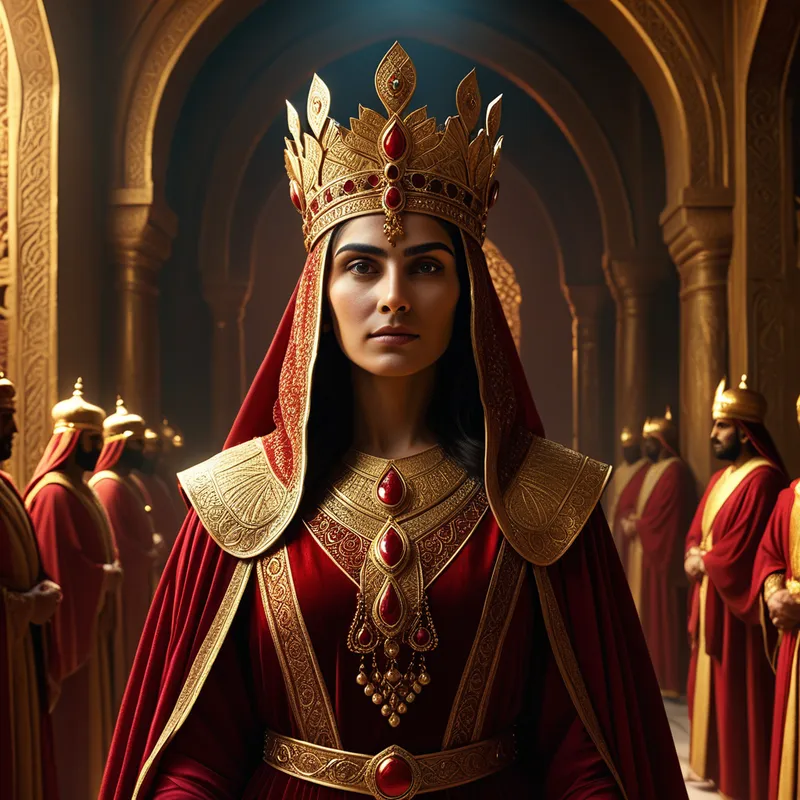
In the vast, perfumed empire of Ahasuerus, a wind of vanity blows. The king, in his pride, deposes one queen and seeks another from the most beautiful maidens in the land. Among them is Hadassah, an orphan of the exiled Judean people, raised by her wise cousin Mordecai. He instructs her to conceal her people and her lineage, to speak only her Persian name: Esther. Grace and wisdom rest upon her, and the king’s heart is captured. He places the royal crown upon her head, and she becomes queen in the palace of Shushan.
But a shadow grows in the court. The Agagite Haman, elevated by the king, demands all bow before him. Mordecai, sitting at the king’s gate, refuses. A cold, consuming rage fills Haman. It is not enough to punish one man; he devises a final solution. Casting lots—Purim—to choose a day, he convinces the king to decree the annihilation of all of Mordecai’s people, their goods to be plundered. The decree is sealed with the king’s ring and dispatched to every province. Mourning and sackcloth spread among the Jews.
Mordecai comes to the queen’s gates, clothed in ashes and lamentation. He sends word: “Do not think that in the king’s palace you will escape any more than all the other Jews. For if you keep silent at this time, relief and deliverance will rise from another place, but you and your father’s house will perish. And who knows whether you have not come to the kingdom for such a time as this?”
The words strike Esther’s heart like a hammer on metal. The law is clear: to approach the king unsummoned is death, unless he extends the golden scepter. She has been hidden, protected, silent. Now, her hiddenness becomes her prison. She sends her reply: “Gather all the Jews… and hold a fast on my behalf… I and my young women will also fast. Then I will go to the king, though it is against the law, and if I perish, I perish.”
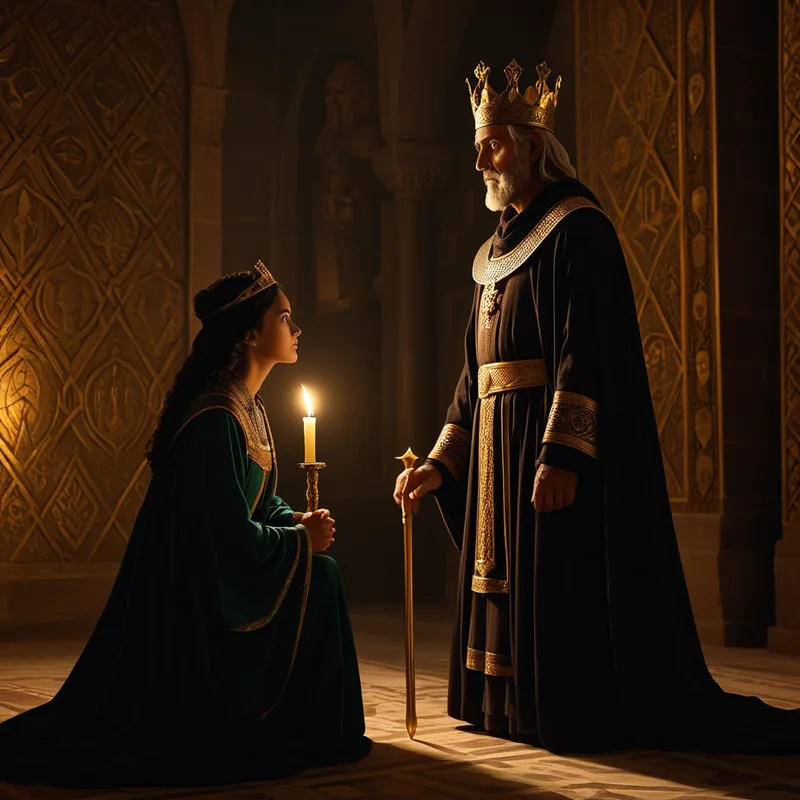
For three days, the fast holds the community in a collective breath. Then, Esther robes herself not in mourning, but in her royal majesty. She stands in the inner court. The king, upon his throne, looks up. A moment stretches into eternity. Then, he extends the golden scepter. Life. “What is your request?” he asks. “Even to the half of my kingdom, it shall be given.”
But Esther does not unveil her plea. She invites the king and Haman to a banquet. There, she invites them again to another banquet the next day. Haman swells with pride, yet is infuriated by Mordecai’s enduring defiance. He erects a towering gallows for him.
That night, the king cannot sleep. The chronicles are read to him, revealing how Mordecai once uncovered an assassination plot. “What honor has been bestowed on him?” the king asks. Nothing. At that moment, Haman enters to seek permission to hang Mordecai. The king asks, “What should be done for the man the king delights to honor?” Thinking himself the man, Haman describes a lavish public parade. “Do so,” commands the king, “for Mordecai the Jew.” Haman is forced to lead his enemy through the streets in glory.
At the second banquet, the wine is poured. The king asks again for Esther’s request. This is the moment. The veil drops. “Let my life be given me as my wish, and my people as my request. For we have been sold, I and my people, to be destroyed.” The king is aghast. “Who is he? Where is he?” Esther’s finger points, her voice clear as a bell. “A foe and enemy! This wicked Haman!”
Terror seizes Haman. The king, in fury, storms into the garden. Haman falls upon Esther’s couch to beg for mercy. The king returns and misinterprets the scene as an assault. “Will he even assault the queen in my presence?” The sentence is swift. Haman is hanged on the very gallows he built for Mordecai. The king’s ring, once used for destruction, is given to Mordecai and Esther. A new decree is written, allowing the Jews to defend themselves. On the appointed day, the shadow of death is turned back. Mourning becomes feasting, terror becomes joy, and the festival of Purim is born from the ashes of averted doom.
Cultural Origins & Context
The Scroll of Esther (Megillat Esther) is a unique text within the Hebrew canon. It is the only biblical book that does not explicitly mention YHWH. This conspicuous absence is not an accident but the story’s central theological tension: it presents a world where divine action is utterly hidden, operating solely through human courage, chance, and the intricate weaving of circumstance. The story is set in the Persian diaspora following the Babylonian exile, a period where Jewish identity was maintained not in the Temple of Jerusalem, but in foreign courts and communities under constant threat of assimilation or persecution.
Passed down and ritually chanted during the raucous, carnivalesque festival of Purim, its societal function is multifaceted. It is a myth of survival, a reassurance that even when God seems absent, providence works through the brave choices of individuals. The public reading, where listeners drown out the name of Haman with noise (graggers), serves as a cathartic, communal defiance of historical oppression. It legitimizes life in the diaspora, teaching that one can be both Esther (assimilated in the palace) and Mordecai (faithful at the gate), and that wisdom lies in knowing when to hide and when to reveal one’s true self for the sake of the collective.
Symbolic Architecture
The myth is a masterclass in the symbolism of concealed identity and fateful timing. Esther herself is the ultimate symbol of the Shadow made conscious and potent. She begins as Hadassah (myrtle, a plant associated with the righteous), hidden behind the Persian mask of Esther. Her entire power derives from this duality; her hidden Jewishness is not a weakness but a latent strength that must be activated at the precise moment.
The most profound courage is not born in the blaze of certainty, but in the terrifying silence between the fast and the feast, when the soul must gamble its hidden truth against the world’s decree.
The Haman archetype represents the inflating, paranoid ego that seeks to annihilate any reflection that does not bow to it (Mordecai’s refusal). His casting of Pur (lots) symbolizes a belief in blind, mechanistic fate. The story’s genius is showing how this very device of “chance” becomes the pivot upon which his own destruction turns, revealing a deeper, hidden order. The Golden Scepter is the threshold object, the slender bridge between certain death and sovereign agency. To approach it is the ultimate risk, requiring the queen to shed the safety of her role and stand, utterly exposed, as her authentic self.
The Dreamer's Resonance
When this myth stirs in the modern psyche, it often manifests in dreams of hidden identities, forbidden thresholds, and urgent, time-sensitive missions. You may dream of being in a grand, opulent building (the palace) where you must keep a vital secret, feeling both powerful and isolated. The somatic sensation is often one of constriction in the chest or throat—the held breath of the unspoken truth.
Dreams of Esther signal a psychological process where a long-concealed aspect of the self—a talent, a trauma, a heritage, a true feeling—has reached a point of critical mass. The “Haman” in the dream may be an internalized voice of shame, a domineering authority figure, or a systemic oppression that demands you annihilate this part of yourself. The dream presents the crucial, non-negotiable choice: to remain silent and safe but complicit in your own soul’s destruction, or to “approach the king”—to risk vulnerability, rejection, or loss in order to speak your truth and claim your full sovereignty. The fasting period in the myth translates to the dreamer’s necessary withdrawal for inner preparation, gathering the psychic resources for the revelation to come.
Alchemical Translation
The alchemical journey of Esther is the opus of Individuation in a hostile environment. It begins with the nigredo: the blackening, the decree of annihilation, the mourning and sackcloth. This is the crushing pressure that forces the hidden content (the prima materia of one’s true identity) to the surface.
The albedo, the whitening, is Esther’s three-day fast—a purification, a conscious withdrawal from external roles to consult the inner council (the self and the community). Here, the ego aligns with the deeper Self (“for such a time as this”). The critical operation is the rubedo, the reddening or royal act: robing oneself in purpose and stepping across the fatal threshold. This is the moment of psychic transmutation where fear is not eliminated but integrated, and the persona (the Queen) is fused with the authentic shadow (Hadassah the Jew).
The alchemical gold forged in Esther’s story is not personal glory, but the creation of a vessel—the festival of Purim—that can hold and transform collective trauma into celebratory memory. The individual’s courage becomes the community’s salvation.
The final stage is circulatio, the circulation. Mordecai, the steadfast inner guardian, is honored. Haman, the inflating, destructive complex, is hanged on its own petard (its own rigid structure). The king’s ring, the seal of power, changes hands. The psyche is re-ordered. What was once a law of death (the first decree) is transmuted into a law of self-preservation and joyful life (the second decree). The individual who completes this process no longer lives in hiddenness or reaction, but from a place of integrated, sovereign authority, capable of turning the instruments of threat into tools of liberation.
Associated Symbols
Explore related symbols from the CaleaDream lexicon:
- Mask — The dual identity of Esther/Hadassah, representing the necessary persona for survival and the potent power that resides in what is consciously concealed and later revealed.
- Queen — The sovereign feminine principle that must risk everything to enact justice and protection, moving from a position of ornamental power to authentic, life-saving authority.
- Queen's Crown — The symbol of attained status and role, which becomes both a shield and a responsibility, compelling the wearer to act for a purpose greater than their own safety.
- Key — Esther’s courage, which unlocks the sealed decree of fate and opens a door to deliverance, representing the pivotal choice that changes a seemingly fixed destiny.
- Shadow — The hidden Jewish identity of Esther and the repressed Mordecai, representing the vital, powerful aspects of the self that are denied but hold the key to salvation.
- Fate — The casting of the Pur (lots) by Haman, representing a superficial, mechanistic view of destiny that is overturned by the deeper, purposeful unfolding orchestrated by courage and wisdom.
- Sacrifice — Esther’s willingness to perish (“if I perish, I perish”), representing the ultimate gamble of the ego, offering its safety for the potential of the Self’s fulfillment.
- Light — The deliverance and joy that emerges from the shadow of annihilation, celebrated in the festival of Purim, symbolizing consciousness triumphing over the darkness of decree and despair.
- Door — The inner court of the king, the fatal threshold Esther must cross, representing the liminal space between the old life of concealment and the new life of integrated truth.
- Blood — The threatened annihilation of a people, representing the deepest collective trauma and the vital life-force that must be defended through courageous action.
- Feast — The banquets of Esther and the subsequent celebration of Purim, representing the transformation of anxiety into communion, and terror into joyful, life-affirming ritual.