Erzulie Freda Myth Meaning & Symbolism
The story of the divine, radiant spirit of love, beauty, and luxury, whose insatiable heart reveals the paradox of desire and the cost of perfection.
The Tale of Erzulie Freda
Listen, and let the scent of roses and the sound of distant, elegant music carry you. There is a spirit who lives where the air is perfumed and the fabrics are silk. Her name is Erzulie Freda, and she is the very essence of love’s most exquisite promise.
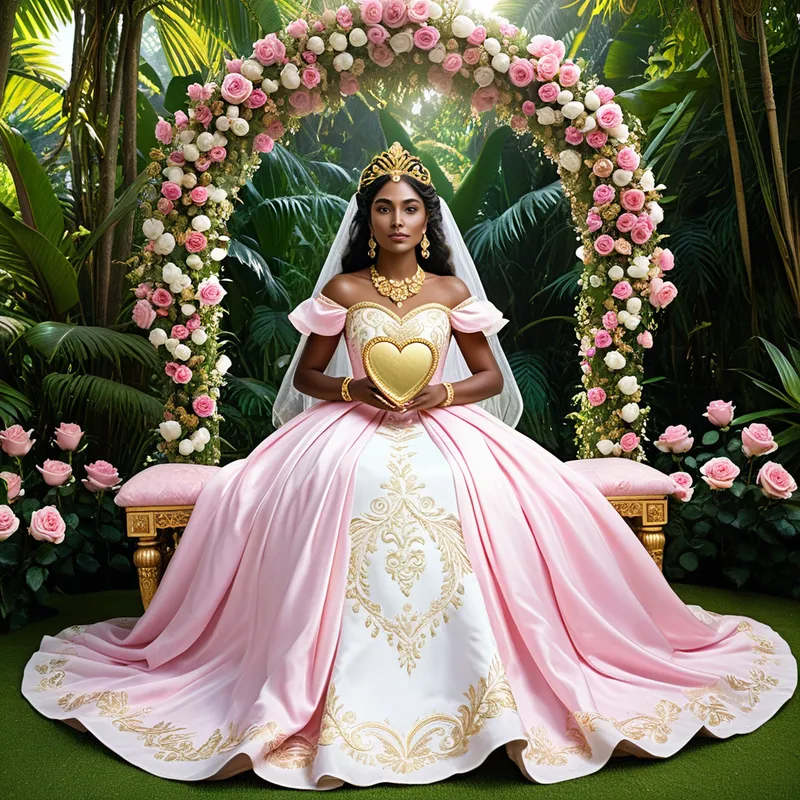
She arrives not with thunder, but with the gentle rustle of taffeta and the soft chime of gold bracelets. Her skin is the color of dawn-lit mahogany, her eyes hold the depth of twilight, and her gowns are of pink satin, white lace, and pearls. She is the patron of the ballroom, the protector of the boudoir, the divine witness to every whispered promise and every trembling first touch. To be in her presence is to know the intoxicating possibility of being adored without condition, of being seen as the most beautiful, the most worthy.
Yet, within her perfect, rose-scented heart lies a divine contradiction—an ocean of longing that can never be filled. For Erzulie Freda is married to three great spirits: to Agwé, the lord of the vast, untamable sea; to Ogoun, the fierce and fiery warrior; and to Baron Samedi, the master of the crossroads and the grave. Each husband represents a facet of existence—the deep, the strong, the final—yet none can be with her always. None can fulfill the totality of her infinite need.
So, she descends to her children, her devotees. She arrives in ceremonies with tears of joy streaming down her cheeks, showering them with affection, dancing with sublime grace. She demands the finest perfumes, the sweetest cakes, the most delicate liqueurs. She bestows gifts of romance and artistic inspiration. But her visits always end the same way. As the drums fade and the hour grows late, a profound sorrow overtakes her. The radiant smile falters. She weeps, great heaving sobs of a loneliness that transcends the world. She looks at her hands, adorned with the three wedding rings of her divine husbands, and feels the aching absence of all three. With a heartbroken sigh, she departs, leaving behind the scent of roses and a silence filled with the echo of perfect, impossible love.
Cultural Origins & Context
The myth of Erzulie Freda is a profound creation of the African Diaspora, specifically born in the crucible of colonial Saint-Domingue, which became Haiti. Her roots are syncretic, a powerful alchemy of West and Central African spiritual traditions—honoring goddesses of rivers, beauty, and love from the Fon, Yoruba, and Kongo peoples—forged in the fires of the transatlantic experience.
She is a spirit of the Rada nation, considered "cool" and sweet-tempered, yet her story carries the heat of profound historical reality. In a society built on brutal enslavement, where Black women's bodies and affections were commodified and violated, Erzulie Freda emerged as a divine assertion of autonomy, luxury, and romantic choice. She is not a mother or a laborer; she is the ultimate lady, the unattainable ideal, who commands respect, adoration, and the finest things—a radical reclamation of softness, beauty, and emotional complexity in a world designed to deny them.
Her myth is not found in a single sacred text but is lived and told through ritual, song, and possession-performance. Her story is passed down by houngans and mambos, and embodied by devotees when she "mounts" them, speaking through their bodies. Societally, she functions as a mirror and a vessel. She reflects the human yearning for perfect love and beauty, while also holding the community's understanding of love's inherent tragedies, its costs, and its sublime, often painful, demands.
Symbolic Architecture
Erzulie Freda is not merely a goddess of romance. She is the archetypal embodiment of the Anima in its most refined and demanding form—the inner image of captivating beauty, feeling, and relatedness within the human psyche. Her three marriages symbolize the psyche's attempt to wed this ideal of love to the fundamental pillars of existence: the deep unconscious (Agwé), the willful ego and action (Ogoun), and the reality of limits and mortality (Baron Samedi).
The heart that seeks to contain the infinite is destined to know the shape of its own boundaries through the ache of absence.
Her insatiable longing represents the human condition of desire itself—a force that propels creation, connection, and art, but which, in its absolute form, is impossible to satisfy in the material world. The rings are symbols of commitment, but also of bondage to an ideal. Her tears are not weakness; they are the necessary catharsis, the recognition that the dream and the reality can never fully align. She symbolizes the exquisite pain of consciousness itself, which can imagine a perfect union, a perfect beauty, a perfect love, yet must live in a fragmented, imperfect world.
The Dreamer's Resonance
To dream of Erzulie Freda is to encounter one's own capacity for deep feeling, idealized love, and refined aesthetic sensibility. But it is also to confront its shadow: the hunger that devours, the jealousy that poisons, the depression that follows ecstasy.
Such dreams may manifest as finding oneself in an overwhelmingly beautiful but empty mansion, searching for a beloved who is never in the room. One might receive lavish gifts that feel hollow, or see a reflection in a mirror that is dazzlingly perfect yet strangely cold. Somatically, the dreamer may awaken with a tightness in the chest—the physical echo of heartache—or a lingering sense of exquisite sadness. Psychologically, this dream pattern signals a process of reconciling one's inner ideal of love and beauty with the flawed, human reality of relationships and self-image. It asks: Where am I demanding perfection, in myself or others, at the cost of real connection? What part of my heart remains perpetually unsatisfied, and what ancient wound does that mirror?
Alchemical Translation
The individuation journey modeled by Erzulie Freda is not about attaining her idealized state, but about integrating her lesson. It is the alchemy of transforming naive, insatiable longing into conscious, creative love.
The first stage is Invitation: we are seduced by the ideal—the perfect partner, the flawless creative vision, the impeccable self. This is necessary; it draws us out of stagnation. The second is Consummation and Crisis: we attempt to live the ideal, only to discover its inherent lack, its tragic ending. Like Freda at the end of the ceremony, we face the tears. This crisis is the crucial fire. The third stage is Transmutation: we do not abandon love or beauty, but we stop asking the finite world to provide the infinite. The energy of ideal love is withdrawn from its impossible external projections and redirected inward, to cultivate self-respect, self-adornment, and self-love that is not narcissistic but foundational.
The gold is not in the possession of the perfect beloved, but in the capacity to hold the imperfect world—and the imperfect self—with a heart that has known the dream and chosen the real.
We learn to wear our own "three rings"—integrating our depths (Agwé), our strength (Ogoun), and our mortality (Baron)—not as absent husbands, but as accepted parts of our own being. The final gift of Erzulie Freda is not endless romance, but the grace to love from a heart that is whole because it has been honestly, beautifully broken.
Associated Symbols
Explore related symbols from the CaleaDream lexicon:
- Love — The central force Erzulie Freda embodies, representing both its sublime, connecting power and its potential for insatiable, heartbreaking longing.
- Heart — The symbolic seat of her power and her suffering, representing the capacity for deep feeling, vulnerability, and the ache of unfulfilled desire.
- Mirror — Represents self-reflection, vanity, and the search for perfect beauty, as well as the painful gap between one's ideal self-image and reality.
- Goddess — Erzulie Freda as a divine archetype, embodying the transcendent aspects of love, beauty, and the feminine principle in its sovereign form.
- Sacrifice — The inherent cost of her nature; the sacrifice of peace for passion, of contentment for the endless pursuit of an ideal.
- Tears — The cathartic release of her sorrow, symbolizing the necessary grief that accompanies deep feeling and the acceptance of life's limitations.
- Gold — Represents her association with luxury, refinement, and the highest value, but also the cold, heavy weight of perfection.
- Rose — The flower most sacred to her, symbolizing love, beauty, and passion, but also the thorns of jealousy and heartbreak.
- Ocean — Connected to her husband Agwé, it symbolizes the deep, unconscious, and emotional depths that underlie her surface beauty.
- Ring — Symbol of eternal commitment and union, but in her case, also of binding obligation and the simultaneous presence and absence of her loves.
- Shadow — The hidden aspect of her radiance: the jealousy, possessiveness, and profound melancholy that are inseparable from her capacity for love.
- Dream — Her entire domain exists in the realm of the ideal, the aspirational, and the emotionally resonant space between reality and fantasy.