Elven Cloaks of Lothlórien Myth Meaning & Symbolism
A tale of elven weavers who craft cloaks from twilight and memory, granting wearers the power to walk unseen through the world's peril and beauty.
The Tale of Elven Cloaks of Lothlórien
Listen now, by the hearth-fire’s glow, to a whisper from the twilight woods where the world is older and the air is thick with memory. This is not a tale of thunderous gods, but of subtle craft, of the quiet power that dwells in the spaces between the leaves.
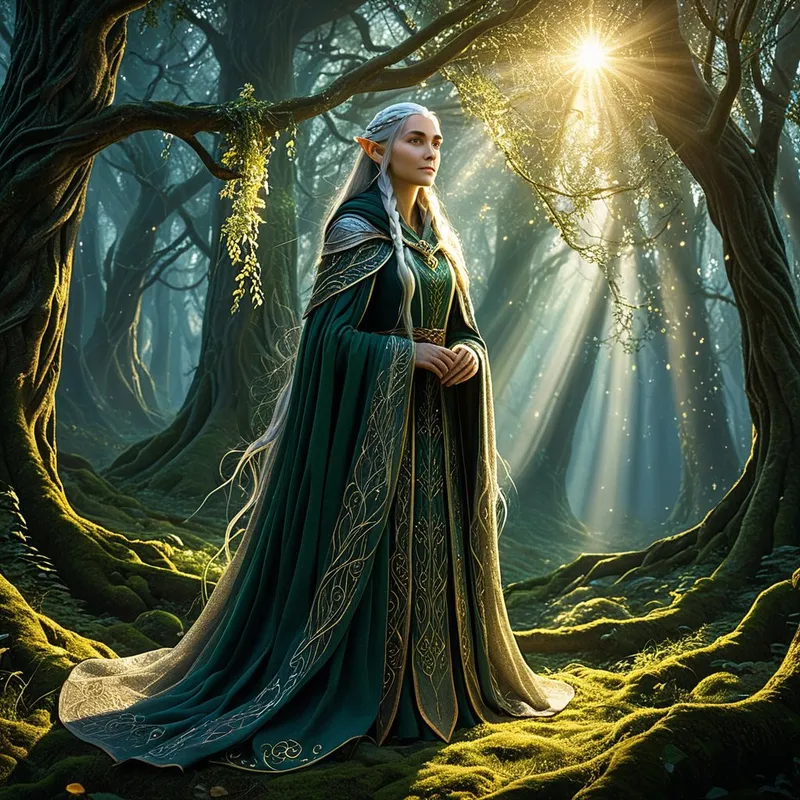
In the heart of the great forest of Lothlórien, where the mallorn trees wear silver bark and their leaves are gold not of greed, but of captured sunlight, the Elven-folk dwelt. They were the Sindar, the Grey-elves, whose eyes had seen the light of the stars before the moon was wrought. Their queen was the Lady Galadriel, who held a basin of silver water that showed things that were, and things that yet might be. Their lord was Celeborn, whose voice was the sound of the wind in the high branches.
But the tale sings not of them first, but of the weavers. In clearings where the sun fell in dappled pools, they worked not with loud looms, but with a silence that was itself a thread. They gathered the grey mist of dawn as it clung to spider-webs. They carded the soft shadows that pooled beneath holly bushes. They spun the fading green of evening and the deep brown of fertile earth. Their shuttles were carved from fallen branches, and their pattern was the pattern of the forest itself—the interlace of branch and vine, the secret runes that dew writes on a leaf.
The need for such craft arose from the Shadow. From the dark tower of Dol Guldur, across the river, crept eyes that were not eyes—a searching malice, a will to devour all things fair and free. The forest, though guarded by the power of the Elven-ring, was not impervious. Orcs with black blood slithered beneath its boughs. Spies with hearts of stone listened at its borders.
Then came the Fellowship, nine walkers on a desperate road, bearing a burden that would scorch the soul. They were exposed, a ripple of discord in the forest’s harmony. The Lady, seeing their hearts in her mirror, knew their path led into deeper shadow than any wood. And so she gifted them. Not swords of shining steel, nor helms of terrible aspect. She gave them cloaks.
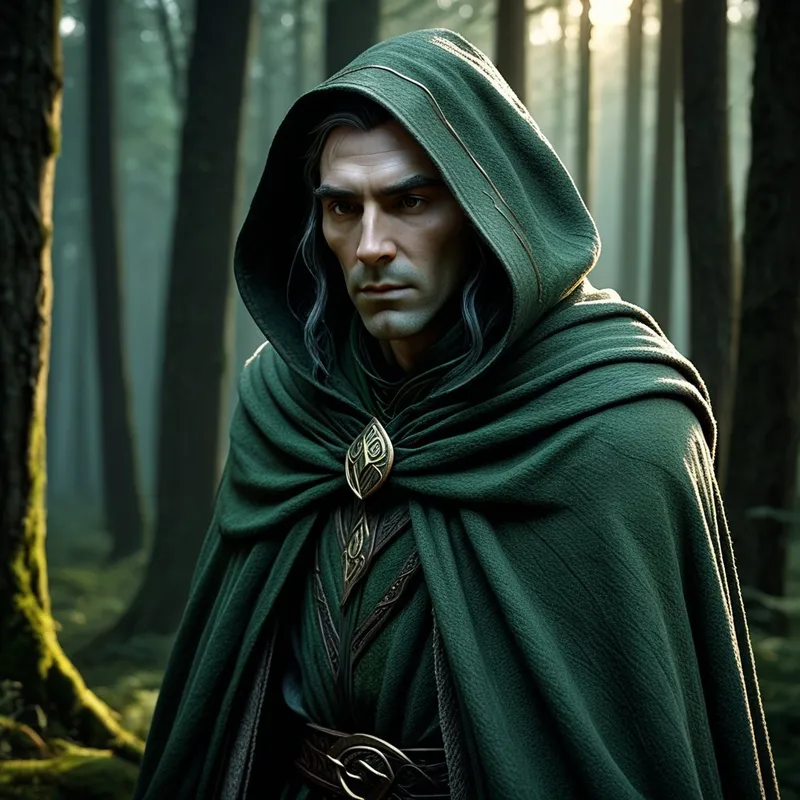
The weavers brought them forth, and they seemed but simple grey cloth, hooded and long. But as each traveler—the stout Dwarf, the earnest Hobbit, the grim Man—drew one about their shoulders, a change came. The grey became the color of twilight under trees, of stone in a stream, of a cloud against a hillside. It did not hide them, but wove them into the tapestry of the world. To a searching eye, they became a root, a rock, a trick of the light. The cloak was a shell of perceived reality, a gift of un-being to the hostile gaze.
And with the cloak came a brooch, a leaf-shaped clasp of silver that was both a fastener and a seal. It was a token of the Sindar, a sign that the wearer walked, for a time, under the protection of that which does not dominate, but enfolds. So clad, the Fellowship passed out from the golden wood and into the grim lands beyond, carrying with them not just a garment, but a piece of the forest’s soul—a whispered promise that even in the land of shadow, one need not be fully seen.
Cultural Origins & Context
While the specific narrative of the Cloaks of Lothlórien originates in the 20th-century synthesis of J.R.R. Tolkien, its roots are deeply embedded in the soil of Norse and Celtic lore. Tolkien, a renowned philologist, constructed his legendarium as a "mythology for England," consciously drawing from the Northern European tradition he studied. The cloak as a magical artifact of concealment and protection is a potent motif in these cultures.
In Celtic mythology, the fé or magic mist often used by the Tuatha Dé Danann to shroud their fortresses or themselves is a direct precursor. It is a glamour, an enchantment of perception. Similarly, many Celtic heroes possess cloaks of invisibility or camouflage, such as those occasionally associated with figures in the Welsh Mabinogion. The cloak is an extension of the Otherworldly power to exist between realms, to be present yet unseen by the mortal eye.
The Norse tradition offers parallels in the concept of ørlög and the shaping of reality. The dwarven masters of craft in the Dvergatal are famed for creating items of profound power, often imbued with specific, subtle magics. The act of gifting such an item, as Galadriel does, is also deeply Norse/Celtic; it creates a bond of reciprocity and obligation (do ut des—"I give so that you may give"). The cloak is not merely a tool, but a sacred trust, a piece of the giver’s power lent to the receiver for a purpose. It was a myth told not in grand halls of kings, but in the quieter spaces—by firesides, in forest clearings—a story that explained how the subtle, defensive wisdom of the natural and supernatural world could be accessed by those on a righteous, if desperate, path.
Symbolic Architecture
The Elven Cloak is a masterful symbol of the psyche’s adaptive and protective mechanisms. It represents not brute force, but intelligent integration.
The cloak does not deny the shadow; it weaves the wearer into the landscape of the shadow, changing the terms of engagement from confrontation to fluid passage.
Firstly, it symbolizes conscious camouflage. This is not the cowardice of hiding, but the wisdom of strategic non-disclosure. In a world—or a psyche—filled with predatory "eyes" (hostile judgments, corrosive anxieties, external pressures), to fully expose one’s raw, unformed self is to invite attack. The cloak is the persona, not as a false face, but as a skilled presentation of self that is both true and protective, blending one’s essence with the environment.
Secondly, it embodies the gift of grounded perception. The cloak is made of the forest itself. To wear it is to be reminded that one is part of a larger, living system (Yggdrasil, the ecosystem of the psyche). It counters the isolation of the ego. The leaf-shaped brooch is crucial here—it is the symbol that anchors the adaptive garment. It is the core value, the true identity (the "leaf" of the individual tree) that remains constant even as the protective coloring shifts.
Finally, it represents grace under pressure. The cloaks are not earned through trial; they are bestowed. They symbolize those moments of insight, resilience, or creative adaptation that seem to come from beyond the conscious ego—from the deeper, wiser Self (the Galadriel within). It is the psyche’s innate ability to provide exactly the resource needed for the next stage of the journey.
The Dreamer's Resonance
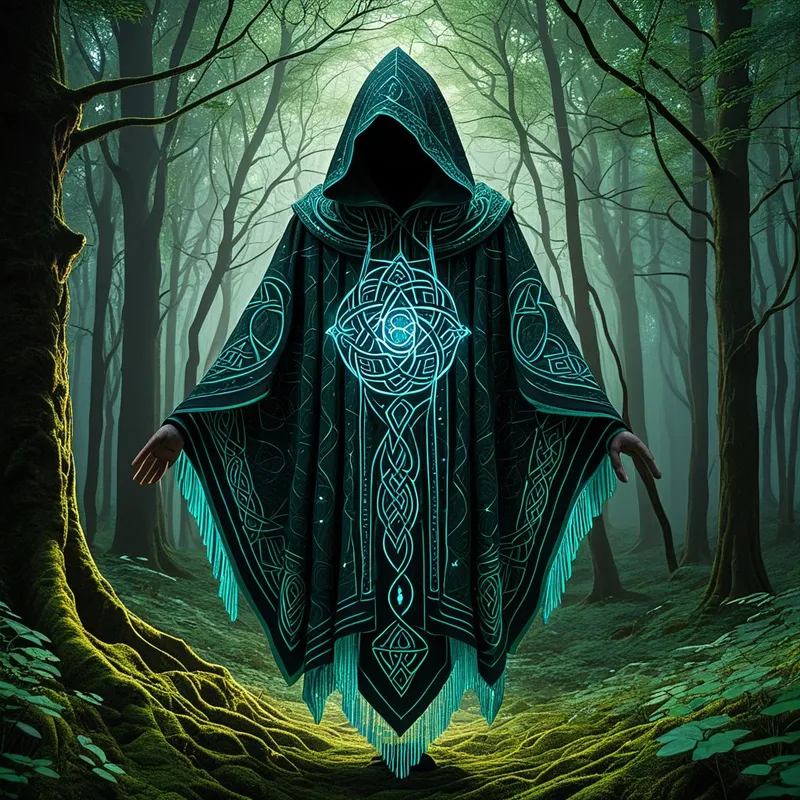
When the motif of the Elven Cloak appears in modern dreams, it signals a critical phase of psychological navigation. The dreamer is likely in a situation—externally or internally—that feels perilously exposing.
To dream of receiving such a cloak suggests the unconscious is offering a solution to a feeling of vulnerability. The somatic sensation might be one of relief, a sudden lightness or a warming cover where there was cold exposure. It indicates the dreamer is ready to accept a more nuanced, adaptive way of being in a challenging environment, perhaps in a toxic workplace or a fraught family dynamic. The psyche is crafting a "cloak" of professional demeanor, emotional boundaries, or strategic silence.
To dream of wearing the cloak and finding it ineffective is a stark warning. The feeling is of panic, of being seen despite one's best defenses. This points to a situation where the adaptive persona has failed, or where the threat has penetrated to a core level that cannot be camouflaged. The work here is not to weave a better cloak, but to examine the nature of the "eyes" that see so piercingly—often, they are one’s own inner critic or a deeply internalized fear.
Dreaming of weaving the cloak is a powerful sign of active individuation. The dreamer is not passively receiving protection but consciously engaging in the creation of their own adaptive capacities. This is the work of therapy, journaling, or artistic expression—actively gathering the threads of one’s experience (the greys, the shadows, the flashes of insight) to craft a more resilient way of moving through the world.
Alchemical Translation
The journey of the Fellowship through Lothlórien and their receipt of the cloaks is a perfect allegory for a stage in the alchemical process of individuation: the phase of dissolution followed by coagulation, but here in a uniquely protective form.
The Fellowship enters the wood in a state of nigredo—blackening. They are traumatized, lost, and burdened by the Ring (the ultimate symbol of the inflating, corrupting shadow). Lothlórien represents the temenos, the sacred enclosure of the therapeutic vessel or the safe inner space. Here, under the mirror-gaze of the Self (Galadriel), they are seen, their burdens acknowledged. This is the dissolution of their old, battered identities as mere fugitives.
The gift of the cloak is the coagulatio—but not into a fixed, hardened form. It is a coagulation into a fluid, intelligent form. This is the alchemy of the subtle body.
The goal is not to become invulnerable stone, but to become like water wearing the color of the sky and the riverbed—present, essential, yet impossible to grasp or define.
For the modern individual, this translates to the process of developing psychological fluidity. One does not overcome the "Orcs" of anxiety or the "shadow of Dol Guldur" of depression by direct, head-on battle while fully exposed. This often leads to exhaustion and defeat. Instead, the alchemical work is to retreat to the inner Lothlórien—through meditation, nature, creative work—and there, with the help of the guiding Self, weave a new way of being.
This "cloak" is a synthesized attitude. It is the ability to hold one’s core truth (the silver leaf brooch) while allowing one’s expression and interaction with the world to be adaptive, context-sensitive, and protective. It is the transmutation of raw, wounded vulnerability into guarded strength. The individual learns to walk through the dark woods of life not as a glaring target, but as a integrated part of the landscape, carrying the light of their purpose hidden within the grey folds of skillful means. The journey continues, the burden remains, but one is no longer walking naked in the land of shadow.
Associated Symbols
Explore related symbols from the CaleaDream lexicon: