
The Dream Theme of Concealment: Unearthing the Buried Archive
The Somatic Echo
Before the image forms, the body knows. It is a specific gravity, a density in the chest that feels less like a weight and more like a sealed chamber. The breath becomes shallow, cautious, as if drawing too deeply might disturb something resting just beneath the sternum. There is a clenching in the jaw, a subtle armoring of the shoulders—not against an external threat, but as a containment field for an internal one. The hands may feel restless, wanting to both hide and uncover. This is the somatic signature of concealment: a physiological paradox of protection and imprisonment. It is the body holding a secret it was never meant to keep, a living vault for an experience, a memory, or a potential self that has been deemed too volatile, too tender, or too powerful to see the light of day.
The Dreamer's Log
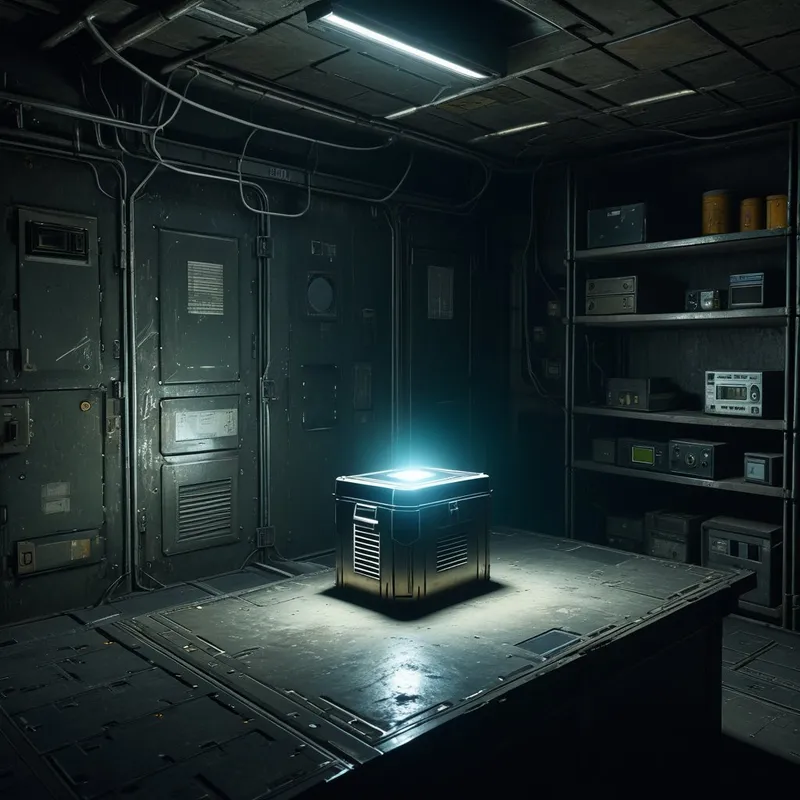
I am in a derelict archive, a place of endless, identical grey corridors. I know, with absolute certainty, that I have hidden something vital here—a small, unmarked box. The panic isn't about someone else finding it; it's that I can no longer remember what's inside, or even which corridor holds the door. The air hums with the low frequency of forgotten machines.
This dream is the psyche’s alchemical report: the conscious self has successfully compartmentalized a core piece of data, but at the cost of severing its own connection to a vital source of energy and identity.
The False Lead
Concealment is not mere secrecy or simple privacy. Privacy is a conscious boundary, a door you can open at will. Concealment is a forgotten room behind a wall you yourself plastered over. It is also not a sign of inherent deceit or moral failing. To mistake it for such is to blame the vault for the treasure it was forced to hold. The terror in these dreams is not of exposure to others, but of re-exposure to the self. The grief is not for a lost object, but for the part of you that went into exile with it.
Psychological Architecture
Here, Shadow work is not a battle but an archaeology of the interior. The process of individuation—becoming a whole, self-aware individual—requires reintegrating these concealed aspects. Think of your psyche not as a single self, but as an internal family system. The part of you that made the executive decision to hide that box was likely a Protector, a managerial self that operates on an old logic: This pain, this desire, this memory is too much for the system to handle. Bury it. Label the file corrupted. Seal the chamber.
The concealed material is then an Exile—a fragment of experience frozen in time, holding raw emotion, unmet need, or unexpressed potential. The dream of the forgotten archive is the Exile’s signal, growing stronger. It is not knocking down the door; it is causing a faint, persistent power drain on the entire network, a hum in the walls of your life. The work is to respectfully negotiate with the Protector, to update its firmware with a new truth: The system is now capable of processing what it once could not. The goal is not to violently unearth, but to carefully exhume, to bring the Exile home with witness and compassion, thus transforming the entire internal structure from a regime of secrecy to an ecosystem of conscious acknowledgment.
Mythic Resonance
This theme pulses in the heart of the myth of Inanna’s Descent. The Queen of Heaven must pass through seven gates to reach the underworld, and at each, a piece of her regalia—her crown, her lapis beads, her royal robe—is stripped away. She arrives naked and bowed before her sister, Ereshkigal, and is killed. This is the ultimate concealment: the hiding of the sovereign self, piece by piece, until nothing of the surface identity remains. The return journey, requiring helpers and negotiation, speaks to the slow, assisted process of reclaiming those concealed aspects. We also see it in the story of Psyche, whose final, impossible task is to retrieve a box of beauty cream from the underworld with the strict warning never to open it. She does, of course, and is plunged into a deathlike sleep—a metaphor for the unconsciousness that occurs when we prematurely open a concealed chamber without the inner stability to integrate its contents. The myth instructs us: the act of revealing must be timed, and it requires the intervention of a more transcendent love (Eros) to awaken and integrate what is found.
Symbolic Nodes
- Hidden compartments, false-bottom drawers, sealed rooms behind bookcases.
- Objects wrapped in cloth, buried in earth, or locked in unmarked boxes.
- Masks, veils, uniforms, or costumes that obscure the face or form.
- Dense fog, murky water, or impenetrable shadows that limit vision.
- Forgotten basements, locked attics, abandoned bunkers—spaces within the dream structure itself.
- Encrypted files, corrupted data, passwords on the tip of the tongue.
- Muted sounds, swallowed words, or conversations heard through thick glass.
Archetypal Resonance
The energy of Concealment most powerfully resonates with The Shadow Ruler.
The Ruler archetype governs order, structure, and sovereignty. In its shadow aspect, this drive for control curdles into a tyranny of the internal landscape. The Shadow Ruler does not lead; it censors. It does not organize; it compartmentalizes. It declares entire territories of the self "off-limits" or "unstable" and walls them off to maintain a fragile, superficial order. The somatic echo of clenched containment is its decree. The alchemical potential lies in the Shadow Ruler's profound, if misapplied, strength: its ability to manage complex systems. The task is not to depose it, but to reform it—to upgrade its mandate from "conceal and control" to "integrate and govern wisely." In doing so, the raw, exiled material is not a threat to the kingdom, but a reclaimed resource that strengthens the sovereign's true authority.
The Alchemical Process
The alchemical stage corresponding to concealment is Mortificatio—the blackening, the dissolution, the facing of the nigredo. This is not an external fire, but an internal pressure, the heat of which is generated by the friction between who you present yourself to be and who you actually are. The concealed material exerts a gravitational pull, creating a low-grade, persistent anxiety—the "hum in the archive."
The transmutation begins when you stop trying to silence the hum and instead sit in the corridor and listen. The pressure builds as you consciously hold the tension between the Protector's fear ("It will destroy everything") and the Exile's longing ("I must be known"). This is the crucible. The solve (dissolving) occurs as you allow old, rigid identities—"I am someone who would never feel/need/remember that"—to soften. The coagula (re-forming) is the slow, careful act of rewriting your inner narrative to include the recovered truth. The leaden terror of exposure is transmuted into the golden sovereignty of wholeness. You are no longer a keeper of secrets; you become the author of your complete story.
The Integration Protocol
Question 1: Where in my waking life do I feel that same somatic echo—the shallow breath, the armored chest—as if I am passively guarding a boundary I didn't consciously choose?
Question 2: If the concealed thing in my dream were not a threat, but a lost resource, what quality (e.g., fierce protection, wild creativity, deep grief) might it contain?
Question 3: What old, internal law—what "rule for survival"—did my psyche write that made concealment the only safe option at the time?
Action 1 (Somatic Mapping): For one week, carry a small notebook. When you feel that familiar "concealment clench" in your body, pause. Do not analyze. Simply note the time, the context, and draw a simple outline of a body, shading exactly where you feel the sensation. Look only for the pattern of location, not the cause.
Action 2 (Unaddressed Correspondence): Set a timer for 15 minutes. Write a letter from the perspective of the place where the thing is hidden (the archive, the box, the fog). Let it describe what it's like to hold this secret. What does it feel? What does it hear from the concealed thing? Do not write as the thing itself, only as its container. This externalizes the Protector's role.
Action 3 (Ritual of Acknowledgment): Find a small stone or natural object. Holding it, consciously project into it the energy of that concealed, exiled part—not the story, but the core quality (e.g., "this stone holds my unexpressed rage"). Take it to a crossroads—a literal path intersection, a stream, or even a significant potted plant. Bury it or place it there, stating aloud: "I acknowledge you. I am building a home within me worthy of your return." This ritualizes the update to your internal governance.
Final Validation
To dream of concealment is to touch one of the most profound and lonely human experiences: the self hiding from the self. It is a testament to past survival, a scar-tissue of the psyche that once served as sanctuary. To feel its weight is not a failure, but evidence of a deepening integrity—your wholeness is now strong enough to sense its own missing pieces. The path forward is not a frantic excavation, but a gradual, respectful thawing of a long winter. You are not uncovering a crime scene; you are recovering a lost embassy of your own soul. The light you bring to that forgotten corridor does not expose; it welcomes. And in that welcome, the vault becomes a sanctuary once more, not for what must be hidden, but for what is finally, safely, home.