Ekur Sacred Mountain House
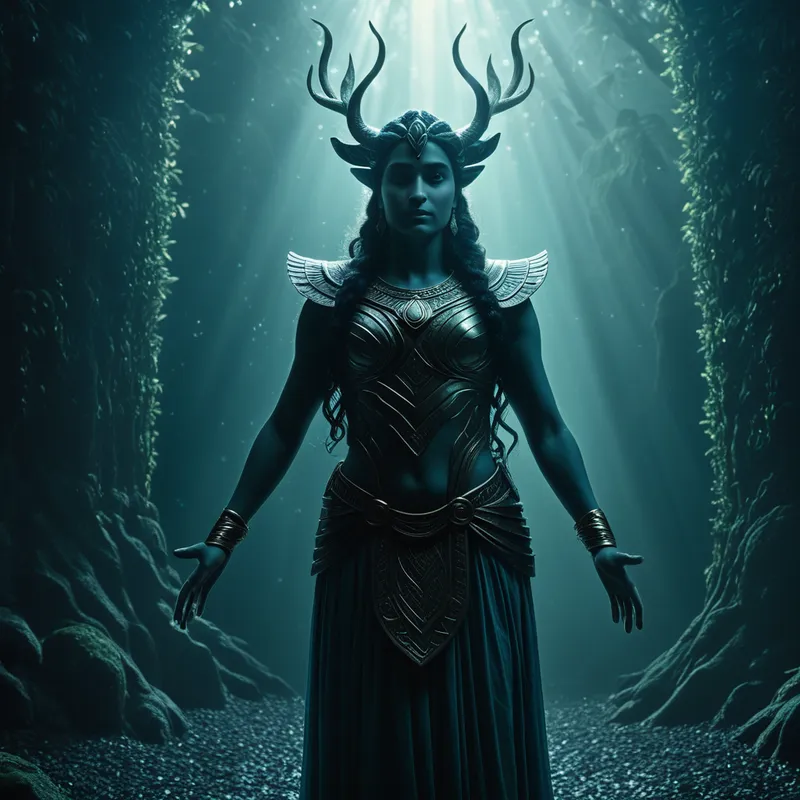
The Ekur was the sacred mountain dwelling of Sumerian deities, representing divine authority and the cosmic center of the universe in Mesopotamian mythology.
The Tale of Ekur Sacred Mountain House
In the beginning, when the world was still being shaped from the watery abyss of Nammu, the gods sought a place of assembly, a seat from which to govern the newly ordered cosmos. It was Enlil, the lord of the storm and breath, who took up this sacred task. With a word that split the heavens and a breath that stirred the deep, he summoned the earth to rise. Not as a wild, untamed peak, but as a great, deliberate mound—a cosmic pillar connecting the realms of the divine An and the earthly Ki.
This was Ekur, the “Mountain House.” Its foundations were laid in the underworld, its summit piercing the vault of the sky. Here, in its shadowed halls and luminous courts, the divine assembly, the Anunnaki, would gather. The air within thrummed with the me, the fundamental decrees and essences of civilization—kingship, the arts of the scribe, the craft of the builder, the laws that bind society. Ekur was not merely Enlil’s dwelling; it was the beating heart of cosmic administration, the axis where divine will crystallized into worldly order.
The myth tells of a time when the mountain’s integrity was challenged. The hero-god Enki, lord of the subterranean waters and cunning intelligence, grew restless. Perhaps he coveted the power concentrated there, or perhaps he sought to test the foundations of Enlil’s authority. In a great act of defiance, Enki commanded his servant, the monster Asag, to attack. The sacred mountain trembled; its gates shook. But Ekur, imbued with the authority of its master, stood firm. Enlil’s word proved mightier than the chaotic waters, and order was preserved. The mountain house was revealed not as a passive fortress, but as an active embodiment of sovereign power, capable of repelling the forces of dissolution.
To approach Ekur was to approach the divine source of all legitimacy. Kings of Sumer, from Lugalzagesi to the mighty rulers of Akkad, derived their right to rule from Enlil’s favor, symbolized by their intimate connection to his mountain house. They were but stewards of the power that emanated from that cosmic peak.
Cultural Origins & Context
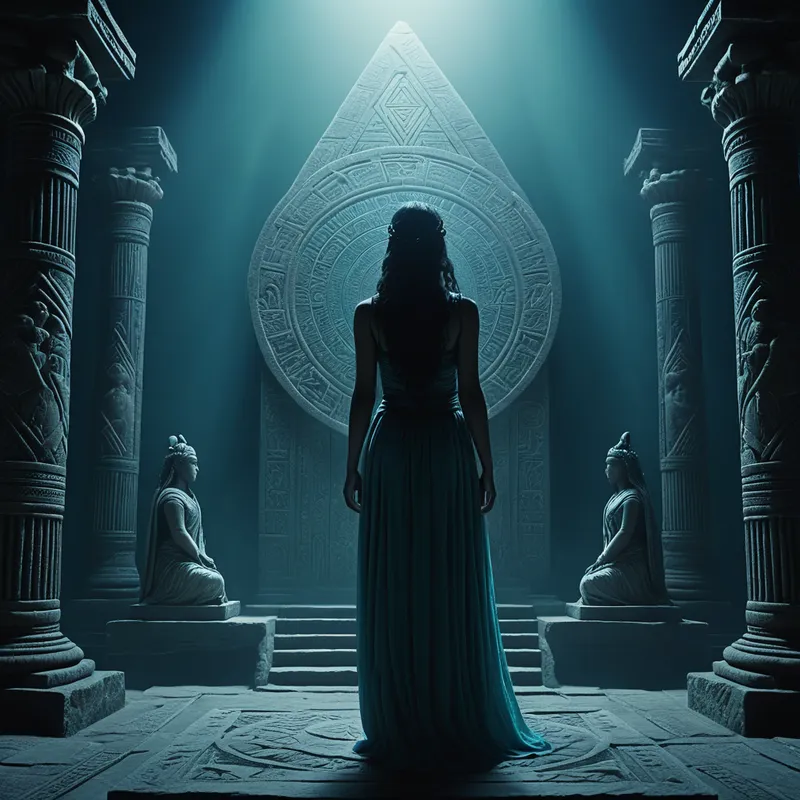
The Ekur was the central theological and political concept of early Sumerian city-states, particularly Nippur, Enlil’s cult city. Unlike the ziggurats of later periods, which were human-built stairways to heaven, the Ekur was first and foremost a divine, primordial reality—a mythic archetype that preceded and inspired all earthly architecture. Its name itself, “House which is like a Mountain,” reveals its dual nature: it is both domicile and geologic feature, a meeting point of the domesticated (house) and the elemental (mountain).
In a land defined by the flat, fertile alluvium between the Tigris and Euphrates, the mountain held profound symbolic weight. It represented the visible edge of the known world, the source of life-giving rivers and precious stones, and the feared origin of storms. By claiming the mountain as the divine abode, Sumerian theology located the source of cosmic order in the most potent and enduring feature of their geographical imagination. The Ekur was the ultimate “there,” the fixed point around which the chaos of the world could be organized.
This concept provided the metaphysical backbone for kingship. The king was not a god, but the “tenant farmer” of the god, entrusted with the administration of the god’s estate (the world). His legitimacy flowed directly from Enlil’s decree, issued from the Ekur. Thus, the stability of the state was mythically rooted in the stability of the cosmic mountain. To rebel against the king was to rebel against the divine order emanating from the Mountain House, an act with cosmic repercussions.
Symbolic Architecture
The architecture of Ekur is an architecture of consciousness, built from the materials of separation, hierarchy, and centralization. It is the psychic structure that establishes a “center” and a “periphery,” a place where decisions are made that ripple outward to shape reality.
The Mountain House is the archetypal seat of judgment. It is not where things grow, but where things are decided. Its halls echo with the decrees—the me—that define the boundaries between culture and chaos, justice and transgression.
Its foundations in the underworld connect it to the ancestral and the chthonic, the deep, often unconscious, sources of law and tradition. Its summit in the heavens links it to the realm of pure principle and celestial order. The structure itself is a conduit, a vertical axis (axis mundi) that allows communication and the transfer of authority between these realms. The “house” aspect signifies interiority, a sacred, enclosed space where the private deliberations of the gods occur before their public manifestations as natural and social laws.
This symbolic architecture manifests in the human psyche as the faculty of discernment and the internalization of authority. It is the psychic “seat” from which the ego, ideally in service to a higher principle (the Self), administers the inner kingdom. When this inner Ekur is strong and aligned, one experiences a sense of rightful authority and clear judgment. When it is attacked or undermined—by internal “Enki” forces of doubt, rebellion, or chaotic emotion—the entire inner world can tremble.
The Dreamer's Resonance
To encounter the Ekur in dream or active imagination is to engage with the very core of one’s personal sovereignty and place in the cosmic order. It is an encounter with the “inner Nippur,” the psychic location where ultimate authority resides.
Dreaming of approaching a vast, awe-inspiring mountain that is also a dwelling place may signal a call to confront the sources of authority in one’s life. Who or what “sits on the mountain” within you? Is it an internalized parent, a cultural dogma, or an authentic, inner connection to the divine? The dream may be inviting an audience with this inner ruler, a necessary step in psychological maturation. Conversely, dreaming of attacking such a mountain, or seeing it shaken, often reflects a period of inner rebellion, a crisis of faith in one’s guiding principles or life structure. The chaotic force of the abzu—the unconscious—may be rising to challenge a ruling attitude that has become too rigid or alienated from the depths.
The feeling-tone is critical. The Ekur should inspire a profound, humbling awe, a mysterium tremendum et fascinans. If it evokes only terror or crushing oppression, it may represent a tyrannical super-ego. If it feels trivial or accessible, it may indicate a lack of connection to any guiding transpersonal principle. The true Ekur mediates power; it does not merely dominate. Its resonance is one of formidable, but ultimately lawful, order.
Alchemical Translation
The alchemical process corresponding to the Ekur myth is coagulatio—the making solid, the precipitation of spirit into matter, or of chaotic potential into definite form. Enlil’s act of raising the mountain from the watery abyss is the primal coagulatio, the establishment of a fixed point in the flux.
The psychological operation is the crystallization of identity around a central, ruling principle. It is the moment when diffuse longing, talent, or insight “takes its seat” and becomes a governing faculty of the personality.
This is not a one-time event but a continual process. The challenge from Enki represents the necessary solutio—the return to the fluid state—that tests the integrity of the coagulated form. A ruling principle that cannot withstand the dissolving waters of doubt, critique, or the unconscious is mere dogma, not living authority. The alchemical goal is a “kingdom” (the integrated personality) ruled by a “sovereign” (the Self) whose authority is resilient because it has been tested and tempered by engagement with its opposites. The Ekur, therefore, is not a static fortress but a dynamic, living structure that undergoes its own cycles of stability and challenge, always in service to the greater order of the cosmos. To integrate Ekur is to take responsibility for the mountain of one’s own being, to become the steward of the divine decrees written in one’s own soul.
Associated Symbols
Explore related symbols from the CaleaDream lexicon:
- Mountain — The primordial axis of the world, representing stability, aspiration, and the enduring connection between heaven and earth.
- Temple — The human-built echo of the divine dwelling, a consecrated space where cosmic order is mirrored and maintained through ritual.
- Scepter of Authority — The tangible extension of sovereign will, a symbol of the legitimate power to command and judge that emanates from the sacred center.
- Thunder — The audible manifestation of Enlil’s voice and will, the terrifying and awe-inspiring sound of divine decree breaking into the human world.
- Stone — The foundational material of the mountain, representing permanence, law, and the unyielding ground of being.
- Door — The threshold of the Mountain House, the critical point of transition and decision between the outer world and the inner sanctum of power.
- Circle — The shape of divine jurisdiction, representing the totality of the cosmos administered from the central point of the Ekur.
- Order — The supreme principle embodied by the Ekur, the cosmic and social arrangement enforced by divine authority.
- Root — The hidden, chthonic foundations of the mountain, connecting its visible authority to the deep, ancestral, and unconscious sources of law.
- Crown — The symbol of enacted sovereignty, the earthly reflection of the authority that has its true source in the divine assembly upon the mountain.