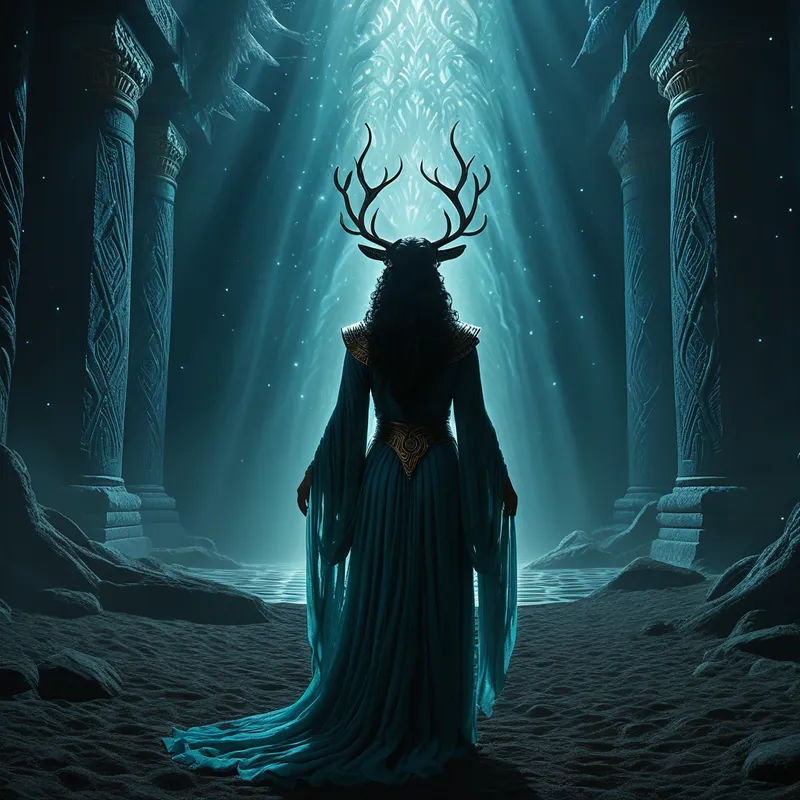
Eeyeekalduk Spirit of Medicine
An Inuit spirit embodying healing and medicine, Eeyeekalduk represents the sacred connection between physical wellness and spiritual harmony in Arctic traditions.
The Tale of Eeyeekalduk Spirit of Medicine
In the time when the ice first learned to sing and the great darkness of winter held the world in its long embrace, there lived a people who understood that illness was never merely a matter of the body. A sickness could begin as a whisper in the soul—a forgotten promise to an animal spirit, a crack in the harmony between person and place. Into this understanding was born, or perhaps always existed, the spirit known as Eeyeekalduk.
The tale is not one of epic battles or stolen suns, but of a profound and quiet presence. Eeyeekalduk did not dwell in a distant, glittering realm, but in the liminal spaces of the world: in the steam rising from a hot stone in the qaggiq (the communal snow house), in the last breath of warmth from a freshly killed seal, in the silent moment between a shaman’s chant and the community’s sigh. He was the bridge, the essential translator.
It is said that when a person fell ill, their inua—their personal spirit or life force—would become untethered, wandering the bleak landscapes of fear and cold. The physical body would weaken, a mere echo of its true self. The angakkuq (the shaman), in a state of deep trance, would undertake a perilous journey to the spirit world. Their task was not to fight, but to seek. And there, often at the threshold of the great unknown, they would encounter Eeyeekalduk.
He is described not with grandiose imagery, but with the clarity of necessity. Some say he appeared as an elder of immense calm, his parka made of light and shadow, his eyes holding the depth of a thawing polynya. Others felt his presence as a resonant hum, a vibration that realigned the disordered song of a life. The angakkuq would present the case—the symptoms of the flesh, the suspected spiritual transgression. Eeyeekalduk, in turn, would reveal the true nature of the ailment. The cure was never a simple herb or chant, but a restoration of relationship: a specific offering to Sedna, the mistress of sea beasts, for a sickness born of wasted seal parts; a song to be sung to the spirit of the wind for a child’s persistent cough; a amulet of carved bone to be worn to mend a rift with one’s own ancestral guide.
The healing was a pact. Eeyeekalduk provided the knowledge, the spiritual “medicine,” but the community enacted it. The patient, the angakkuq, and the family all participated in the prescribed ritual, weaving the spiritual remedy back into the fabric of their physical lives. Thus, Eeyeekalduk did not heal instead of people; he made healing possible through them, mending the tear between the seen and unseen worlds so life could flow freely once more.
Cultural Origins & Context
Eeyeekalduk emerges from the core existential reality of the Inuit worldview, where survival is an active, daily negotiation with a sentient and often unforgiving environment. In the Arctic, the margin between life and death is thin as a knife’s edge. A minor infection, a prolonged bout of bad weather, a failed hunt—each could mean extinction for an individual or a family group. In such a world, the concept of medicine could not be confined to pharmacology. Illness was a systemic failure, a sign that the delicate balance between the human community, the animal world (inue of the seal, caribou, bear), and the overarching forces of nature (the weather spirits, Sedna) had been disrupted.
The spirit of medicine, therefore, had to be a diplomat, a mediator, and a diagnostician of the soul. Eeyeekalduk’s role reflects the Inuit understanding of health as sila—a concept encompassing weather, the atmosphere, consciousness, and the universal order or breath of life. To be healthy was to be in right relationship with sila. Eeyeekalduk was the guardian of that relational truth. He belongs to the pantheon of helping spirits (tuurngait) that a skilled angakkuq could call upon, but his domain is uniquely holistic. He is not the spirit of a specific plant or animal, but of the process and principle of restoration itself.
His presence in mythology underscores that healing was, and is, a communal and spiritual responsibility. The angakkuq was the specialist, but the ritual—the singing, drumming, feasting, or crafting—required the collective. Eeyeekalduk’s “medicine” only became potent when the community reaffirmed its bonds and its respect for the world. In this sense, he is the spiritual embodiment of cultural resilience, the knowledge that survival depends on maintaining the sacred connections that sustain life.
Symbolic Architecture
Eeyeekalduk’s essence is architectural; he is a structure of connection in a cosmology where separation means death. He is not a deity to be worshipped from afar, but a functional principle made manifest.
He symbolizes the necessary third that emerges between any two fractured parts—between body and soul, human and spirit, error and atonement. He is the active ligament of reconciliation.
His symbolism is inherently liminal. He operates at thresholds: the threshold of the spirit world, the threshold of consciousness in trance, the threshold of life and death in illness. He is the embodiment of the passage itself, the critical moment of translation where a nonsensible spiritual cause is given a sensible, actionable form in the physical world. This makes him a spirit of profound communication, but not with words. His language is the language of resonance, of sympathetic vibration—the sick person’s inua and the healing ritual are tuned to the same frequency through his influence.
Furthermore, Eeyeekalduk represents the sacred logic of the cure. In a mechanistic view, a cure attacks a symptom. In Eeyeekalduk’s logic, the symptom is a message, and the cure is the appropriate response to that message. The “disease” is the unresolved tension in the network of life; the “medicine” is the act that restores harmony to the network. He thus guards against the profound danger of treating only the physical manifestation while ignoring the spiritual wound, which would be like repairing a crack in an igloo’s wall while ignoring the blizzard still raging outside.
The Dreamer's Resonance
To the modern psyche, estranged often from both community and a sense of the world’s animacy, Eeyeekalduk speaks to a deep, archetypal hunger. He is the archetype of the Caregiver in its most profound form: one who cares for the whole system, not just the individual. In our dreams, he may not appear as an Inuit spirit, but as a figure of immense, quiet authority—a wise doctor who listens to more than just symptoms, a guide who shows us the root of our dis-ease in forgotten relationships, broken promises to ourselves, or disconnection from our own inner nature.
He resonates with the part of us that knows our anxieties, depressions, and physical ailments are often somatic echoes of spiritual or psychic imbalances. A recurring dream of being lost in a cold, featureless landscape may be our soul’s version of an untethered inua, and the appearance of a calming, guiding figure could be Eeyeekalduk’s archetypal form, offering a way back to integration. He challenges the dreamer to ask: what in my life is out of balance? What relationship—to a person, a passion, a part of myself, or the natural world—needs mending for my health to be restored?
His presence in the psychic realm is an antidote to fragmentation. He represents the healing that comes not from adding something new (a pill, a quick fix), but from re-membering—literally, putting the dis-membered parts of the self and one’s world back into right relationship. He is the dream’s answer to the soul’s illness, always pointing toward reconnection and the rituals (personal or communal) that facilitate it.
Alchemical Translation
In the alchemy of the soul, Eeyeekalduk represents the crucial stage of solutio—not merely dissolution, but the freeing of a trapped essence through the medium of spirit. The illness, the neurosis, the “lead” of suffering, is dissolved in the waters of understanding so its hidden spiritual component can be revealed and addressed.
He is the operator of symbolic diagnosis, turning the base metal of physical suffering into the gold of spiritual insight, provided the community (inner and outer) participates in the transformative ritual.
Psychologically, his function is akin to that of a skilled therapist or analyst who perceives the archetypal pattern beneath the personal symptom. The patient presents with “depression” (the physical/emotional symptom); the Eeyeekalduk principle seeks the unfulfilled destiny, the unlived life, the unexpressed rage or grief that is the true inua of the depression. The healing ritual becomes the therapeutic process—the act of giving form to that grief, speaking that truth, or reclaiming that destiny.
On a cultural level, Eeyeekalduk’s alchemy is one of meaning-making. A random tragedy—a hunting accident, a sudden illness—is unbearable in a meaningless universe. But in a universe mediated by Eeyeekalduk, no suffering is truly random. It is a communication. The alchemical work is to decipher it, to perform the rites that re-integrate the event into the meaningful order of the world and the community. This transforms passive victimhood into active, participatory healing. The poison of meaningless suffering is transmuted into the medicine of sacred responsibility and restored connection.
Associated Symbols
Explore related symbols from the CaleaDream lexicon:
- Bridge — The essential structure of connection, representing Eeyeekalduk’s primary function as the link between the physical realm of illness and the spiritual realm of cause and cure.
- Spirit Guide — A being that provides wisdom and direction from the non-material world, analogous to the angakkuq’s relationship with Eeyeekalduk as a source of diagnostic knowledge.
- Ritual — The prescribed, meaningful action that enacts spiritual truth in the physical world, the necessary counterpart to Eeyeekalduk’s revelation without which healing cannot be completed.
- Dream — The liminal state of consciousness where communication with spirits like Eeyeekalduk most readily occurs, and where the soul’s ailments first make themselves known.
- Medicine — Not merely substance, but the entire sacred process of restoration, encompassing knowledge, ritual, and community to mend imbalance.
- Water — The element of fluidity, cleansing, and dissolution, representing the medium through which trapped spirits are freed and healing flows between worlds.
- Mirror — A tool for reflection and revelation, symbolizing Eeyeekalduk’s role in showing the true, often hidden, spiritual reflection of a physical ailment.
- Door — The threshold or portal between realms, the space where Eeyeekalduk stands and operates, granting passage for healing knowledge.
- Circle — The symbol of wholeness, community, and the cyclical, interconnected nature of life, health, and the cosmos that Eeyeekalduk works to restore.
- Ancestral Spirits — The collective wisdom and presence of the past, often involved in the healing process and part of the spiritual network Eeyeekalduk helps to realign.
- The Tradition — The living body of knowledge, practice, and story that contains the protocols for healing and through which Eeyeekalduk’s power is channeled and sustained.