Domovoi Myth Meaning & Symbolism
The ancient Slavic guardian of the hearth, a spirit of place and memory, whose presence demands respect and ritual to bless a household.
The Tale of Domovoi
Listen, child of brick and beam, to the tale that lives in the grain of the wood and the memory of the mortar. Before the city’s hum, there was the forest’s sigh. Before the electric light, there was the fire’s whisper. And in that whisper lived a presence.
He did not arrive with the first cut log, nor with the laying of the foundation stone. He came when the first fire was kindled on the new hearth, when the smoke, carrying the prayers of the family, first touched the blackened ceiling. He was born of that moment—a coalescence of place, purpose, and people. They called him Domovoi.
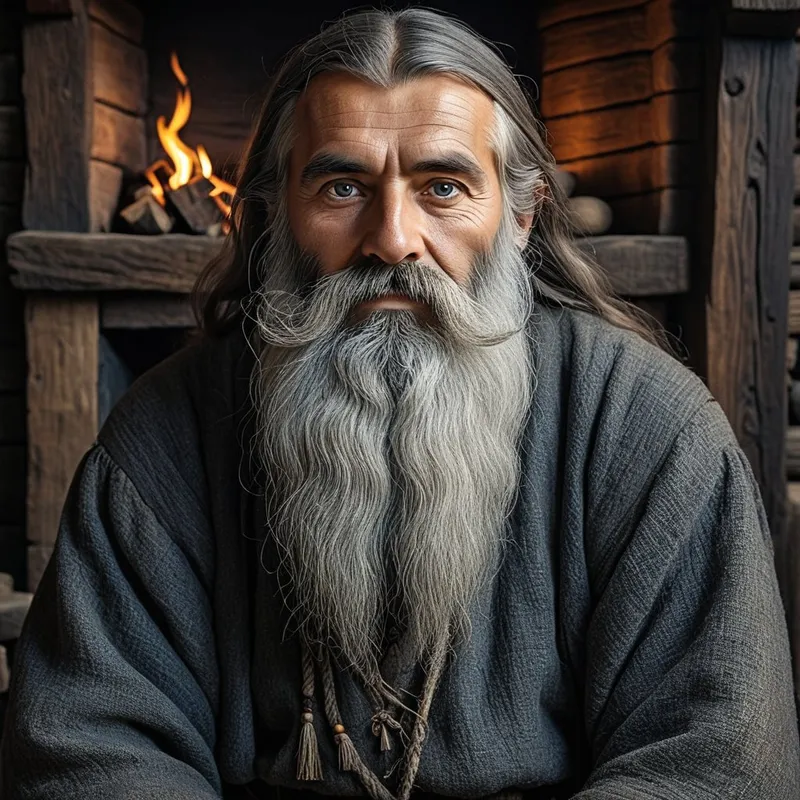
He was not tall, but broad, shaped like the trunk of an ancient oak. His hair and beard were the grey of hearth-ash and long winter nights, thick and tangled like uncombed wool. His eyes, when you dared to meet them, held the deep, patient glow of banked coals. He wore the simple clothes of the master of the house, but older, woven from shadow and memory. He did not walk through doors; he was the creak of the floorboard you knew, the sigh of the settling beam, the sudden warmth in a cold corner.
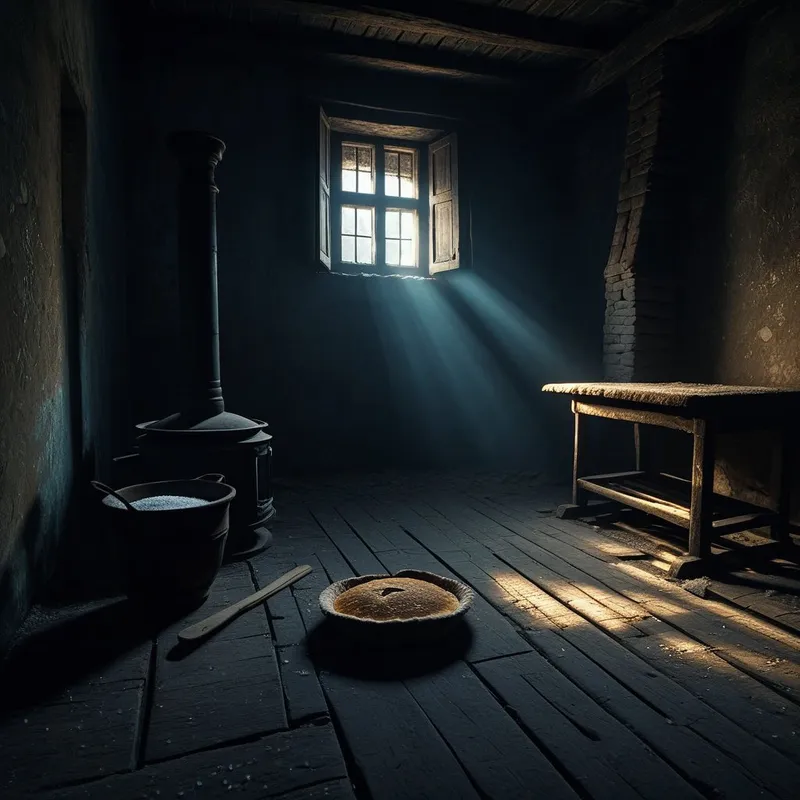
His domain was from the threshold to the hearth, the soul-space of the izba. He was the guardian of order. When the family lived in harmony, when the home was clean and the offerings of bread crust or a bowl of porridge were left by the stove, his presence was a blessing. The milk was rich, the bread rose high, the livestock were calm. He would be heard at night, humming a wordless tune, or seen as a shadow brushing the sleeping child’s forehead, a protector in the dark.
But woe to the house of strife! The slovenly home, the disrespectful child, the family steeped in bitter silence—this was an agony to him. Then, the Domovoi would become a trickster of misery. He would pinch the sleepers black and blue, hide essential tools, sour the milk, and make the horses tremble in their stalls. His actions were not evil, but a profound correction, a desperate shaking of the house’s very foundations to restore its sacred balance.
And when a family abandoned their home, or when a new family moved in, the ritual was everything. The old family would formally invite him to come with them, leaving a treat in a corner. The new family would, before all else, formally invite the residing Domovoi to stay, to accept them as his new charge. For to live in a house without making peace with its soul was to live in a shell, haunted by misfortune and deep, inexplicable loneliness. He was the spirit of the home itself, and a home without its spirit is but a pile of wood and stone.
Cultural Origins & Context
The Domovoi is not a god of grand temples, but a deity of the doorstep. His roots dig deep into the pre-Christian, animistic soil of the Slavic world, where every stream, forest, and stone held a conscious presence. He belongs to a vast family of genius loci, spirits of place. Specifically, he is the genius of the domesticated space—the crucial transition where wild nature was shaped into human shelter.
His myth was not preserved in sacred texts but in the oral tradition of the peasant household. Grandmothers told of him to children, not to frighten, but to teach. His stories were practical theology, passed down by the fire. The primary tellers were the matriarchs and the elders, the keepers of domestic ritual. His societal function was profound: he was the psychological and spiritual enforcement mechanism for domestic harmony, hygiene, respect for ancestors (as he was often considered one), and the sacredness of the hearth. He externalized the conscience of the home, making the abstract values of family, tradition, and stewardship tangible and immediate.
Symbolic Architecture
The Domovoi is a masterful symbol of the psyche’s relationship with place and belonging. He represents the anima loci—the soul of a place—but more intimately, he symbolizes the psychological complex that forms between a person and their dwelling.
He is not merely in the house; he is the house’s memory, its emotional patina, the accumulated spirit of all the laughter, arguments, births, and deaths that have occurred within its walls.
Architecturally, he is the hearth, the warm, nourishing center, and the threshold, the permeable boundary between the inner, safe world and the outer, unknown world. Psychologically, he embodies the Self as it manifests in a specific life context—the organizing, guiding principle of one’s personal, domestic universe. When we are in alignment with our true "home" (both physically and psychologically), the Domovoi is benevolent, a nurturing, protective presence. When we live out of harmony with our deepest needs for safety, order, and authentic relationship, he becomes the critical, punishing voice—the shadow of the caregiver archetype, manifesting as domestic chaos and unease.
The Dreamer's Resonance
To dream of a Domovoi is to dream of the psyche’s dwelling place. Such dreams often arise during life transitions: moving to a new home, a shift in family structure, or a period of profound internal disquiet where one feels psychologically "homeless."
The dream image may not be a literal bearded spirit. It may be a feeling of a warm, watchful presence in a particular room of the dream house. It could be the house itself behaving with intention—a door that will not stay closed, a fireplace that erupts with cold ash, or a comforting heat emanating from a wall. Somaticly, the dreamer might experience this as a feeling of profound safety and grounded weight, or its opposite: a chilling, pinching anxiety specifically located in the domestic space of the dream.
This is the unconscious process of the psyche assessing its container. Is the current structure of one’s life—the routines, relationships, and physical environment—a true "home" for the soul? The Domovoi dream is a report from the guardian of that inner sanctum. Its actions, benevolent or troubling, are direct feedback on the dreamer’s state of domestic and psychological integrity.
Alchemical Translation
The individuation process, the journey toward psychic wholeness, requires building a durable inner structure—a temenos or sacred precinct—where the Self can reside. The myth of the Domovoi models the alchemical operation of inhabitation.
The first step is Coniunctio with the spirit of the place. One cannot simply occupy a space (physical or psychological); one must ritually engage with its existing spirit. This translates to consciously acknowledging the history, patterns, and unconscious complexes that already dwell within us—our personal and ancestral "furniture." We must leave an offering of respect to these old structures.
The core transmutation is from seeing a house as a shell to experiencing it as a living relationship; from seeing the psyche as a static space to engaging with it as a dynamic, conscious ecology.
The Domovoi's dual nature—blessing and blight—mirrors the alchemical nigredo and albedo. The "pinching" and chaos he causes when displeased are the nigredo, the necessary darkening and rotting of outmoded, disrespectful ways of living. This decay makes space. The restoration of order through ritual and right relationship is the albedo, the whitening, where the home/psyche is cleansed and illuminated.
Finally, the myth teaches that this guardian spirit can be invited to move with you. As we evolve, our inner "home" must be renovated or even relocated. The alchemical translation is the careful, respectful process of integrating what is essential from our old psychic structures into the new, ensuring the continuity of the soul’s core identity—the Domovoi Self—across the threshold of transformation. We do not leave ourselves behind; we invite our deepest, most grounded spirit to dwell in the new chambers of our becoming.
Associated Symbols
Explore related symbols from the CaleaDream lexicon: