Dionysus & the Fig Tree Myth Meaning & Symbolism
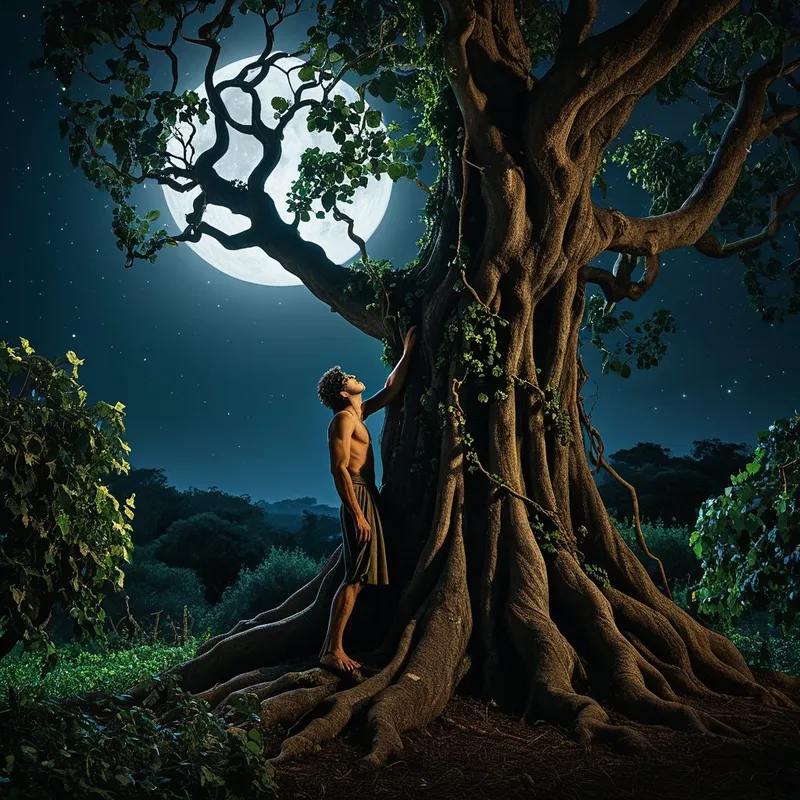
The god Dionysus, enraged by a mortal's betrayal, finds sanctuary and revelation within the hollow of a sacred fig tree.
The Tale of Dionysus & the Fig Tree
The air in Boeotia was thick with the scent of crushed grapes and trampled earth. It was the time of the Dionysia, and the god himself walked among the revelers. Not as the serene, bearded elder of the vine, but as Dionysus Neos, a beautiful, long-haired stranger with eyes that held the deep purple of twilight and the wild spark of lightning. He had descended, as was his custom, to taste the mortal world, to feel the drumbeat of their ecstatic dances, to be recognized in the frenzy he inspired.
His path led him to the home of a prosperous man, a certain Dionysius. The god, cloaking his divinity in the guise of a weary traveler, asked for shelter, for a cup of water, for the sacred right of xenia. The man looked upon the beautiful youth with a gaze not of awe, but of cold calculation and disdain. Perhaps he saw only a vagabond. Perhaps the ordered world of his courtyard felt threatened by the untamed energy this stranger carried. With a curt gesture, he refused. He barred his door. He turned the god away.
A silence fell, deeper than the absence of sound. It was the silence of the world holding its breath. The playful light in the stranger’s eyes died, replaced by a chilling, absolute darkness. The air grew heavy and sweet with a perfume that was not of flowers, but of impending madness. This was no mere insult; it was a sacrilege, a tearing of the cosmic fabric that bound guest and host, mortal and divine.
The god did not roar. He simply… changed. The pleasant features of the traveler melted away, and the true form of Dionysus Lysios was revealed. A palpable wave of mania radiated from him. The well-ordered house of the mortal man seemed to shudder. Vines, thick as serpents and moving with a will of their own, erupted from the packed earth, snaking up the walls, shattering the pottery, pulling the very beams apart. The stored wine in the cellars boiled over, not as liquid, but as a crimson mist that carried the scent of terror. The household descended into a screaming, chaotic nightmare, a private, horrifying thiasos.
But the god himself turned from the ruin. The cold fire of his wrath needed a different kind of solace. He strode from the crumbling courtyard, past the boundary stones, and into the wild land beyond. His divine rage was a storm contained within skin, seeking an echo, a vessel. And he found it.
There, on a lonely hillside, stood a great fig tree. It was not a cultivated tree from an orchard, but a wild, ancient thing, its trunk gnarled and split with age. At its base was a hollow—a dark, moist cavity formed by time and decay. Without hesitation, Dionysus folded his luminous form into that earthy darkness. He drew his limbs in, pressing his back against the living wood. The tree did not reject him. It embraced him. The cool, damp interior of the hollow cradled his fevered divinity. The scent of rich soil and sweet, milky sap filled his senses, a balm after the metallic taste of wrath. There, in that womb of wood and shadow, the storm within him began to still. The god of ecstasy found, in the heart of a tree sacred to his own wild nature, a profound and unexpected sanctuary. The fig tree had given what the house of man had refused: shelter, containment, and a return to the primal earth from which all life, even the divine, springs.
Cultural Origins & Context
This haunting episode is not the grand narrative of an epic poem, but a fragment, a piece of cult lore preserved for us by the scholar Athenaeus in his Deipnosophistae. It belongs to the rich tapestry of local Boeotian myths that surrounded the worship of Dionysus. These stories were not merely entertainment; they were the sacred scripts for ritual, told during initiations or festivals to explain the god's nature and the stakes of encountering him.
The myth served a crucial societal function. In a culture built on the sacred law of hospitality (xenia), the story was a terrifyingly clear parable: to refuse the stranger is to refuse the god, and the god’s vengeance is not a punishment from afar, but a dissolution of the very order you sought to protect. The god who could overturn the mind could overturn the home. Furthermore, it rooted Dionysus firmly in the uncultivated landscape. His sanctuary is not a temple built by human hands, but a natural, wild formation—a hollow tree. This connected his worship to older, chthonic deities and natural shrines, reminding the community that the divine force of fertility and madness resided just beyond the city walls, in the untamed earth itself.
Symbolic Architecture
At its core, this myth is a profound study in containment and transformation. Dionysus represents the raw, unbounded life force—ecstatic, creative, but also destructive and disintegrating when met with rigid denial. The mortal’s house symbolizes the fragile ego-structure, the persona of civilized order that says "no" to the chaotic, vital aspects of the self.
The hollow fig tree is the crucible where raw, divine rage is transmuted into sacred mystery. It is the psyche’s own capacity to hold its unholdable contents.
The fig tree is immensely symbolically fertile. In the ancient world, it was a symbol of abundance, fertility, and specifically of the feminine (its milky sap, its hidden, flower-filled fruit). Its hollow is a natural temenos—a sacred precinct. By entering it, Dionysus, the unrestrained masculine spirit, returns to a feminine, containing space. He undergoes a symbolic regression, a return to the womb, not to be undone, but to be reconstituted. The wrath that destroys a man-made house is soothed by a nature-made sanctuary. The myth suggests that what the conscious ego refuses, the deeper, instinctual psyche (symbolized by the wild earth and its tree) can accept and hold.
The Dreamer's Resonance
When this myth pattern stirs in the modern dreamer, it often signals a profound confrontation with a rejected part of the self. To dream of being an enraged, divine figure denied shelter may point to a powerful inner energy—a creative drive, a passionate emotion, a deep need—that has been met with internalized judgment or shame (the "mortal who refuses"). The ensuing feeling of destructive fury is the psyche's violent reaction to this self-betrayal.
The dream may then offer the solution: not a better-built house, but a retreat into a natural, containing space. Dreaming of hollow trees, caves, or any dark, earthy enclosure after a period of intense emotional turmoil is the psyche enacting the myth. It is the somatic intelligence pulling the conscious self into a necessary state of incubation. The process feels like a collapse, a withdrawal from the world, a curling inward. It is not depression, but a sacred, somatic regression where the fragmented self seeks the primal container it was denied.

Alchemical Translation
The journey of Dionysus models the alchemical process of nigredo and albedo, as applied to the psyche. The betrayal and the explosive rage represent the nigredo: the confrontation with the shadow, the darkening, the feeling of being poisoned by one's own denied passions. The conscious attitude (the mortal host) fails utterly, and the psychic structure built on its principles is dissolved.
The triumph is not in the destruction, but in finding the hollow tree. Individuation is the discovery of an inner sanctuary that can hold what the persona cannot.
The hollow fig tree is the alchemical vessel. Entering it is the crucial, counter-intuitive move of cibation. One must consciously withdraw from the fray and descend into the dark, moist, instinctual layer of the psyche. This is not an intellectual analysis of the rage, but a somatic surrender to it, within a safe, natural container. Here, in this psychic womb, the disintegrating fire of emotion is gradually cooled by the sap of instinctual wisdom. The raw, destructive god-force is not eliminated; it is integrated, given a home. It emerges not as blind wrath, but as a grounded, fertile power—the god who is both of the vine and of the rooted tree. For the modern individual, the myth instructs: when your inner world is destroyed by a truth you have refused, do not rush to rebuild the same house. Seek instead the hollow within your own nature, and allow the shattered pieces to be held and reformed by a wisdom older than your name.
Associated Symbols
Explore related symbols from the CaleaDream lexicon: