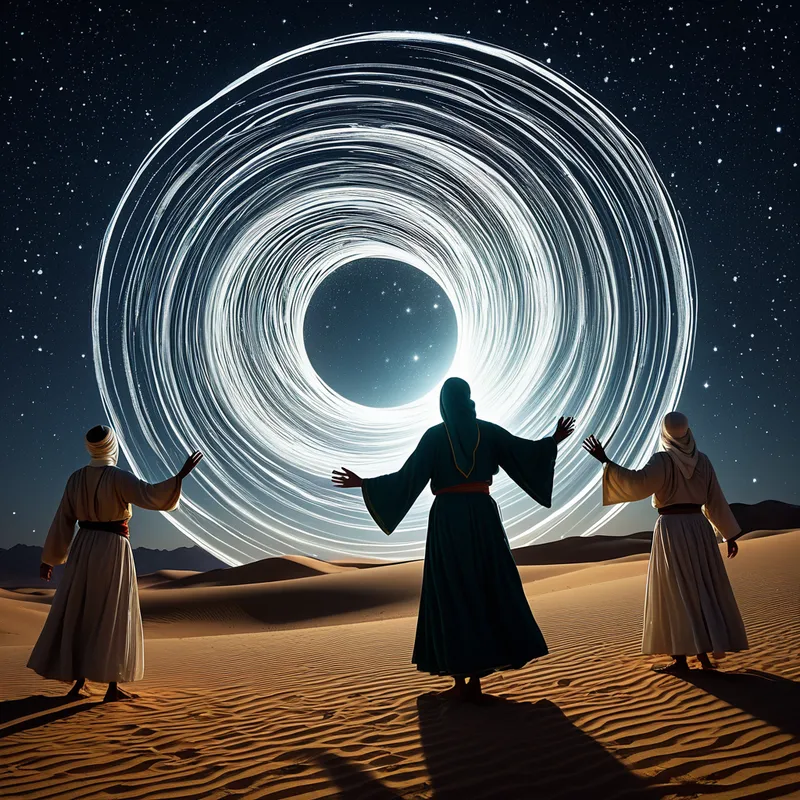
Dhikr the Remembrance Ritual Myth Meaning & Symbolism
The myth of the heart's journey through sacred repetition to shatter the ego's illusion and remember its divine origin in the Beloved.
The Tale of Dhikr the Remembrance Ritual
Listen. Listen with the ear of your heart.
In the beginning, before time was a line, there was a Sound. A single, pure note that held within it all names, all forms, all love and longing. This was the Mithaq, the Covenant. Every soul, drawn from the light of the Beloved, heard this Sound and knew it as Home. "Am I not your Lord?" asked the Sound. And every soul, in ecstatic unison, whispered back, "Yes, we bear witness."
But then came the great descent. The soul was clothed in the clay of the earth, wrapped in the heavy cloak of the self—the Nafs. The world of senses roared, a marketplace of distraction. The memory of the Sound grew faint, a distant echo behind a mountain of forgetfulness. The soul became a stranger in a strange land, haunted by a homesickness it could not name.
Then, a whisper began. It started not in the sky, but in the deepest well of the human breast, in the secret chamber called the Qalb. A faint, rhythmic pulse, a ghost of the original Sound. This was the seed of Dhikr.
The first to hear it clearly was a wanderer, a heart cracked open by longing. He sat in the ruins of his own life, the dust of the world thick upon him. In the silence of his despair, he began to polish the mirror of his heart with the only tool he had: a word. "Allah... Allah..." Not as a plea, but as a hammer against the stone of his own chest.
At first, nothing. Only the echo of his own voice in a cavern of doubt. But he persisted. The repetition became a rhythm, the rhythm a drumbeat, the drumbeat a journey. With each utterance, a layer of dust fell away. The Nafs, the tyrannical self, raged and schemed, offering him visions of power, of comfort, of pride. "Stop this foolishness," it hissed. "You are alone."
But the seeker, now a traveler on the path of Tariqa, held to the word. He breathed it in the market, whispered it in the night, chanted it until his throat was raw and his mind was still. The word became a Murshid, an inner guide, leading him through valleys of annihilation (Fana). He saw his own illusions burn away in the fire of his longing.
Then, in a moment when the repetition had worn his individual will to nothing, it happened. The hammering from within met the Answer from beyond. The whispered name was caught and completed by a Presence. The mirror of the Qalb shattered—not into pieces, but into a thousand suns. The seeker was gone. Only the Sought remained. The echo became the original Sound. The remembrance became the Presence. The ritual was no longer something he did; it was the very pulse of what he was. He had returned from exile, not to a place, but to a state: the state of being remembered by the One he sought to remember.

Cultural Origins & Context
The myth of Dhikr is not a story with a single author or date. It is the living, breathing core of Sufism, woven from Quranic verses, the sayings of the Prophet Muhammad (Hadith), and the direct experiences of generations of mystics across centuries, from the deserts of Arabia to the courts of Persia and the plains of Anatolia. It was passed down orally in the lodges (Khanqah or Tekke) from master to disciple, not as a mere technique, but as a transmitted state of heart.
Its societal function was dual. For the community, collective Dhikr ceremonies (Majlis al-Dhikr) fostered social cohesion, spiritual purification, and a direct, ecstatic experience of the divine that complemented formal, exoteric worship. For the individual seeker, it was the central technology of the inner journey, a practical method to enact the Quranic injunction to "remember God often." It served as the engine of transformation, turning theological concept into lived reality.
Symbolic Architecture
At its core, the myth of Dhikr is a map of consciousness returning to its source. The ritual is the journey; the repetition is the vehicle; the divine name is both the path and the destination.
The Name is the boat, the ocean, and the far shore. To chant it is to build the vessel, become the current, and arrive home simultaneously.
The Nafs represents the psyche's identification with the personal ego, the separate self that feels autonomous and alone. The Qalb is the deeper Self, the transcendent center that knows its connection to the Whole. Dhikr is the process of shifting identity from the former to the latter. The "forgetfulness" is the primal wound of separation consciousness; the "remembrance" is the healing of that wound through re-integration.
The repetition symbolizes the relentless focus required to break habitual patterns of thought and perception. It is a psychospiritual drill boring through the bedrock of the ego. The eventual breakthrough—Fana followed by Baqa—represents the death of the illusion of separation and the birth of a consciousness rooted in unity.
The Dreamer's Resonance
When this myth stirs in the modern dreamer, it often manifests as dreams of searching for a lost home, a forgotten name, or a vital object. One might dream of a relentless, rhythmic sound (a heartbeat, a drum, a clock) that grows louder, organizing the chaos of the dreamscape around it. There may be imagery of polishing, cleaning, or repairing something central—a dusty mirror, a clogged fountain, a broken musical instrument.
Somatically, this points to a process of gathering. The psyche is exhausted by fragmentation—the disparate roles of professional, parent, consumer, critic. The myth of Dhikr emerges as a call to gather these scattered energies back to a single point of focus and value. The psychological process is one of re-membering: literally, putting the members of the self back together, healing the split between the daily persona and the neglected soul. The anxiety in the dream is the friction of this gathering; the peace that sometimes follows is the momentary touch of that centered state.

Alchemical Translation
For the modern individual navigating a world of infinite distraction, the alchemy of Dhikr is a model for psychic transmutation. The "base metal" is our identified, reactive, and scattered mind, constantly pulled by external stimuli and internal narratives. The sacred repetition is the opus, the continuous work.
Individuation is not about adding more to the self, but about subtracting everything that is not the Self, through the focused fire of attention.
First, one must choose their "word"—a core value, an authentic feeling, a true north that represents their deepest reality (Love, Truth, Presence). Then comes the repetition: the conscious, daily return to that value amidst life's chaos. This is not mere positive thinking. It is the disciplined redirection of psychic energy (Libido) from the periphery to the center.
The raging Nafs appears as resistance—procrastination, cynicism, old wounds, and fears that arise to sabotage the practice. The alchemical fire is the willingness to stay with the repetition anyway, to let the friction of that resistance generate the heat that burns away the dross. The eventual "shattering of the mirror" is the ego's relinquishment of control, leading to a state where one's actions are no longer driven by personal will but flow from a deeper, aligned source. The individual becomes a vessel for something greater than the individual—not by losing themselves, but by finding their true Self in the context of the whole. The ritual becomes life itself, and every moment an opportunity for remembrance.
Associated Symbols
Explore related symbols from the CaleaDream lexicon:
- Ritual — The structured, repetitive container that transforms mundane action into sacred journey, providing the safe vessel for the ego's dissolution.
- Heart — The Qalb, the battlefield and throne room where the remembrance is enacted and the divine presence is unveiled.
- Mirror — The human soul that must be polished clean of the rust of forgetfulness and ego to perfectly reflect the divine attributes.
- Fire — The purifying intensity of divine love and the focused repetition that burns away the veils of illusion separating the seeker from the Beloved.
- Circle — The whirling dance of existence and the gathering of seekers, symbolizing unity, eternity, and the orbit of the soul around its divine center.
- Door — The threshold between the realm of form and the formless, which the rhythmic key of Dhikr unlocks, granting passage from separation to union.
- Name — The potent sound-vibration that carries the essence of the Named, serving as the vehicle, map, and final destination of the spiritual journey.
- Journey — The inward path (Tariqa) through the stations of the self, a pilgrimage without physical movement toward the homeland of the soul.
- Dance — The ecstatic, physical expression of Dhikr, where the body becomes a whirling prayer and the boundaries of the self spin into unity.
- Light — The original nature of the soul and the illuminating grace that floods the heart once the obstructions of the ego are cleared through remembrance.
- Shadow — The Nafs in its resistant, commanding form, which must be faced and transformed through the relentless light of awareness.
- Union — The ultimate goal and resolution of the myth, the state of Baqa where the lover, the beloved, and the love are experienced as one.