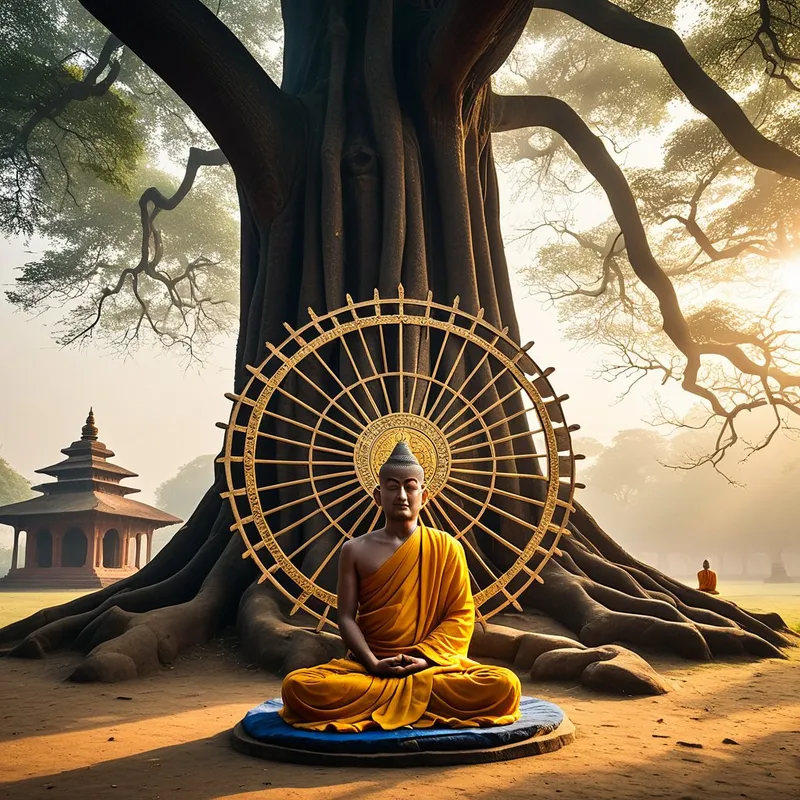
Dharma Wheel Myth Meaning & Symbolism
The story of the Buddha's first turning of the Wheel of Dharma, setting in motion the timeless teachings of liberation from suffering for all beings.
The Tale of Dharma Wheel
Listen. In the deep silence that follows a great storm, when the world holds its breath between one age and the next, a man sat beneath a tree. He was no ordinary man. He was Siddhartha Gautama, a prince who had walked away from palaces to wrestle with the great demon of the world: suffering. For six years, he had dueled with this demon—through fasting, through austerity, through the very limits of the body. And in the final, deepest watch of the night, as the star Dhruva pierced the velvet dark, he touched the earth. He called the very ground to witness his resolve. And the earth trembled in answer.
The demon Mara fled. The veils of illusion tore. And the man saw—not with his eyes, but with his whole being. He saw the endless turning of lives, linked by cause and effect, a vast, sorrowful wheel. He saw the root of this turning, and the path to its cessation. In that moment, he was no longer Siddhartha. He was the Buddha.
But what is an awakening if it is not shared? For seven weeks, this knowledge sat within him, a sun contained in a single vessel. He wondered: Could this profound, subtle truth, born in the depth of silence, be spoken? Would the world, drowning in its own churning, understand the taste of the shore?
His compassion turned him toward the world. He walked from Bodh Gaya to the Deer Park at Sarnath. The air was cool, smelling of damp grass and ancient trees. There, he found his five former companions, the ascetics who had shared his earlier struggles. Seeing him approach, they resolved to ignore him, believing he had abandoned the holy life for comfort.
Yet as he drew near, a radiance preceded him—not of light, but of an imperturbable peace. Their scorn melted into awe. Without a word, they prepared a seat for him. And there, amidst the gentle gaze of browsing deer, he did the unthinkable. He set in motion that which is forever still.
He began to speak. And with his first utterance, the cosmos aligned. He turned the Dharma Wheel for the first time. He spoke of the Middle Way between indulgence and denial. He laid out the Four Noble Truths—the diagnosis of suffering, its cause, its cessation, and the path to that cessation. He detailed the Noble Eightfold Path, a practical guide for human feet. His words were not commandments from a distant heaven, but a map drawn from the very terrain of the human heart.
As he spoke, the Wheel turned. It did not turn in the dirt, but in the minds and hearts of those five listeners. One by one, their inner sight opened. They saw the truth for themselves. The first Sangha was born. And the Dharma, the timeless law of reality, was no longer a secret held by the earth and the enlightened one. It was now a wheel set rolling, destined to cross mountains and oceans, to turn for anyone with the courage to listen, to see, and to walk the path.
Cultural Origins & Context
This event, known as the Dharmachakra Pravartana, is the foundational myth of Buddhism. It is not a tale of gods warring in the heavens, but of a human being achieving the highest insight and choosing to teach. Historically situated in the 5th century BCE in the Gangetic plain of India, it emerged from a cultural milieu rich with philosophical debate and ascetic experimentation.
The myth was passed down orally for centuries within the monastic community before being committed to text in the Sutta Pitaka. Its primary tellers were the monks and nuns of the Sangha, who recited it not as mere history, but as a living reality—the moment the liberating doctrine became accessible to the world. Its societal function was profound: it established the Buddha’s authority as a teacher, defined the core doctrinal framework of Buddhism, and created the template for the symbiotic relationship between the Buddha (the enlightened one), the Dharma (the teaching), and the Sangha (the community). It was, and remains, the myth of Buddhism’s very beginning as a world religion.
Symbolic Architecture
The Dharma Wheel is not merely a symbol; it is a dynamic, multi-layered blueprint of reality and the path to transcend it.
The Wheel turns not to move us forward, but to show us we are already at the center.
Its hub represents ethical discipline (sila), the unmoving core from which all else radiates. Without this stable center, the wheel wobbles and collapses. The rim symbolizes meditative concentration (samadhi), the unifying force that holds the entire practice together. The spokes, typically eight, represent the Noble Eightfold Path—the practical applications of wisdom (panna) that connect the disciplined core to the unifying rim, allowing the wheel to roll.
Psychologically, the Wheel maps the structure of the psyche. The endless turning (samsara) is the neurotic, repetitive cycle of our conditioned patterns—our cravings, aversions, and delusions. The Buddha’s act of “turning the Wheel” is the moment these unconscious, automatic cycles are interrupted by conscious insight. The Wheel of Dharma is the wheel of samsara seen with awakened eyes, transformed from a mechanism of bondage into a vehicle for liberation.
The Dreamer's Resonance
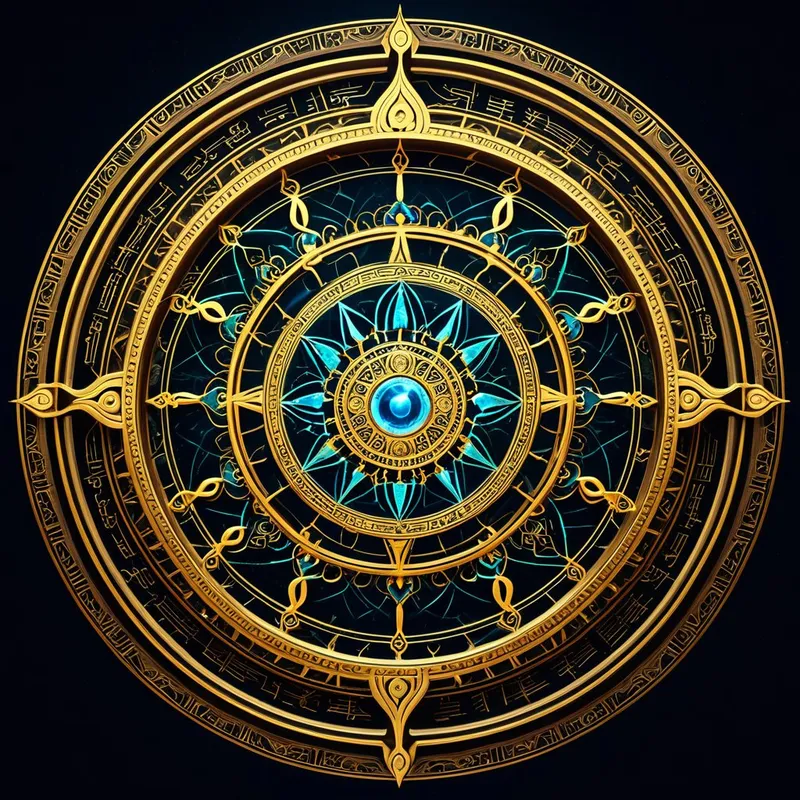
When the Dharma Wheel appears in a modern dream, it rarely comes as a pristine religious icon. It may manifest as a spinning gear in a machine, a stalled bicycle wheel, a mesmerizing mandala on a computer screen, or a circular room with many doors. The dreamer is often at a point of profound cognitive or moral reckoning.
Somatically, there may be a feeling of being “stuck in a loop” or, conversely, a sensation of sudden, smooth momentum. Psychologically, this dream signals the psyche’s attempt to integrate a core insight or ethical principle. The wheel turning smoothly suggests the dreamer is aligning their actions with a deeper understanding. A wobbly, broken, or stuck wheel indicates a conflict between one’s perceived path and one’s core values—the hub is compromised. The dream is an image of the psyche’s own lawfulness, pressing for a more coherent, truthful, and centered way of being.

Alchemical Translation
The myth models the complete arc of individuation—not as a solitary achievement, but as a process that culminates in service to the whole.
The Buddha’s journey under the Bodhi tree represents the nigredo, the dark night of the soul, where all previous identities (prince, ascetic) are dissolved in the confrontation with the shadow (Mara). The enlightenment is the albedo, the illuminating whitening, where the pure, unconstructed nature of mind is realized.
The true alchemy is not turning lead into gold, but turning wheel into witness.
Yet the process is incomplete here. The critical rubedo, the reddening, is the journey to Sarnath and the turning of the Wheel. This is the alchemical return, the integration of the transcendent insight back into the fabric of the human community. The gold of enlightenment must be minted into the currency of compassionate speech and wise teaching.
For the modern individual, this translates to a profound psychological truth: our deepest realizations demand embodiment and communication. Individuation is not a retreat from the world but a responsible return to it. We must “turn the Wheel” by translating our inner authority, our hard-won self-knowledge, into a “dharma”—a truthful way of living and relating that can, in its own small way, help turn the wheels of suffering for others. The myth teaches that the culmination of the self is found in the generosity of the teaching.
Associated Symbols
Explore related symbols from the CaleaDream lexicon: