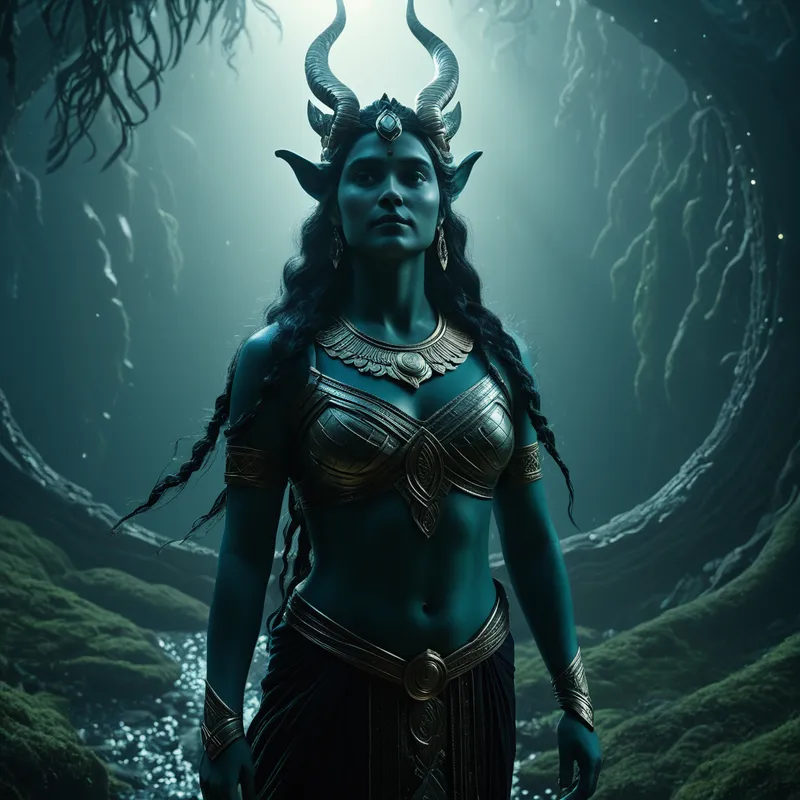
Damballa Wedo
The primordial serpent deity of Vodou, Damballa Wedo represents creation, wisdom, and the cosmic connection between African traditions and the diaspora.
The Tale of Damballa Wedo
In the beginning, there was only the vast, dark, and silent ocean. From its unfathomable depths, the great serpent Damballa Wedo uncoiled. His body, immense and luminous, was the color of milk and sky, and as he moved, he did not swim but flowed, his scales tracing the first patterns upon the face of the deep. His movement was creation itself—a slow, cosmic undulation that pushed the waters apart, forming the sky above and the earth below. Where his body arched, mountains rose; where it dipped, valleys were carved. His essence was not of violence, but of patient, inevitable force.
He ascended, coiling around the pillar of the world, and from his mouth fell a cascade of shimmering, iridescent shells. These were not mere objects, but the very seeds of life and consciousness. They scattered across the newborn earth, and from them sprang the first rivers, the first trees, and the first sacred places. His mate, the radiant rainbow serpent Ayida Wedo, joined him, and together their intertwined bodies formed the first veve, a living sigil in the sky, a bridge between the unformed potential of the waters and the structured reality of the land.
Damballa speaks rarely, and never in human tongue. His voice is the hiss of rain, the crackle of lightning in a distant cloud, the deep, tectonic groan of the earth settling. He is the ancient memory encoded in the spiral of a shell and the winding path of a river. He witnessed the scattering of his children—the forced diaspora across the bitter ocean—and in their sorrow, he did not abandon them. He coiled himself within their very spirits, becoming the hidden river of memory that connected them to the ancestral homeland. In the harsh new world, his people called to him through salt, egg, and white cloth, and he answered not with thunder, but with a profound, calming presence, a reconnection to the primordial source that no middle passage could erase.

Cultural Origins & Context
Damballa Wedo’s roots reach deep into the spiritual soil of West and Central Africa, particularly among the Fon and Yoruba peoples, where he is associated with the serpent deity Dan Ayido Hwedo. The transatlantic slave trade did not destroy this archetype; it necessitated its metamorphosis. Uprooted from specific geographical shrines and genealogical lineages, the serpent spirit had to become portable, internal, and resilient. In the crucible of Haitian Vodou and other African Diasporic traditions, Damballa emerged as a lwa of supreme antiquity and purity.
His syncretization with the Catholic figure of Saint Patrick, who is iconographically depicted banishing snakes from Ireland, is one of history’s profound spiritual ironies. To the colonizer’s eye, it was a substitution. To the enslaved eye, it was a brilliant act of cryptographic preservation—the serpent, hidden in plain sight upon the altar of the oppressor. This act of spiritual synthesis ensured Damballa’s survival, transforming him from a local divinity into a transatlantic symbol of cultural continuity. He became the embodied promise that the essential connection to origin, to wisdom, and to creative power could not be severed, only transmuted.
Symbolic Architecture
Damballa Wedo is not a god of one thing, but a constellation of interconnected primal realities. He is the symbol of ultimate origin, the fons et origo from which all differentiation flows. As the serpent, he embodies wisdom not as accumulated knowledge, but as primordial knowing—the instinctual intelligence of life itself. His whiteness signifies not absence, but the unity that precedes color, the potential that contains all spectra, much as white light holds every hue.
He represents the cosmic umbilical cord, a living connection between the diaspora and the ancestral continent, a reminder that displacement exists within a larger, unbroken circle of being.
His connection to water and the serpentine form speaks to the psyche’s deepest structures. The serpent is the spinal column of the world, and of the individual—the kundalini-like energy of pure life force and elevated consciousness. Damballa’s muteness is critical; his wisdom is pre-verbal, transmitted through feeling, presence, and the silent language of symbols and dreams. He is the stillness at the center of the storm of history, the ancient, unblinking eye that witnesses all transformation without being consumed by it.
The Dreamer's Resonance
To encounter Damballa in the inner landscape is to touch the most archaic layers of the self. Psychologically, he represents the deep, instinctual core of the psyche—what Jung might term the psychoid base of the unconscious, where matter and spirit are not yet divided. He is the archetype of the Self in its most primordial, unifying aspect.
When this archetype is activated, one may feel a powerful pull toward origins: a yearning to understand one’s roots, a fascination with genesis myths, or a need to reconnect with the body’s innate wisdom. He appears in times of profound personal or collective fracture, offering not a solution, but a re-contextualization. His energy does not “fix” the wound of diaspora, personal or psychic; instead, it reveals that wound as a sacred opening to a deeper, vaster identity. He calls the dreamer away from fragmented ego-consciousness and toward an experience of the self as part of an eternal, coiling continuum of life. To be mounted by Damballa in ritual is to experience a temporary dissolution of the anxious, modern ego into a state of serene, cosmic belonging.

Alchemical Translation
The alchemical process mirrored in Damballa’s myth is the prima materia—the formless first matter from which the great work begins. He is the massa confusa, the chaotic, watery beginning that holds all possibilities within it. The journey of the African Diaspora, and indeed any profound transformation, recapitulates this alchemy.
The forced dissolution of the nigredo—the crushing darkness of the middle passage and slavery—was followed not by a simple return, but by a miraculous albedo, a whitening, seen in Damballa’s color: a purification through suffering that distilled the essence of the spirit from the specifics of its cultural container.
Damballa is the serpens mercurialis, the mercurial serpent of alchemy that unites opposites. He bridges Africa and the Americas, past and present, spirit and matter, silence and meaning. The final stage is not a return to a lost past, but the creation of a new, conscious caelum—a sky of understanding. The scattered children, like the scattered shells from his mouth, become the seeds for a new, resilient form of spiritual life. The alchemy is one of endurance and re-synthesis, where the primal creative force adapts and persists, proving itself more durable than any structure built to contain or destroy it.
Associated Symbols
Explore related symbols from the CaleaDream lexicon:
- Serpent — The primordial coil of life-force, wisdom, and cyclical renewal, representing the foundational energy that moves through all creation.
- Water — The formless, potential-filled source of all life, embodying the subconscious, memory, and the ancestral realm from which forms emerge.
- Ocean — The vast, boundless totality of origin and the traumatic yet transformative journey across the deep that separates and connects worlds.
- Bridge — A spiritual and psychic connector between disparate realms, ancestries, and states of consciousness, built over the abyss of displacement.
- Roots of Wisdom — The deep, often hidden connections to ancestral knowledge and primal understanding that nourish and stabilize the present self.
- Transformation Cocoon — The protective, isolating space of profound metamorphosis, where old identities dissolve so a new, more resilient form can integrate.
- Circle — The unbroken continuum of existence, symbolizing wholeness, eternity, and the cyclical nature of time, loss, and return.
- Sky — The expanse of possibility and spiritual connection, formed by the serpent’s arching body, representing order, height, and divine perspective.
- Cave Wisdom — The deep, introspective knowledge gained in periods of retreat, darkness, or enforced seclusion, where essential truths are preserved.
- Seed — The concentrated essence of potential and identity, scattered by fate, which holds the blueprint for future growth and cultural regeneration.
- Dragon — The majestic, potent, and often silent guardian of ancient treasures and profound, earth-connected power and sovereignty.
- Ancestral River — The flowing, continuous stream of lineage, memory, and spiritual sustenance that runs beneath the surface of conscious life.