Cyclops Myth Meaning & Symbolism
The one-eyed giant, a primordial force of raw creation and brutal consumption, is outwitted by the cunning hero, a clash between brute instinct and strategic intellect.
The Tale of Cyclops
Hear now the tale sung when the hearth-fire is low and the wine is deep, a story of cunning and terror from the wine-dark sea. It begins with a hero, scarred by war, whose heart yearned only for the smoke of his own hearth. Odysseus, the man of twists and turns, sailed for home, but the gods had woven a longer thread for his fate.
A mist, thick as wool, stole the sun and the stars, leaving his ships blind on the heaving breast of the sea. For nine days, the wind was a thief, until on the tenth, a strange shore rose from the waves—an island untouched by plow or pruning hook, where wild goats danced on cliffs and the air smelled of thyme and salt. But the true heart of the island was a gaping wound in the mountainside: a cave, high and wide-mouthed, with walls smoothed by some immense, ancient presence. Around it, pens were built not with wood, but with boulders heaved from the earth’s bones, holding flocks of fat sheep and goats.
Odysseus, ever-curious, took twelve of his best men and a skin of potent, dark wine, a gift fit for a god. They entered the cavern’s cool, dank throat. Inside was a bounty that stole their breath: racks of cheese drying like stone, pails brimming with whey, and lambs and kids penned in their own stone folds. His men begged to take the cheese and flee, to drive the flocks to their swift ships. But Odysseus, his spirit tested by war, refused. He wished to see the cave-dweller, to take a guest-gift from his hand. A fatal curiosity.
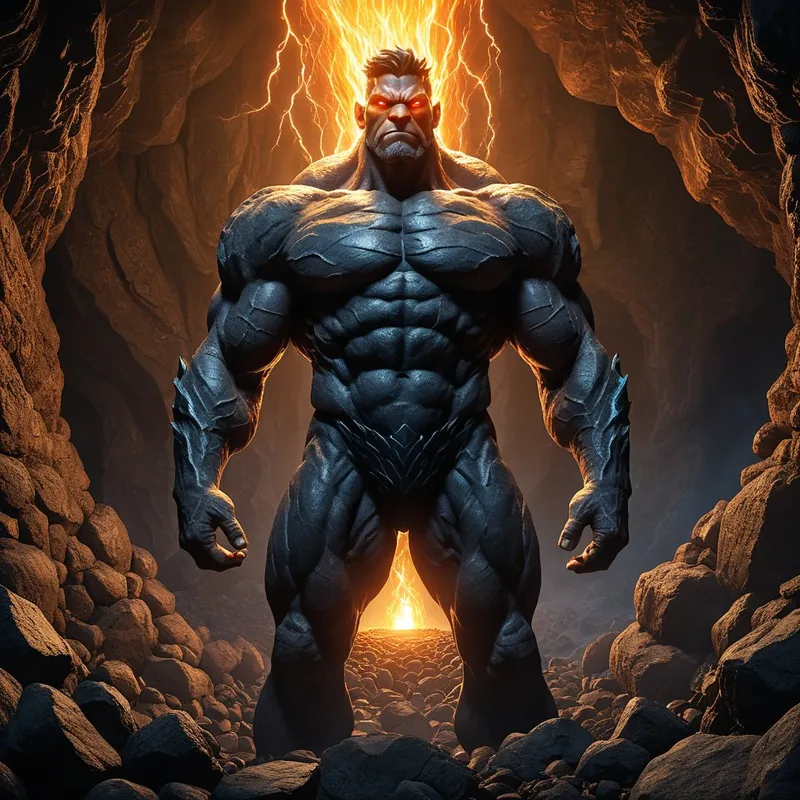
As the sun fled the sky, the earth began to tremble. A shadow fell across the entrance, blotting out the last light. In lumbered the shepherd, a shape of nightmare. He was not a man, but a raw force of the earth—a mountain that walked. His single, round eye burned like a shield-boss in the center of his forehead. On his back, he carried a monstrous load: a great bundle of dry wood to feed his evening fire. With a grunt that echoed in the vault, he flung down his load, drove his fat flocks inside, and then, with a sound of grinding stone, heaved a gigantic door-stone into place—a slab so vast two dozen wagons could not budge it. The trap was shut.
The fire was lit. In its leap and crackle, the giant saw them. His voice was a rockslide. “Strangers! Who are you? Are you pirates, roving the sea to plague men?” Odysseus, his heart a drum in his chest, spoke with a diplomat’s tongue. He spoke of their journey home from Troy, of being blown off course, and appealed to the sacred law of xenia, the respect due from host to guest. The giant’s answer was a roar of laughter that shook the cheese from the racks. He feared no gods. He was Polyphemus, son of the Earth-Shaker himself.
Then came the horror. With a casual, brutal motion, the Cyclops snatched up two of Odysseus’s men, dashed their heads against the stone floor like ripe melons, and devoured them, bone and marrow, washing them down with great draughts of milk. He belched, then slept, leaving Odysseus to a night of silent, gut-churning grief. In the morning, the monster ate two more men for his breakfast, then moved the door-stone, drove out his flocks, and sealed the cave once more, leaving the survivors to the echoing dark and the stench of death.
But in that darkness, a plan was forged in the fire of Odysseus’s mind. They found a great club of green olive-wood, left by the giant to dry. They sharpened its end in the fire, hardening the point to a wicked stake. They drew lots for the terrible task to come. When the Cyclops returned that evening and repeated his ghastly feast, Odysseus approached with the skin of wine. “Here, Cyclops,” he said, his voice honeyed. “Drink this wine to follow your meal of men.” The giant drank, gulping the sweet, strong liquor, and demanded more. Three bowls he drank, and the wine, a gift from the gods, unstrung his limbs and clouded his single eye.
Drunk and merry, the monster asked Odysseus his name. The hero, a shadow in the firelight, replied: “My name is Outis. No-man. That is my name.” The Cyclops, with a slurred laugh, promised to eat No-man last as a guest-gift, and then fell into a stupor, vomiting wine and bits of human flesh.
Now was the moment. Odysseus heated the stake in the embers until it glowed, a star of pain. With his men holding it firm, he drove the burning point into the giant’s eye, twisting it like a man boring a ship’s timber. The sizzle of burning flesh filled the cave, and the Cyclops’s scream was a thing to shatter stone. He roared, blinding and in agony, pulling the stake from his eye, while his neighbors, other Cyclopes, gathered outside. “What hurts you, Polyphemus?” they called. “Why do you cry out and ruin our sleep?”
And the blinded giant, true to the trick, bellowed back: “My friends! No-man is killing me! No-man is murdering me by cunning!” The others, hearing this, grumbled and turned away. “If no man is hurting you, then it must be a sickness sent by Zeus. Pray to your father, Poseidon.” And they left him to his fate.
In the morning, the blind giant rolled back the stone and sat at the mouth, feeling the backs of his sheep as they left to graze. But Odysseus, the weaver of wiles, had tied his men beneath the rams, three to a beast, and clung himself to the fleecy belly of the largest. Feeling only wool, the Cyclops let them pass. Once free on the shore, they drove the best of the flock to their ships and pushed off. At a safe distance, Odysseus’s pride overcame his caution. He shouted back across the water, revealing his true name, boasting of his victory. The blinded Cyclops, weeping tears of blood, lifted his hands to the sky and called upon his father, Poseidon, to curse Odysseus: may he wander, lose all his companions, and find only trouble at home. And the Earth-Shaker, from the depths, heard his son’s prayer, setting in motion the long, bitter waves of the hero’s journey home.
Cultural Origins & Context
The myth of the Cyclops is woven into the foundational epic of Greek identity, Homer’s Odyssey. This was not a story confined to parchment but a living, breathing performance, recited by bards (rhapsodes) at festivals and in the halls of the powerful. Its function was multifaceted: it was entertainment, a repository of cultural values like cunning (metis) over brute force, and a theological exploration of humanity’s relationship with the monstrous, primordial forces that preceded the ordered Olympian world.
The Cyclopes themselves have a dual lineage in Greek myth. Hesiod, in his Theogony, describes them as three primordial brothers—Brontes, Steropes, and Arges—forgers of Zeus’s thunderbolts. They represent the raw, creative power of the cosmos, allied with the new order. Homer’s pastoral, cannibalistic Cyclopes are a different breed—lawless, isolated beings living in a pre-social state, a direct contrast to the Greek ideals of community, agriculture, and hospitality. The story of Odysseus and Polyphemus sits at this crossroads, pitting the defining Greek virtues of intelligence, civility, and maritime skill against a chaotic, antisocial, and terrifyingly powerful “other.”
Symbolic Architecture
The Cyclops is not merely a monster but a profound psychic symbol. His single eye represents a singular, undifferentiated consciousness. It sees only one thing at a time, one perspective, one overwhelming impulse—be it hunger, rage, or possession. It is the vision of the totalitarian instinct, incapable of nuance, reflection, or empathy.
The single eye is the prison of a consciousness that has not yet split into subject and object, self and other. It consumes the world literally, because it cannot relate to it symbolically.
The cave is the womb of this undifferentiated state—a closed, self-contained system of instinctual satisfaction (the cheese, the milk, the sheep) and horrific consumption. Odysseus, the hero of multiplicity and strategy (the “man of many turns”), enters this womb/tomb. His victory is not one of strength, but of differentiation. The sharpened stake is the piercing instrument of intellect, which blinds the overwhelming, singular vision of the instinctual self. To “blind the Cyclops” psychologically is to disrupt the totalitarian rule of a single complex or drive—be it unchecked anger, addictive desire, or rigid dogma—that consumes all other aspects of the personality.
The brilliant trick of the name “No-man” (Outis) is the ultimate symbolic act. When the hero is possessed by the Cyclopean complex, he loses his identity; he becomes “no one,” a slave to the monocular drive. By naming himself as this emptiness, he turns the monster’s own nature against it. The complex, screaming in pain, can only name its tormentor as “No-man,” ensuring no help will come from the outside world of other, similar complexes. The victory is achieved from within the psyche itself.
The Dreamer's Resonance
When the Cyclops stalks the modern dreamscape, it rarely appears as a literal giant. It manifests as an overwhelming situation, a person, or a feeling characterized by a terrifying singularity. It might be a domineering boss whose will is absolute law, a suffocating relationship that demands you see the world through only one lens, or a personal addiction that consumes all other interests. Somatically, the dreamer may feel trapped, paralyzed, or literally unable to see a way out.
The dream-Cyclops is the embodied feeling of being psychologically eaten alive by a one-dimensional force. The cave is the dreamer’s own life, which has become constricted and defined solely by this complex. The dream is a snapshot of the psyche’s recognition of this possession. The emotional tone is primal fear mixed with a desperate, claustrophobic cunning. The dreamer, in the role of Odysseus, is being called to stop being a passive victim (“No-man”) and to begin, however fearfully, plotting a strategy of liberation.
Alchemical Translation
The myth models the painful but necessary alchemy of consciousness. The initial state is one of identification: we are the complex. We are the rage, the hunger, the obsession. The first step, like Odysseus entering the cave, is to consciously engage with this shadow content, to see it up close in all its horrifying reality, rather than projecting it onto the external world.
The blinding is the critical operation. It is not the destruction of the instinct, but the dismantling of its totalitarian rule. The singular, consuming vision must be broken so that peripheral vision—other perspectives, values, and feelings—can emerge.
The stake is the focused, painful truth we must apply to our own monomania. It is the moment we say, “This rage is blinding me,” or “This need is consuming me.”
The subsequent escape, clinging to the underbelly of the rams, signifies a new relationship with our instinctual nature (the sheep). We no longer face it directly or try to overpower it; we use its own energy to carry us to freedom, but from a position of hidden guidance and control. We learn to “ride” our instincts, not be ruled by them.
Finally, Odysseus’s boast—the revelation of his true name—represents the enduring danger of inflation. Even after a great victory over the shadow, the ego can claim the achievement as its own alone, inviting the curse of the deeper, wounded psyche (Poseidon’s wrath). The full alchemical process requires not just the blinding of the monster, but the humility to integrate the experience without arrogance, acknowledging that the journey home—towards wholeness—is long, humbling, and governed by forces greater than our cunning.
Associated Symbols
Explore related symbols from the CaleaDream lexicon: