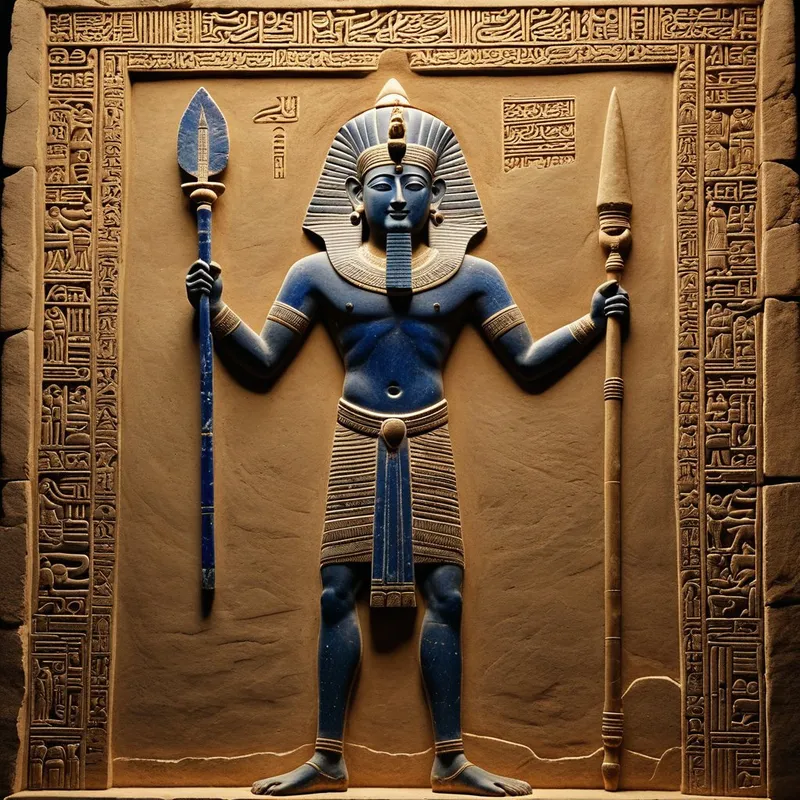
Cuneiform Tablets Myth Meaning & Symbolism
The story of how the gods, through the scribe god Nabu, gave humanity the wedge-shaped script, etching divine law and human fate into the clay of existence.
The Tale of Cuneiform Tablets
Before the world knew its own name, the gods held all things in their minds. The Apsu and the Tiamat churned in silence, and the stories of what was, what is, and what shall be were locked in the divine breast. It was a heavy burden. The decree of Anu was spoken but could be forgotten. The judgment of Enlil was mighty but could fade like a storm. The wisdom of Ea was deep but could slip away like water through fingers.
Then came Nabu, the far-seeing, the holder of the tablet of destinies. He walked the banks of the great rivers where the clay was rich and red. He took a reed, straight and true, and cut its end not to a point, but to a wedge. He knelt, not in submission, but in the posture of creation. The sun, Utu, watched as Nabu pressed the reed into the soft, damp earth.
Tak. A single wedge, a triangle pointing downward like a falling star caught in clay. Tak. Tak. Two more, side by side, a constellation born from mud. He worked with the patience of the moon, Sin. Each press was not a drawing, but a making. Each combination of wedges—horizontal, vertical, angled—was a trap for a thought. Here, a sign for “star.” There, a sign for “grain.” Here, a complex weaving for “the king is the shepherd of the people.” The clay drank the symbols and held them fast.
Nabu presented the first tablet to the assembly of the gods. It held the Me, the fundamental decrees of civilization: kingship, truth, law, the art of the scribe itself. The gods saw their own will reflected back, immutable. No longer would a decree be a whisper on the wind. It was now a thing, a dub, a tablet. It could be held, stored, sent, and read a thousand years hence. The divine word had been given a body of earth and a voice that echoed across time.
Then, the great gift and the great burden. Nabu, with Ea’s cunning, taught this art to chosen humans. He showed them how to mix the clay, how to shape the stylus, how to bake the memory hard as stone. The first human scribe trembled as he made his first mark. In that moment, humanity was severed from the eternal present of the animal and joined to the chain of time. They could now accuse and acquit, buy and sell, praise gods and curse enemies, and send their words across deserts. They could, for the first time, lie in a form that looked like truth. They could write a name and make a man immortal, or scratch it out and condemn him to oblivion. The power of the gods was now in the hands of mortals, etched in fragile clay.
Cultural Origins & Context
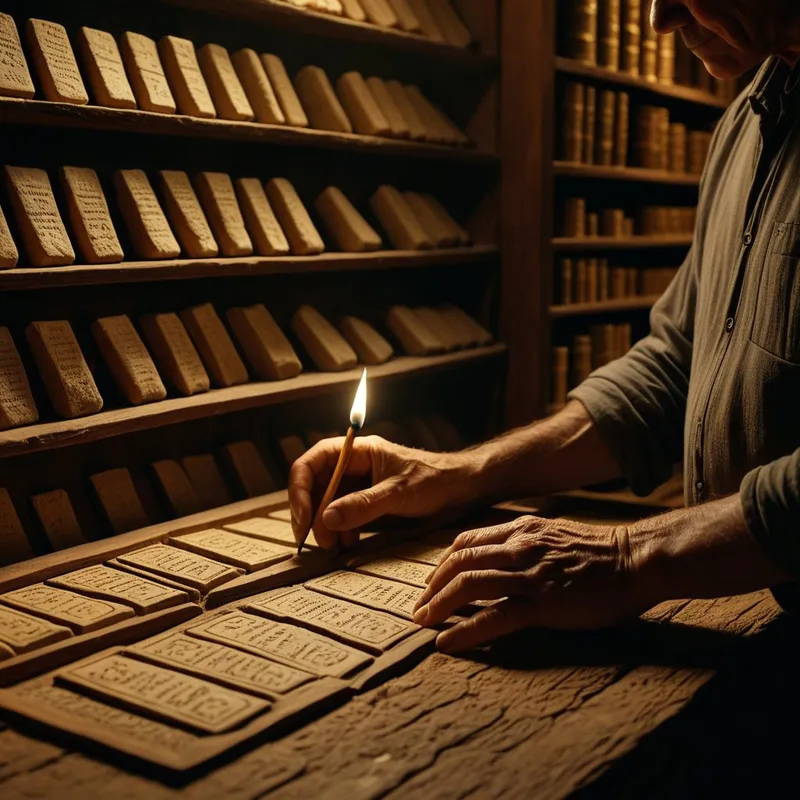
This is not a single myth from one tablet, but the foundational truth woven into the very fabric of Mesopotamian civilization for over three millennia. The act of writing cuneiform was itself a sacred, mythic act. Scribes were trained in temple and palace schools, often under the patronage of Nabu, whose symbol was the stylus and the writing board. To write was to participate in the divine ordering of reality.
The stories of writing’s origin are implied in god lists, hymns, and in the pervasive cultural understanding that literacy was a me—a divine decree of civilization granted by the gods. It was passed down not by bards around a fire, but by master scribes to apprentices in crowded scriptoria, copying lexical lists, royal inscriptions, and literary texts. Its societal function was total: it was the engine of administration, the bedrock of law (like the Code of Hammurabi), the medium for literature (like the Epic of Gilgamesh), the conduit for prayer, and the tool of prophecy. To control the tablets was to control memory, and thus to control power, history, and the future.
Symbolic Architecture
The cuneiform tablet is the ultimate symbol of the human psyche’s struggle to wrest permanence from flux, order from chaos, and consciousness from the unconscious.
The wedge is the fundamental unit of consciousness—a decisive impression made upon the soft, receptive clay of the soul.
The clay represents the primordial, undifferentiated substance of the unconscious—malleable, fertile, and dark. The stylus (the reed of Nabu) is the focused force of the ego, the will to make a mark, to differentiate. The wedge-shaped sign is the archetypal form itself: the first distinct “thought” or “complex” pressed into the psyche. Once impressed, it is fixed. It can be combined with others to create the intricate, sprawling narratives of a life.
The tablet is the nascent self—a bounded entity that contains a unique arrangement of these archetypal impressions. The archive or library is the cultural collective unconscious, where all individual tablets (selves) are stored, creating a lasting, shared memory that transcends any single life. Writing, therefore, symbolizes the birth of objective consciousness—the moment an internal experience is externalized, examined, and made subject to law and communication.
The Dreamer's Resonance
To dream of cuneiform tablets is to dream of the foundational inscriptions of one’s own psyche. It speaks to a process of deep, somatic encoding.
You may dream of finding a tablet—often in water, sand, or the ruins of a personal “inner Babylon.” This signals the emergence of a buried complex, a core belief, or a forgotten trauma into consciousness. The script may be illegible, indicating that the content is felt but not yet understood by the waking mind. The body may feel heavy, like damp clay, or the hands may tingle with the memory of making.
You may dream of breaking a tablet. This is a profound image of psychic rebellion—shattering an old, rigid law of the self, a covenant made with a parental or internal “god” (an authority complex). It can feel terrifying (a loss of order) or liberating (an escape from a fate written by others).
You may dream of endlessly writing on a tablet that never fills or that erases itself. This is the somatic echo of the anxiety of impermanence, the fear that one’s identity or legacy is insubstantial. It calls for a ritual of embodiment—making something real in the world, a true and lasting impression.
Alchemical Translation
The myth models the individuation process as the slow, deliberate work of becoming your own scribe and archivist.
The first alchemical stage is Nigredo: the primal, undifferentiated clay of the unconscious—the mud of the riverbank, the chaos of unprocessed experience. Here, one must simply gather the material of a life.
The second is Albedo: the cutting of the stylus. This is the development of a disciplined, focused consciousness (the ego) capable of making distinctions. It is the painful honing of attention and intention.
The great work is to take the stylus of consciousness from the hand of the internalized “god” (the parental complex, the cultural superego) and to inscribe your own name upon the tablet of fate.
The third is Citrinitas: the act of inscription itself. This is the lifelong process of pressing your experiences, choices, and insights into the permanent record of the self. It is creating your own personal me—your own laws, your own literature, your own accounting. It requires accepting that every mark is permanent; you cannot un-write, only write anew.
The final stage is Rubedo: the firing of the tablet in the kiln. This is the integration of these conscious inscriptions into the wholeness of the Self. The fragile, air-dried clay of provisional identity is hardened into the ceramic vessel of character. It becomes a durable artifact that can be placed in the great archive, contributing its unique text to the human story. You are no longer just written upon by gods, parents, or culture. You have become, like Nabu, the scribe of your own destiny, participating in the eternal work of giving form to the formless word.
Associated Symbols
Explore related symbols from the CaleaDream lexicon: