Chronos/Saturn Myth Meaning & Symbolism
The Titan who castrated his father to rule, then devoured his children to prevent his own fall, embodying time's relentless, devouring nature.
The Tale of Chronos/Saturn
Listen, and hear the tale from before the age of gods you know. In the beginning was Chaos, and from it came the wide-bosomed Earth, Gaia, and the starry, encompassing Sky, Ouranos. Their union was fertile, yielding mountains, seas, and the first mighty beings—the Titans. But Ouranos was a jealous tyrant. He hated his children, the Hecatoncheires and the one-eyed Cyclopes, and thrust them back into the dark womb of Gaia, causing her immense pain.
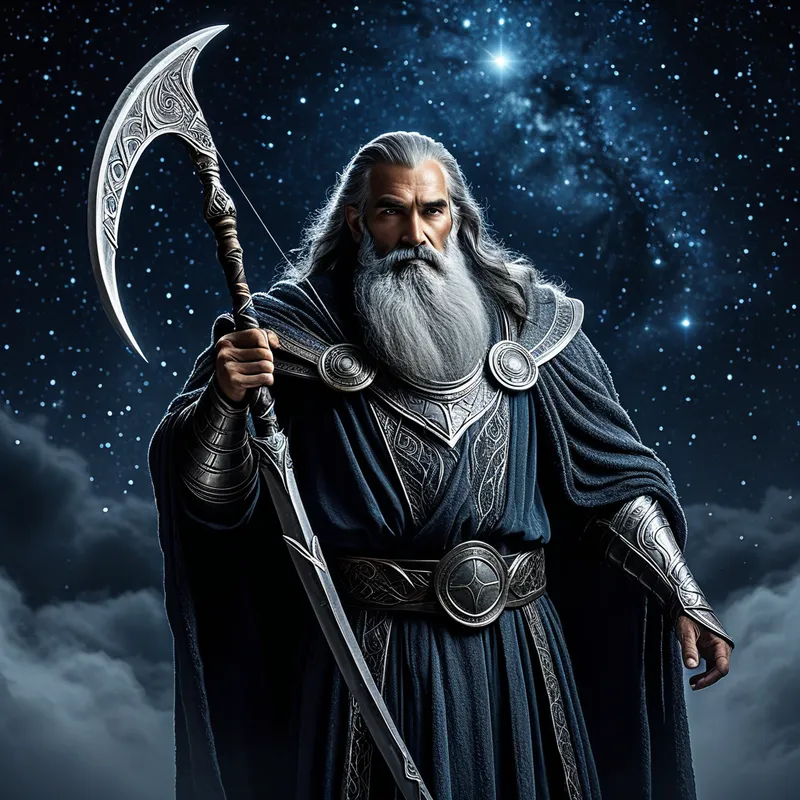
Her groans echoed through the hollows of the world. In her anguish, she forged a weapon of adamant, a sickle with a blade like a crescent of grey lightning. She gathered her Titan children and asked: who would wield it? Who would challenge the tyranny of the Sky?
Silence held the chamber. Then, the youngest Titan stepped forward. His name was Chronos, and in his eyes burned a cold, calculating light. He took the sickle, its weight a promise and a curse. That night, as Ouranos lay upon Gaia, stretching himself across her, Chronos emerged from hiding. The air was thick with the scent of damp soil and ozone. With a motion both swift and terrible, he swung the sickle. A scream tore the fabric of the cosmos. Ouranos was severed, his power bleeding into the sea, giving birth to Aphrodite. Chronos cast his father’s reign down and claimed the throne for himself.
Time now had a master. Chronos ruled with his sister-queen, Rhea. But the curse of his act clung to him. A prophecy, whispered by Gaia and Ouranos, echoed in his halls: just as he overthrew his father, so too would he be overthrown by his own child. This prophecy became the seed of a terrible dread. When Rhea bore their first child, the goddess Hestia, Chronos looked upon the infant not with love, but with the cold fear of endings. He opened his mouth, vast and dark as a cavern, and swallowed the child whole. So it went with Demeter, Hera, Poseidon, and Hades. Each was consumed, living in the silent, timeless prison of their father’s belly.
But Rhea’s grief turned to cunning. When her sixth child was born, she wrapped a stone in swaddling clothes and presented it to Chronos. He devoured it without a glance. The true infant, Zeus, was spirited away to a cave on Crete, where his cries were drowned by the clashing of shields. Zeus grew strong, and in time, he returned. He gave his father a potion that forced him to disgorge his swallowed children, whole and grown. Thus began the Titanomachy, the great war that shook the pillars of the world. Chronos was defeated, cast down, and imprisoned in the misty pit of Tartarus. The Age of the Titans ended, and the reign of the Olympians began.
Cultural Origins & Context
This foundational myth comes to us primarily from Hesiod’s Theogony, an epic poem from the 8th or 7th century BCE that systematized the Greek divine genealogies. It is a story of the archai, the first beginnings and principles. It was not mere entertainment; it was a sacred narrative explaining the origin of cosmic order (cosmos) from primal chaos, and the painful, violent transitions of sovereignty that define existence. The myth of Chronos served as the divine precedent for the Olympian order, justifying Zeus’s rule by framing it as the inevitable, cyclical triumph of a new, more just generation.
In later antiquity, Chronos became conflated with the Roman agricultural god Saturn, whose festival, the Saturnalia, was a time of role reversal, feasting, and temporary freedom from social constraints—a symbolic return to the mythical Golden Age said to have occurred under Saturn’s reign. This duality captures the essence of the figure: both the devouring tyrant of time and the benevolent ruler of a lost age of abundance, reflecting humanity’s ambivalent relationship with time itself—as both destroyer and the necessary condition for harvest and fruition.
Symbolic Architecture
Chronos is not merely a character; he is the personification of a fundamental principle. He represents Time as a devouring force. His act of castration symbolizes the necessary severance from the primal, undifferentiated unity (Ouranos) to create the conditions for linear time, differentiation, and the world as we know it. It is the first act of separation, the original wound that makes creation possible.
The sickle does not merely cut; it defines. It separates what was fused, creating a before and an after. It is the instrument of destiny.
His consumption of his children is the most potent symbol: time consumes all it creates. Every moment, every generation, is born only to be swallowed by the next. This is not simple evil, but the brutal logic of chronology. The stone given to him by Rhea is the symbol of the indigestible, the eternal core of being that time cannot assimilate—the future (Zeus) that must eventually rebel and overthrow the present.
Chronos’s eventual imprisonment in Tartarus represents the containment of raw, cyclical, repetitive time by the new Olympian order, which introduces a different quality of time—one of narrative, justice, and destiny.
The Dreamer's Resonance
When the pattern of Chronos emerges in modern dreams, it often signals a profound engagement with the psyche’s relationship to time, obligation, and legacy. Dreaming of a devouring parent or a faceless force consuming possibilities points to the somatic feeling of time pressure, of being eaten alive by deadlines, responsibilities, or the fear of mortality. It is the anxiety of being trapped in a cycle you did not choose.
Conversely, dreaming of wielding a sickle or a sharp, curved blade can indicate a necessary, if painful, act of cutting away—ending a relationship, a job, or an old identity (the castration of Ouranos). The dream ego may be preparing to sever something to claim its own sovereignty. A dream of being forced to vomit or disgorge (like Chronos with the potion) often relates to a psychological process of reclaiming swallowed parts of the self—talents, emotions, or potentials that were sacrificed to parental expectations or internalized demands for order and control.
Alchemical Translation
The myth of Chronos is a master narrative of psychic transmutation, mapping the journey from being ruled by an internal tyrant to achieving liberation. The first stage is recognition of the internal Saturn. This is the critical, limiting voice, the inner father who says “there is not enough time” or “you must sacrifice your creativity for security.” This voice often devours our nascent ideas and joys.
The alchemical work begins with the wielding of the sickle—the conscious, courageous act of differentiation. One must cut the identification with the oppressive, overarching patterns (the Ouranos complex) inherited from family or culture. This is a violent psychic surgery, but it establishes the principium individuationis, the beginning of the individual.
The stone swallowed in place of the child is the nascent Self, the indestructible core hidden within the persona. It is what survives all devouring.
The final stage is the potion of revelation, facilitated by the nurturing, cunning aspect of the psyche (Rhea). This is the therapeutic or introspective process that forces the internal Chronos to disgorge all the swallowed potentials—the artist, the lover, the leader. This leads to the inevitable Titanomachy, the inner conflict where these newly liberated powers overthrow the old, rigid regime of the psyche. The victory does not annihilate Chronos but imprisons him in Tartarus—he is contained, his devouring nature acknowledged and integrated, but no longer in control. Time becomes a medium for life, not its master.
Associated Symbols
Explore related symbols from the CaleaDream lexicon:
- Sickle — The curved blade of adamant, symbolizing the necessary, severing cut that creates separation, defines time, and enacts a painful but essential sovereignty.
- Stone — The swaddled rock given to Chronos, representing the indestructible core of the future self, the truth that cannot be digested by time or fear.
- Father — The dual archetype of the tyrannical Sky-Father (Ouranos) and the devouring Time-Father (Chronos), representing the oppressive, structuring, and consuming aspects of authority and legacy.
- Child — The potential, the future generation that is both threatened by and destined to overthrow the existing order, embodying new life and inevitable change.
- Cave — The hidden, womblike space where the future (Zeus) is protected and nurtured, symbolizing the unconscious where new potentials gestate in safety.
- Swallow — The act of consumption by Chronos, representing how time, fear, or obligation devours our creations, joys, and nascent possibilities.
- Thunder — The weapon and domain of Zeus, symbolizing the disruptive, revolutionary power that finally challenges and overthrows the old, rigid order of time.
- Tartarus — The deep, misty pit of imprisonment, representing the relegation of the devouring, cyclical aspect of time to the basement of the psyche, contained but not destroyed.
- Order — The central theme of the myth, depicting the violent and sacrificial process required to establish a new cosmic or psychic structure from chaos.
- Sacrifice — The brutal cost of creation and maintenance; the children devoured to preserve a kingdom, representing what we give up to keep our world intact.
- Golden — Referencing the lost Golden Age of Saturn’s rule, symbolizing a nostalgic, paradisiacal time of perfect order and abundance that exists only in memory or potential.
- Greek Temple — The architectural embodiment of the Olympian order that succeeded Chronos, representing structured, sacred space built upon the foundation of this mythic struggle.
- Harvesting Scythe