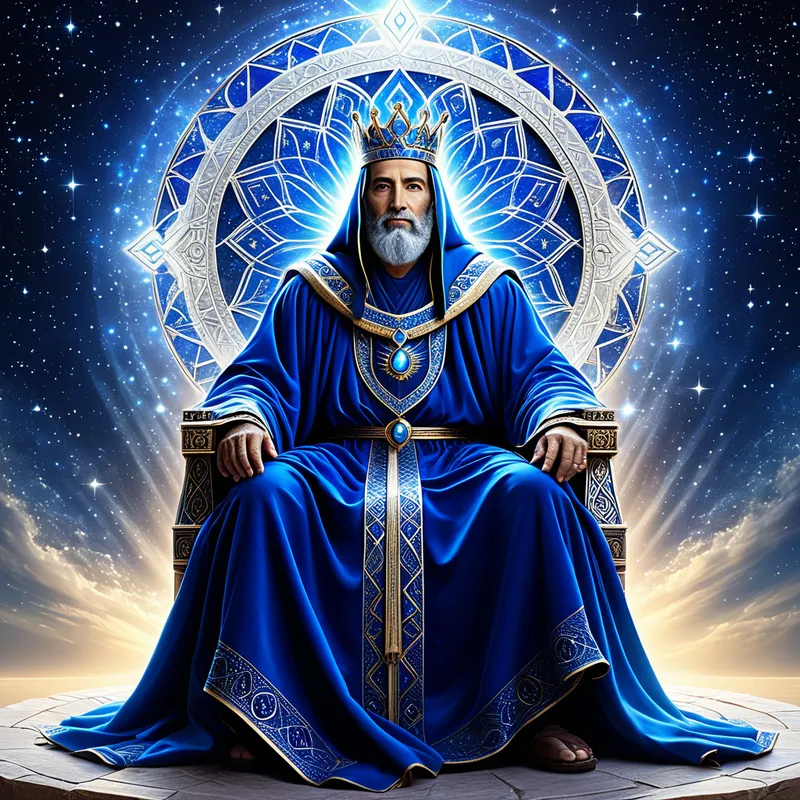
Chesed Lovingkindness Myth Meaning & Symbolism
The story of the fourth Sephirah, a boundless outpouring of grace that must be tempered by form to create a sustainable world of compassion.
The Tale of Chesed Lovingkindness
Before the worlds were worlds, in the silent, boundless expanse of Ein Sof, a desire stirred. It was not a desire of lack, but of overwhelming fullness—a yearning to give, to pour forth, to love. From this primordial wish, a point of light was drawn forth, the first vessel: Keter. And from Keter’s wisdom flowed Binah, the great, dark, receptive womb.
But between the wisdom of the father and the understanding of the mother, a torrent was born. This was Chesed. He was not a thought or a form, but a pure, undirected outpouring. A river of grace with no banks. A sun that knew no horizon. Chesed was the divine “Yes!”—an infinite, unstoppable generosity that sought only to create, to bless, to expand.
He looked upon the latent potential within Binah and saw only a canvas for his love. With a gesture of his right arm, he unleashed the foundational waters of creation. Stars burst into being not from explosion, but from jubilant excess. Colors sang into existence. Every possibility for life, for joy, for connection was poured forth in a dazzling, chaotic cascade. It was beautiful. It was terrifying. For Chesed, in his perfect love, knew no limit. He gave without measure, without structure, without asking if the vessels could hold his light.
The creation groaned under the weight of this unending gift. The nascent structures of the Etz Chaim shimmered, threatening to dissolve back into the blinding unity from which they came. The love was so absolute it risked annihilating the very otherness it sought to cherish. The world was drowning in divinity.
Then, from the left pillar, a counter-force arose. A stern, clarifying fire. This was Gevurah. Where Chesed was the outpouring river, Gevurah was the bank. Where Chesed was the expanding breath, Gevurah was the defining limit. With a voice like a forging hammer, Gevurah spoke the necessary “No.” He raised walls of judgment, carved channels of law, and imposed the form that would allow the light to be received, to be particular.
The clash was the first great drama of the cosmos. The boundless sea of Chesed crashed against the adamant shores of Gevurah. For a moment, it seemed love and law would shatter each other. But in the tension, in the sacred conflict, a miracle was born. Their meeting gave rise to Tiferet, the radiant child of mercy and judgment. Here, the torrent was tempered into rivers that could nourish. The unbounded light was filtered into sunbeams that could warm without burning. Love found its form. Kindness found its purpose. And the world, balanced between the infinite gift and the defining vessel, could finally breathe and live.

Cultural Origins & Context
The myth of Chesed is not a narrative with characters in a conventional sense, but a foundational metaphysical drama within the Jewish mystical tradition of Kabbalah. It was born in the medieval period, most notably crystallized in the Zohar, and further systematized by the 16th-century masters of Safed, like Rabbi Isaac Luria. It was passed down not by bards, but by initiates in closed circles, through dense, symbolic commentaries and meditative practices.
Its societal function was dual. Exoterically, it provided a model for divine attributes (Sefirot) and human ethics, teaching that true piety must balance lovingkindness (Chesed) with judgment and discipline (Gevurah). Esoterically, it was a map of the cosmos and the soul, explaining the origin of imperfection (the "shattering of the vessels" from too much Chesedic light) and the human role in "repairing the world" (Tikkun Olam) by consciously channeling these divine energies.
Symbolic Architecture
Chesed represents the primordial, archetypal force of unconditional giving, the urge toward expansion, connection, and nurture. It is the psychic fuel of all creation, charity, and idealism.
To be in the state of Chesed is to know the self as a conduit for a grace that originates beyond it—a force that seeks not to possess, but to perpetually bestow.
Psychologically, Chesed is the inner wellspring of empathy and the drive to nurture—whether projects, relationships, or communities. It is the "Yes" principle of the psyche. However, the myth’s critical lesson is that untempered Chesed is not sustainable love, but engulfment. Without the defining, structuring principle of Gevurah (discernment, boundaries, discipline), lovingkindness becomes a flood that drowns what it seeks to cherish. The myth encodes the essential truth that form is not the enemy of love, but its necessary vessel.

The Dreamer's Resonance
When this myth activates in the modern psyche, it often manifests in dreams of overwhelming, formless abundance. One may dream of tidal waves of warm water or light, of rooms filling with beautiful but suffocating flowers, or of trying to give a gift that endlessly multiplies and creates chaos. Somatic sensations might include feelings of being dissolved, of boundless warmth turning to a clammy sweat, or of the heart feeling so full it aches.
This signals a psychological process where the dreamer’s innate capacity for generosity, nurture, or creative expansion is surging without an internal container. It may point to a life situation where one is "overflowing" with unregulated emotion, unchecked idealism, or a caregiving role that lacks boundaries. The dream is the soul’s cry for the balancing archetype of Gevurah—for the dreamer to build inner banks for their river of love, to learn the sacred "No" that makes the "Yes" meaningful and safe.

Alchemical Translation
The alchemical work modeled by the Chesed myth is the transmutation of raw, unconscious empathy into conscious, structured compassion. The initial nigredo (blackening) is the crisis of overflow—the burnout of the caregiver, the collapse of a poorly bounded project, the resentment that follows self-abnegating love.
The albedo (whitening) is the painful, necessary confrontation with Gevurah. This is the work of shadow integration: acknowledging the part of oneself that says "enough," that needs limits, that feels anger at being taken for granted. It is forging the vessel of the self.
The ultimate gold, the Tiferet, is not the elimination of Chesed, but its mastery. It is the heart that can pour itself out completely, precisely because it knows its own inviolable shape.
The individuated Self becomes the calibrated chalice—able to receive the infinite flow from the higher Supernals and pour it into the world in measured, healing doses. One no longer is the flood; one channels the river. The triumph is the realization that true lovingkindness is a disciplined art, the sacred balance where infinite potential meets finite, loving form.
Associated Symbols
Explore related symbols from the CaleaDream lexicon:
- Water — The primary symbol of Chesed’s essence: life-giving, fluid, boundless, and potentially overwhelming without the container of the riverbank or cup.
- Cup — The vessel that receives and gives form to the overflowing grace of Chesed; the human heart or psyche as a container for divine love.
- River — Chesed in its balanced, flowing state—a directed, nourishing flow that has been tempered and channeled by the banks of Gevurah.
- Flood — The shadow aspect of untempered Chesed; love that knows no boundaries, leading to dissolution and the drowning of individuality.
- Father — Chesed is often associated with the archetypal Father principle in its nourishing, providing, and expansive aspect, the "right arm" of the divine.
- Sun — The radiant, warming, life-giving force that pours forth energy unconditionally, analogous to Chesed’s constant, generous emanation.
- Love — The core driving force of the Sephirah; not merely emotional love, but the foundational, creative principle of connection and bestowal.
- Goddess — In its receptive, flowing, and nurturing aspect, Chesed connects to the motherly, abundant face of the divine that gives without stint.
- Circle — Symbol of wholeness, inclusion, and expansion without end, reflecting Chesed’s desire to encompass all in its grace.
- Bridge — Chesed as the force that seeks to connect, to span the abyss between the divine and the created, between self and other.
- Heart — The organic, feeling center that corresponds to Chesed’s domain; the seat of unconditional love and empathetic connection.
- Chesed — The symbol itself, representing the pure archetype of lovingkindness, the fourth emanation on the Tree of Life, and the divine attribute of mercy.