Cerberus Myth Meaning & Symbolism
The monstrous guardian of the Greek underworld, Cerberus represents the primal threshold between life and death, and the psyche's terrifying gatekeeper.
The Tale of Cerberus
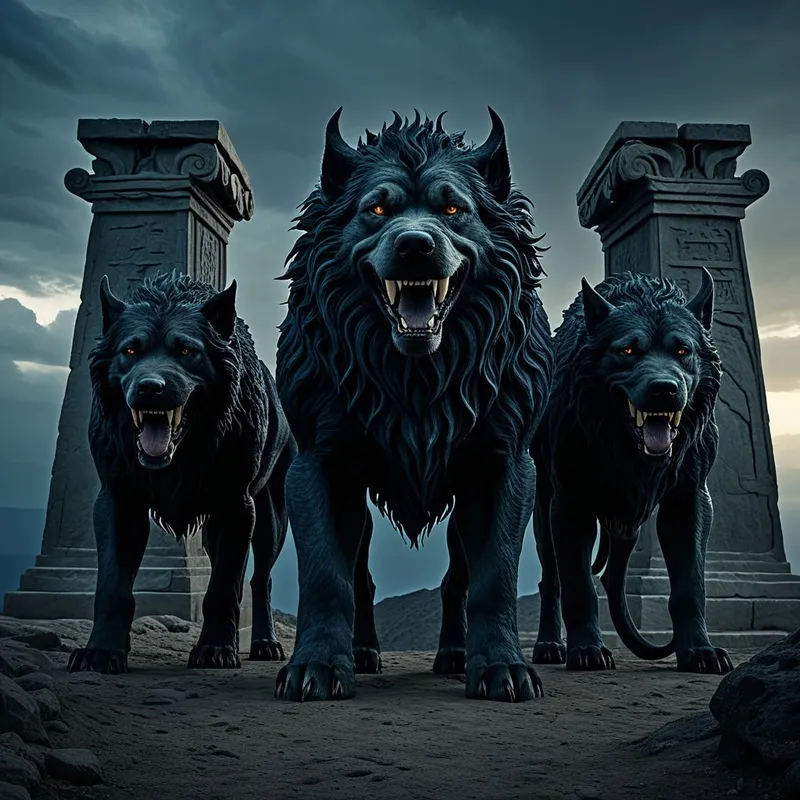
Let the firelight fall low, and listen. This is not a story of sun-drenched Olympus, but of the deep places, where the light of Helios never reaches. It begins in the realm of shadows, in the vast, echoing halls of Hades. There, in the perpetual gloom where the wails of the dead are a constant wind, a creature was born of primordial darkness. His name was Cerberus, and he was no mere beast. He was a living gate, a breathing lock, a terror given flesh and three snapping heads.
His father was Typhon, the storm giant whose breath was hurricane, and his mother was Echidna, the she-viper of the pit. From such stock, Cerberus inherited his purpose: to guard. Not gold, not a treasure chest, but the final, irrevocable threshold. He lay, a coiled mass of muscle and malice, at the point where the Acheron met the shore of the dead. His three heads saw past, present, and future; his mane was a nest of live, hissing serpents; his tail was a dragon, ever vigilant. To pass him was to leave the world of the living forever. His jaws were the last door, and they only swung one way.
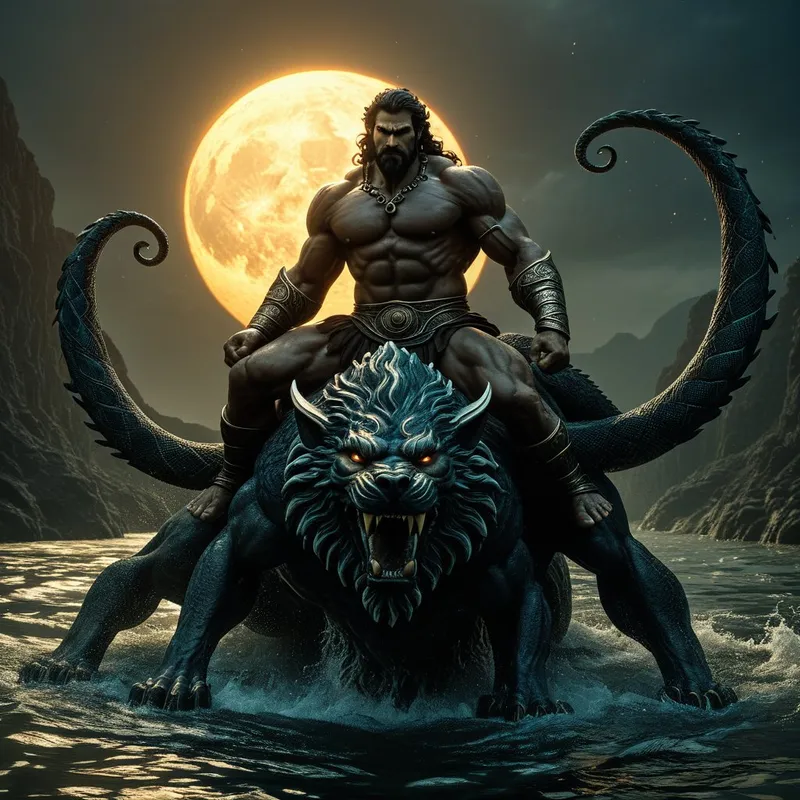
But even the most absolute of gates can be challenged. The challenge came not from a thief, but from a hero bound by a terrible penance. Heracles, in his twelfth and final labor, was commanded to bring the hound itself up from the underworld, a task deemed impossible. We must follow him down. He did not sneak or trick his way past the ferryman Charon; he overwhelmed him with his presence. He did not cower before Hades; he stood as an equal and asked, as a son of Zeus, for the creature. Hades consented, but on one condition: Heracles must subdue the beast with his hands alone, without weapon or tool.
So, in the ashen fields before the throne of the death god, the hero faced the guardian. The air grew thick with the smell of damp earth and decay. Cerberus rose, a mountain of shadow and sound—a cacophony of growls from three throats, the sinister chorus of serpents, the scrape of claws on stone. Heracles shed his lion-skin cloak and stepped forward. What followed was a wrestling match of cosmic proportions, a primal contest of containment against chaos. The hero’s hands found not one neck, but three; he fought against the lashing dragon-tail, avoided the venomous serpent-hair. It was not a battle to kill, but to master, to envelop the infinite fury within the finite strength of his arms. Finally, exhausted, the great hound was subdued. Heracles, his own skin slick with the beast’s saliva and his own sweat, dragged the monstrous guardian up through the caverns, into the shocking, painful light of the living world. The sun, which Cerberus had never known, made him whimper and drool. After showing the beast to the taskmaster Eurystheus, Heracles, honoring his pact, returned the trembling hound to his post at the gate, where he remains, forever waiting, forever watching.
Cultural Origins & Context
The myth of Cerberus is woven deeply into the fabric of Greek eschatology—their understanding of death and the afterlife. He is not a figure of casual storytelling but a cornerstone of a serious, cultural cosmology. His earliest appearances are in the epic poetry of Homer and Hesiod, where he is described with terrifying, formulaic brevity: "the shameless hound," "the brazen-voiced hound of Hades." These were not descriptions for entertainment, but ritualized, almost liturgical acknowledgments of a shared truth about the architecture of the unseen world.
Cerberus functioned as a societal and psychological boundary marker. In a culture without a unified, dogmatic doctrine of heaven and hell, the underworld was a vague, shadowy place. Cerberus gave that vagueness a concrete, terrifying form at its entrance. He was the ultimate psychopomp in reverse—not guiding souls down, but ensuring they did not come back up. His myth reinforced the finality of death, a concept crucial for maintaining social order and the sacredness of funeral rites. To pass him was the true point of no return, making the rituals of burial—the obol for Charon, the proper mourning—not mere custom, but essential navigation for the soul's journey. He was the guardian of the ultimate taboo: the boundary between the realms of the living and the dead, a boundary that must remain inviolate for the cosmos to function.
Symbolic Architecture
Cerberus is the archetypal Custos Liminis. He does not represent evil, but the necessary, terrifying function of the threshold itself. His three heads are a profound symbol, moving beyond simple monstrosity into a representation of totality.
The guardian of the threshold is not there to be slain, but to be faced. Its defeat is never permanent, for the threshold itself is eternal.
The three heads can be seen as the triune nature of time—past, present, and future—all of which must be surrendered upon entry to the land of the dead. Psychologically, they represent a unified yet multifaceted defense system. One head may be rage, another fear, the third compulsive desire—all working in concert to guard the gate to the deeper, unknown contents of the unconscious. The serpentine mane signifies the chthonic, instinctual energy that infuses this guardianship; it is not a rational sentry, but a primal, reactive one. His location at the confluence of river and shore marks him as the guardian of transitions, of the fluid becoming solid, the known dissolving into the unknown.
Heracles’ labor is equally symbolic. He is not sent to kill Cerberus, but to retrieve him. This is critical. The task is one of containment and temporary integration. He must embrace the monster, wrestle with its chaotic, multi-headed nature, and bring it into the light of consciousness (the upper world) before returning it. This models the psychological process not of eliminating one's defenses or shadow aspects, but of consciously engaging with them, understanding their power, and ultimately restoring them to their proper function—as protectors, not as ultimate rulers.
The Dreamer's Resonance
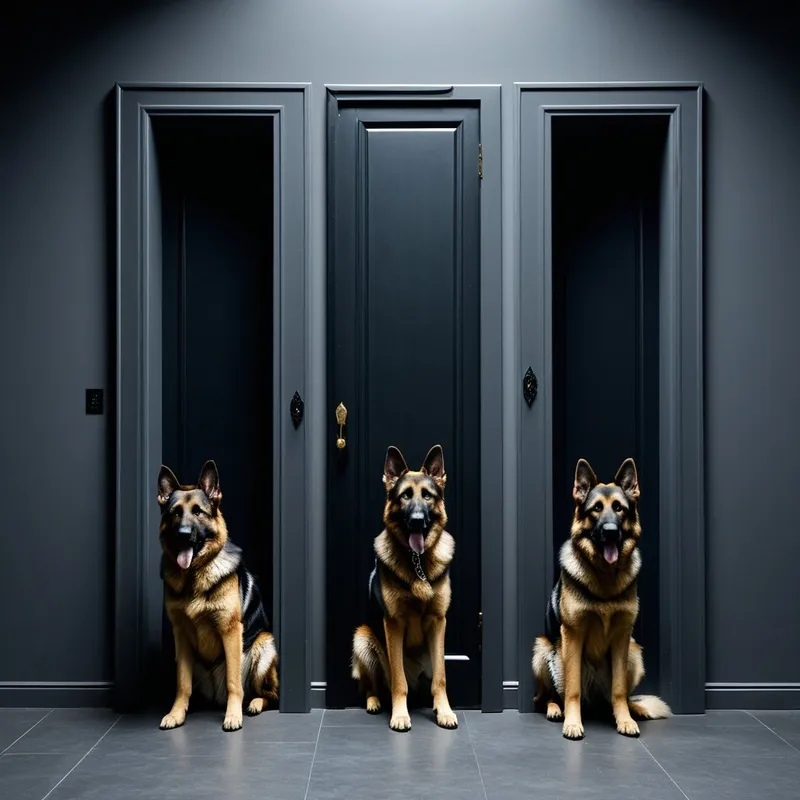
When Cerberus pads into the modern dreamscape, he rarely appears as a literal three-headed dog. He manifests as the pattern of the impassable gate. The dreamer may find themselves before a heavily fortified door, a snarling animal blocking a path, a triplicate problem (three locked doors, three angry figures, three insurmountable deadlines) that feels monolithic and designed to stop them cold. The somatic experience is one of visceral arrest: a tightening in the chest, a sinking in the gut, a feeling of being utterly stuck.
This is the psyche signaling a confrontation with a personal threshold. The "underworld" in this context is the dreamer's own unconscious territory—a repressed memory, a forbidden desire, a profound grief, or the next stage of psychological development that feels like a kind of death. Cerberus-dreams occur when the conscious ego approaches material it is not yet ready to admit. The beast’s growl is the anxiety that arises at the brink of self-knowledge. The dream is not necessarily a call to fight, but an announcement: "You are at a border. What lies beyond is guarded by a part of yourself you find monstrous. To proceed, you must deal with this first."
Alchemical Translation
The myth of Cerberus and Heracles provides a precise model for the alchemical stage of Nigredo, the initial descent into the dark matter of the soul. The labor is a guided descent, a nekyia, into the personal underworld where our most primal guardians reside.
Individuation requires us to befriend our own Cerberus, to learn the purpose of its snarls, and to negotiate passage not by destroying it, but by recognizing its service.
The modern individual's "Heraclean labor" is to approach these internal gatekeepers—our entrenched defenses, our deepest shames, our compulsive behaviors—not with weapons of suppression (rationalization, denial, addiction), but with the bare hands of conscious attention and endurance. We must "wrestle" with them, feel their full strength and terror, and through that intimate engagement, achieve a temporary mastery. This is the "bringing into the light": making the unconscious pattern conscious, seeing the shape of our own defense mechanisms in the clear light of day, where they often lose some of their monstrous power.
But the alchemy is incomplete if we simply keep the beast captive in our conscious world. That leads to inflation or a brutalizing of the personality. The final, crucial step is Heracles’ return of Cerberus to the gate. Psychologically, this is the re-consecration of the boundary. It means acknowledging that not all unconscious content needs to be, or should be, fully integrated into daily ego consciousness. Some truths are rightly kept in the depths, their guardians restored to their post. The integration is in the relationship—knowing the guardian exists, having faced it, and respecting its domain. This completes the transmutation: the threshold remains, but the individual is no longer a helpless victim of it. They have met its keeper, and in doing so, have gained the right to pass when necessary, and the wisdom to know when to turn back.
Associated Symbols
Explore related symbols from the CaleaDream lexicon: