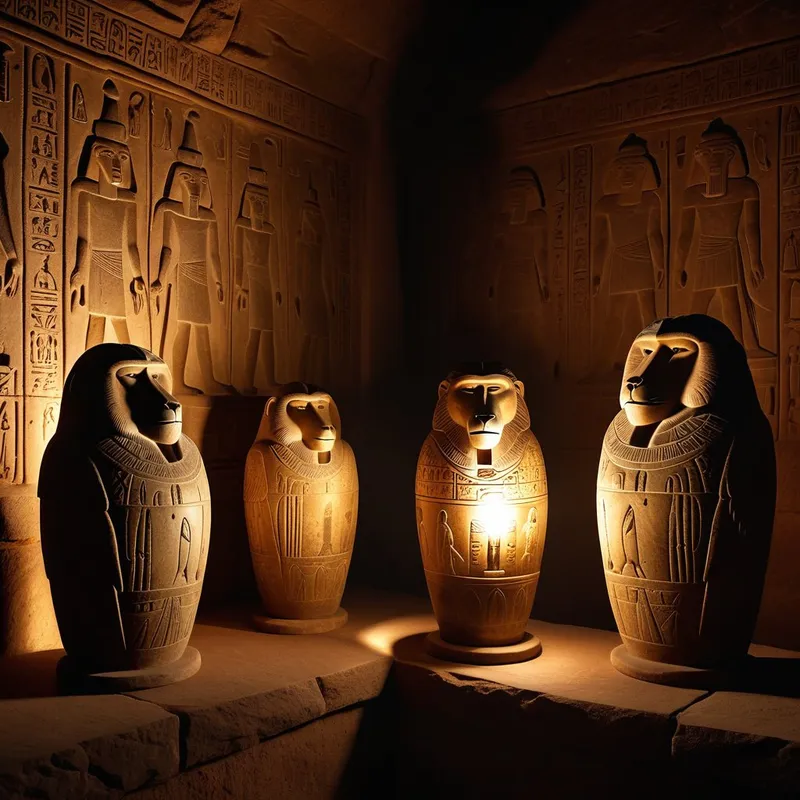
Canopic Jars Myth Meaning & Symbolism
The myth of four divine guardians who protect the viscera of the deceased, ensuring the soul's integrity for its perilous journey to the afterlife.
The Tale of Canopic Jars
In the silent, star-dusted hours before dawn, when the Duat lies closest to the world of the living, the most sacred of preparations begins. The air is thick with myrrh and the weight of eternity.
The body, a vessel that has sailed the Nile of life, now lies still upon a slab of pure alabaster. But this is not an end. It is a delicate unbinding, a careful sorting of the map from the territory. The sem priest, his eyes pools of solemn knowledge, does not see a corpse. He sees a seed. And a seed must be protected for its planting in the Field of Reeds.
With tools of obsidian and words of power older than the pyramids, he begins the work. But the soft parts, the inner landscape of feeling and digestion, of breath and filtration—these cannot make the journey as they are. They are too vulnerable to the demons of decay, to the serpent Apep who dwells in the dark waters. They must be translated.
And so, four guardians are summoned. Not with shouts, but with the whispered names of the Four Sons of Horus. From the four pillars of the sky they come, their essence settling into vessels of cold, carved stone.
First, Imsety, of the human face, whose watchful gaze promises safe keeping. To him is entrusted the liver, the seat of emotion and character. Then, Hapi, with the keen face of a baboon, guardian of the north wind and the lungs that once drew the breath of the world. The lungs, light as whispers, are placed in his care.
From the west comes Duamutef, his jackal ears pricked for danger. To him goes the stomach, the crucible of nourishment and, sometimes, bitterness. He will guard its contents. Finally, from the south, Qebehsenuef, swift as a falcon in flight. He takes charge of the intestines, the long coil of processing and discernment.
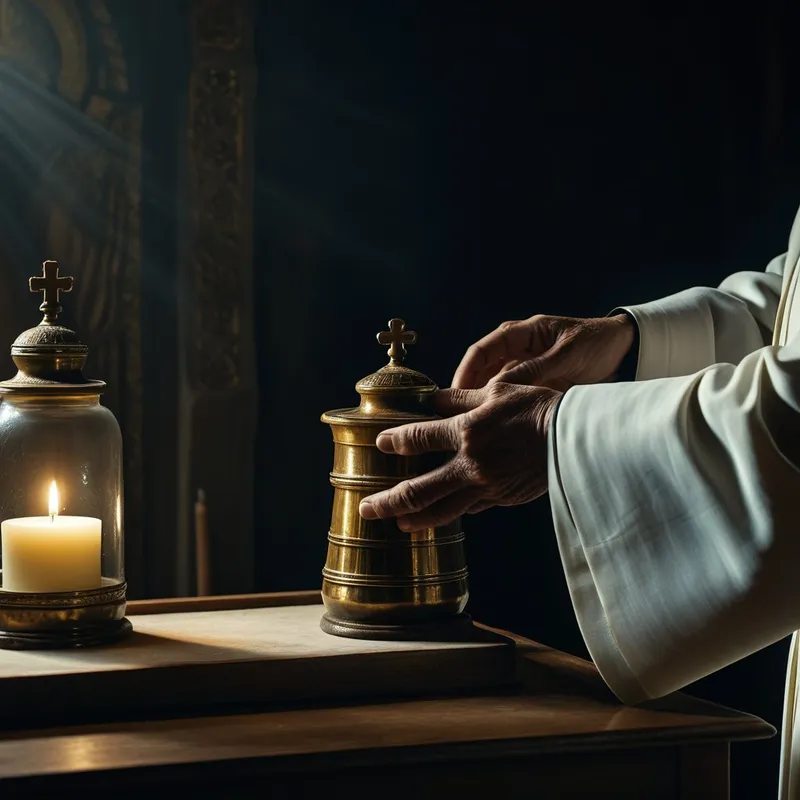
Each organ, cleansed with natron and palm wine, wrapped in linen finer than a pharaoh’s robe, is anointed and cradled into its own jar. The priest seals each lid with resin as black as the fertile Nile soil. A spell is spoken, a binding of protection: "O Imsety, may you cause my name to flourish, may you cause my soul to be stable, may you be a protector behind me."
The four jars are now more than clay and stone. They are sentinels. They are a divine quartet holding the sacred interiority of a person, a compact made with the gods themselves. As the mummy is laid to rest in its outer coffin, the jars are placed close by, in a chest or niche, facing the four cardinal directions—a fortress of the self against the chaos of non-being. The journey through the Duat can now begin, for the soul knows its deepest parts are guarded, preserved, and waiting to be reclaimed when the sun rises on a new, eternal life.
Cultural Origins & Context
The myth and ritual of the Canopic Jars are not a single story transcribed on papyrus, but a living practice woven into the very fabric of Old Kingdom and later Egyptian funerary culture. Their origins are pragmatic, evolving from the necessities of mummification—the removal and disposal of internal organs to prevent rapid decay. But in the Egyptian worldview, where every physical act had a cosmic echo, this practicality was instantly mythologized.
The practice became standardized by the New Kingdom, with each jar assigned to a specific Son of Horus, a specific organ, a cardinal direction, and even a protective goddess (Isis, Nephthys, Neith, and Serqet). This was not mere superstition; it was a sophisticated metaphysical technology. The myth was passed down not by bards, but by guilds of embalmers and priests in the Per-Nefer, the "House of Beauty." It was enacted, not just narrated.
Its societal function was profound: it mediated the ultimate human terror—the dissolution of the self after death. By providing a ritual container (both literal and symbolic) for the visceral self, it asserted that identity could survive physical corruption. It transformed a biological process of decay into a sacred drama of preservation, reinforcing the core Egyptian values of order (Maat) over chaos (Isfet). To have one's organs guarded by the sons of the sky god Horus was to have one's humanity underwritten by divinity itself.
Symbolic Architecture
At its heart, the myth of the Canopic Jars is a profound allegory for the integrity of the self. The body in life is a unified whole, but in the face of transformation (death, or any great crisis), it risks being scattered, lost, or consumed. The jars represent the necessary act of psychic differentiation and conscious safeguarding.
To be whole is not to be a seamless monolith, but to be a wisely governed kingdom of distinct parts.
The four organs are not random. They symbolize core aspects of human experience:
- The Liver (Imsety) is the seat of emotion, passion, and the feeling self.
- The Lungs (Hapi) are the breath, the spirit (Ka), and our connection to the wider world.
- The Stomach (Duamutef) is digestion, assimilation, and the capacity to process experience—both nourishing and toxic.
- The Intestines (Qebehsenuef) are elimination, discernment, and the sorting of the essential from the waste.
The myth tells us that to navigate a profound transition, we must consciously identify, honor, and protect these vulnerable aspects of our being. We cannot drag the raw, unprocessed contents of our inner life blindly into the next phase. They must be "embalmed"—treated with the sacred salt of reflection (natron) and wrapped in the linen of intention. The Four Sons of Horus are thus archetypal guardians, the protective, caring functions of the psyche that watch over our vulnerable inner contents when our central ego-consciousness is undergoing its own "death" or transformation.

The Dreamer's Resonance
When the motif of Canopic Jars appears in modern dreams, it rarely manifests as literal Egyptian artifacts. Instead, the dreamer might encounter a set of four identical but distinct boxes, safes, or compartments. There may be a pressing need to "put something away for safekeeping" or a anxiety about something precious being "scattered."
This dream pattern signals a somatic and psychological process of containment during disintegration. The dreamer is likely in a life transition so potent it threatens their sense of internal cohesion—a divorce, a career loss, a spiritual crisis, a deep grief. The psyche, in its ancient wisdom, is initiating its own ritual of mummification. It is saying: "Your old self is dying. But before you can journey forward, you must carefully remove and preserve the essential organs of your experience. What feelings (liver), what inspirations (lungs), what nourishing lessons (stomach), and what discernments (intestines) must be consciously saved from this decay?"
The dream may evoke a sense of sacred duty mixed with melancholy. It is the work of the Caregiver archetype applied to oneself. To dream of sealing a jar is to perform an act of profound self-compassion, acknowledging that parts of you are too tender to face the immediate storm and must be held in protective stasis until a new dawn.

Alchemical Translation
The alchemical process mirrored in this myth is separation (separatio) and coagulation. In the alchemist's vessel, the primal matter (the nigredo) must be broken down into its constituent parts before it can be purified and reconstituted into a higher, integrated form (the lapis philosophorum).
The journey to wholeness requires a willing descent into parts. One must become a curator of one's own interior museum.
For the modern individual seeking individuation, the "Canopic Jar ritual" is a powerful inner practice. It begins with the recognition that a phase of life is ending—a relationship, an identity, a project. The instinct may be to flee or to cling desperately to the crumbling whole. The myth instructs otherwise: Pause. Perform the sacred autopsy.
Identify the Four Contents: In meditation or journaling, consciously differentiate your inner "organs." What are the core feelings from this experience (Imsety's jar)? What inspirations or connections sustained you (Hapi's jar)? What have you digested and learned, even from hardship (Duamutef's jar)? What have you rightfully discarded or discerned as not yours to carry (Qebehsenuef's jar)?
Invoke the Guardian Archetypes: Consciously call upon your own inner protectors—your capacity for stability (Imsety), your connection to spirit (Hapi), your resilience (Duamutef), and your discernment (Qebehsenuef). Assign them the care of these vulnerable parts.
Seal the Jars: This is the act of conscious containment. It means not obsessively re-examining the raw pain or joy, but granting it a sacred space to rest. It is saying, "This feeling is real and it is mine, but I do not need to live inside it right now. I place it in safekeeping."
This process does not eliminate the experience; it transmutes it. The scattered, reactive contents of a life transition are gathered, honored, and preserved. They are no longer agents of decay poisoning the present, but become sacred relics, the preserved essence of who you were, which will be needed to animate who you are becoming. When the soul finally emerges into the "Field of Reeds"—the new, more conscious state of being—it does so not as a ghost, but as a reconstituted, whole being, able to reclaim the full depth of its journey. The jars ensure that nothing essential was left behind in the dark.
Associated Symbols
Explore related symbols from the CaleaDream lexicon: