
Cancer Myth Meaning & Symbolism
A crab, sent by Hera to aid the Hydra, is effortlessly crushed by Heracles, yet is lifted to the stars as the constellation Cancer.
The Tale of Cancer
The air in the Lernaean marsh was thick with the breath of decay. It was a place where sunlight fractured on the oily water and the very ground seemed to sigh with poisoned bubbles. Here, Heracles, his lion-skin cloak heavy with sweat and resolve, faced his second labor. Before him rose the Hydra, a nightmare given flesh—a nest of serpents with a central head that was immortal, its hisses a chorus of venomous promise.
The battle was a storm of muscle, bronze, and monstrous regeneration. For every head Heracles crushed or severed with his great club, two more sprouted in its place, their jaws dripping with a poison that smoked where it fell. The stench of burning flesh and marsh gas filled the hero’s lungs. His muscles screamed, his world narrowed to the dance of death in the sucking mud.
From her golden throne on Olympus, Hera watched. Her hatred for her husband’s illegitimate son was a cold, constant fire. Seeing her favored monster hard-pressed, her divine will reached into the living world. She did not summon a titan or a storm. She called upon the deep, silent loyalty of the oldest world. From the reeking shallows of the swamp itself, she stirred a creature of instinct and carapace.
It was not large. It was not majestic. It was a crab, a Karkinos, its shell a dull, mottled brown against the vibrant slime. It felt the divine command not as a thought, but as a pull deeper than the tide—a compulsion to aid the Hydra, to serve the Queen of Heaven. Without hesitation, it scuttled from its hiding place, navigating the tangled roots and murky water. Its mission was simple, absurd, and absolute: to pinch the foot of the demigod, to distract him, to offer what aid it could.
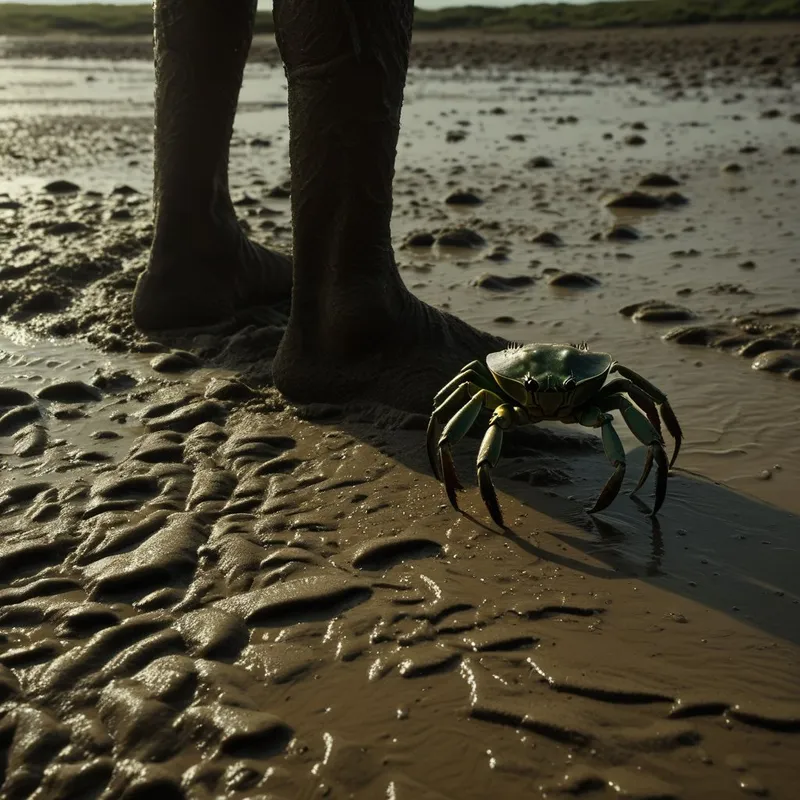
The crab emerged onto the bank where Heracles fought. It saw the pillar-like legs, the feet planted firmly in the mud for leverage. It raised its claws, a tiny, armored soldier answering the call of its goddess. With all the force in its small body, it clamped down on the hero’s heel.
Heracles, immersed in the colossal struggle, barely registered the sensation. A flicker of irritation, a minor pressure amidst the hydra’s crushing coils and snapping jaws. Without breaking his rhythm, without even looking down, he shifted his immense weight. His foot came down. There was a soft, crisp sound, like a dry twig snapping underfoot. The loyal crab, the instrument of a goddess’s wrath, was crushed into the mud, its purpose extinguished in an instant.
The battle raged on. Heracles, with the aid of his nephew Iolaus, found his strategy and prevailed. But Hera did not forget the creature that had answered her call. In the cold fire of the stars, where the gods inscribe their stories, she found a place for the crab. Not among the great heroes or terrible beasts, but in the quiet vastness. She lifted its essence, this fragment of futile loyalty, and placed it among the eternal lights. There it remains, a faint, claw-shaped cluster in the sky—the constellation Cancer, a memorial not to victory, but to the act of trying.
Cultural Origins & Context
This brief episode is embedded within the vast cycle of the Labors of Heracles, a foundational narrative of Greek heroism and suffering. The primary source is the Bibliotheca of Pseudo-Apollodorus, a 1st or 2nd-century CE compendium of myths that systematized older, oral traditions. The crab’s role is a classic example of a divine intervention, a moment where the personal feud between Hera and Heracles spills into the physical struggle.
Its societal function is multifaceted. On one level, it is an aetiological myth, explaining the origin of a constellation. For an agrarian and seafaring culture, the stars were both calendar and compass; giving them a story rooted them in the divine narrative. More profoundly, the myth served as a lesson in cosmic perspective. It illustrated the absolute power of the gods, who could use the smallest creature as a pawn and then, capriciously or mercifully, grant it immortality. It reminded the listener that in the grand conflicts of heroes and gods, most beings are like the crab—acted upon by forces far greater than themselves, their fates decided in a moment.
Symbolic Architecture
The crab, Karkinos, is one of mythology’s most potent symbols of futile loyalty and honorable failure. It represents the part of the psyche—or the community—that answers the call to duty, regardless of the odds or its own capacity. It is the instinct to protect, to aid, to be of service, even when that service is destined to be annihilated by an overwhelming force.
The crab does not choose its battle; it is chosen by it. Its heroism lies not in victory, but in the unwavering commitment of its nature.
Psychologically, Cancer symbolizes the shadow aspect of the caregiver archetype. This is not the nurturing, successful caregiver, but the one who gives everything for a cause that may not value it, who is crushed by the burdens it takes on. The crab’s hard shell represents emotional armor and defensive vulnerability—it can pinch, but it cannot withstand a true cataclysm. Its habitat, the liminal space between water and land, mirrors its role in the myth: a creature caught between the divine will (Hera) and the heroic human endeavor (Heracles), belonging fully to neither and destroyed by both.
The Dreamer's Resonance
When the pattern of the Cancer myth surfaces in modern dreams, it often signals a profound somatic and psychological process related to futile effort and unrecognized sacrifice. The dreamer may experience sensations of being pinched, held, or constricted (the crab’s grip), or of a crushing weight (the hero’s foot). They may dream of small, armored animals in moments of peril, or of performing a vital task that is utterly ignored by larger, chaotic events.
This is the psyche working through experiences of loyalty that led to personal devastation, of caregiving that went unreciprocated or was exploited, or of fighting a battle that was never truly theirs to win. The dream is not necessarily a warning, but an acknowledgment. It is the unconscious honoring that part of the self that said "yes" to an impossible demand, that tried to hold the line, and was broken for it. The emotional residue is not of fear, but of a deep, melancholic honor—the feeling of having been faithful to a call, even if the call came from a place of manipulation (the Hera complex) and the result was annihilation.
Alchemical Translation
The alchemical journey modeled by Cancer is the transmutation of futile sacrifice into cosmic significance. The base material is the leaden feeling of being crushed, used, and discarded. The process begins with the honest recognition of that experience: I was the crab. I answered the call and was broken.
The first stage is calcination—the crushing underfoot. This is the experience of defeat, the reduction of a complex emotional commitment to ash and fragments. The second is dissolution in the swamp waters of the unconscious, where the ego’s narrative of the event breaks down. Why did I feel compelled? Who was I really serving?
The constellation is not a reward for success, but a symbol of integration. The stars are the psychic recognition that the crushed self has a place in the greater order of the soul.
The crucial coagulation comes when the dreamer, like Hera, performs the divine act of remembrance. This is not an act of the victimized ego, but of the transcendent function. It involves lifting the memory of that crushed loyalty out of the mud of shame and viewing it with the cold, objective light of the stars. The transformation is this: the event is no longer a personal failure, but an archetypal node in one’s personal mythology. The care that was given, however futile in the outer world, becomes an immutable part of one’s inner cosmos. The individual learns to honor their own crab-like loyalty, not for its outcome, but for its essence—the courage to pinch the heel of a giant, knowing what must follow. In this act of self-recognition, the crushed caregiver is redeemed, not by the world, but by the soul’s own night sky.
Associated Symbols
Explore related symbols from the CaleaDream lexicon: