
Caipora Spirit of the Hunt Myth Meaning & Symbolism
A myth of the wild guardian who tests hunters, teaching that true sustenance comes not from taking, but from a sacred, reciprocal relationship with the living forest.
The Tale of Caipora Spirit of the Hunt
Listen. The forest is not silent. Beneath the chorus of frogs and the sigh of the canopy, there is a deeper rhythm—the heartbeat of the world before humans. In that green, breathing darkness, where roots are older than memory, dwells the one who owns the game. They call him Caipora.
He is the lord of the tapir’s path, the master of the peccary’s herd, the keeper of every feathered life that flits through the sun-dappled air. His hair is a wild flame of red, his body smeared with the sacred urucum, and his eyes hold the ancient, unblinking knowledge of the jaguar. He rides upon a fierce queixada, his feet never touching the ground that belongs to the dead and the decaying.
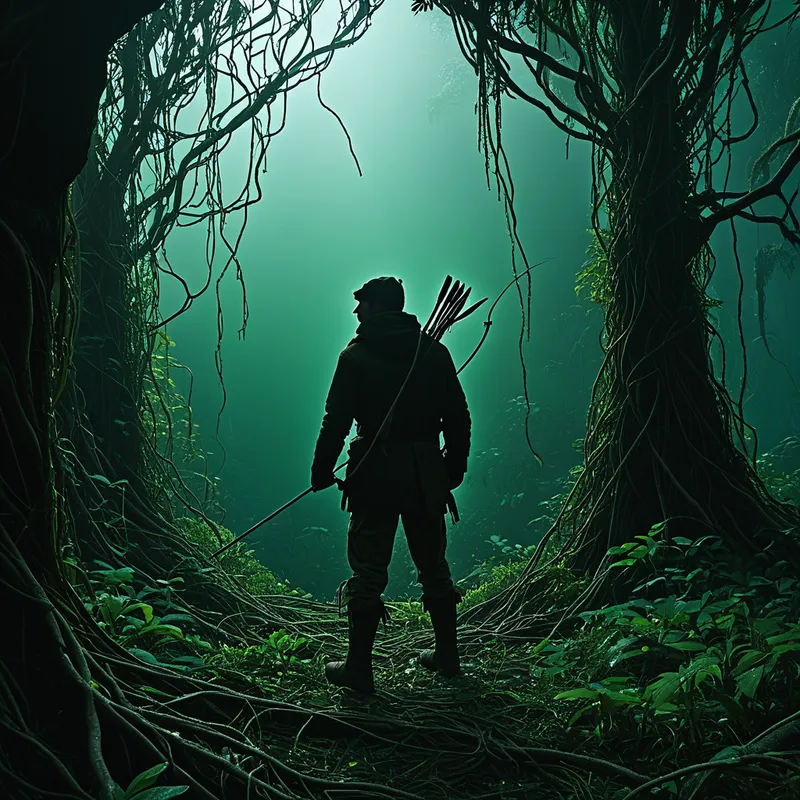
Now, a hunter enters his domain. The man is skilled, his muscles remembering the pull of the bow, his eyes reading the broken fern, the turned leaf. He seeks meat for his family, hide for warmth, life to sustain life. He whispers prayers to the forest, makes his small offerings of tobacco. But hunger is a sharp teacher, and sometimes need makes the heart greedy, the eye covetous.
This is when the air changes. The familiar sounds fall away, swallowed by a watchful quiet. The hunter feels a gaze upon his neck, heavy as a stone. He turns. Between the buttressed roots of a great samaúma, Caipora sits. Not threatening, but present. A test made flesh.
The hunter’s skill is now a toy. His arrow, so true moments before, flies astray. The game he stalked vanishes as if it were mist. The trails he knew twist back upon themselves, the sun hiding behind a sudden veil of cloud. The forest itself has turned stranger, a labyrinth with a single, red-haired guardian at its center. Panic, that cold serpent, coils in the hunter’s belly. He is lost in a world he thought he knew.
The resolution is not a battle, but a realization. The hunt has failed because it was only a taking. Caipora does not deny sustenance; he guards the covenant of it. The hunter must stop. He must sit in his confusion and fear. He must remember the old ways—not just the technique, but the respect. He offers what little he has left: a whispered apology, a promise, a piece of his own food left at the root of the tree.
And as suddenly as it came, the spell lifts. A path clears. A fat bird alights on a nearby branch, offering itself. The hunter takes it with a heart now full of gratitude, not just triumph. He leaves the forest, carrying his meat and a new, humbling knowledge: he does not conquer the wild. He converses with it. And Caipora, the spirit of the hunt, fades back into the leaves, his work done—the balance preserved, the lesson given.
Cultural Origins & Context
The figure of Caipora is woven into the fabric of numerous Indigenous Amazonian cultures, with variations found among Tupi-Guarani and other peoples. He is not a deity of a distant pantheon, but a pervasive spirit of place, an immediate and personal manifestation of the forest’s will. These stories were not recited in temples but shared in malocas (communal houses) after the hunt, by firelight. They were practical theology, passed from elder to youth alongside the crafting of arrows and the reading of tracks.
His primary societal function was ecological and ethical governance. In a world where survival depended on hunting, unchecked human predation could devastate game populations. Caipora served as the embodied conscience of the ecosystem, a regulatory force that taught sustainability through direct, mystical experience. He enforced the rules of reciprocity: one must only take what is needed, must offer gratitude and respect, and must acknowledge that the animals are not mere resources but beings under another’s protection. The myth was a narrative container for profound environmental ethics, ensuring the community’s survival by curbing its potential for excess.
Symbolic Architecture
At its core, the myth of Caipora maps the psyche’s relationship with the instinctual, untamed realm—the Shadow of the natural world. Caipora himself is the archetypal liminal guardian. He is not evil, but sovereign. He represents the autonomous, non-human intelligence of nature that operates by its own laws, indifferent to human ambition.
The true hunt is not for the animal, but for the right relationship with the wildness that sustains and precedes us.
The hunter’s initial failure symbolizes the ego’s inevitable frustration when it attempts to navigate the deep, instinctual layers of the psyche (the Forest) with only conscious skill and strategy. Caipora’s trick—confusing paths, spoiling aim—is the unconscious defending its integrity, refusing to be plundered. The required offering is the symbolic sacrifice of pure egoic will. The hunter must surrender his identity as a mere taker and reconstitute himself as a participant in a sacred exchange. The gift of game that follows is the bounty that flows only when the ego aligns with, rather than assaults, the deeper order of life.
The Dreamer's Resonance
When this myth pattern stirs in modern dreams, it often manifests during life phases where one feels their efforts are fruitless, their paths blocked, or their skills rendered useless. You may dream of being lost in a vast, dense woodland, pursued or observed by a potent, ambiguous figure. Or you may dream of a crucial tool failing at the decisive moment.
Somnologically, this is the psyche initiating a process of reorientation. The frustration in the dream is somatic—it is the feeling of the ego butting against an immovable, inner Caipora. The dream is asking: What are you trying to “hunt” or achieve through force alone? Where are you taking without offering respect or reciprocity—perhaps in your career, a relationship, or your own creative process? The figure’s gaze forces a confrontation with the part of your own nature that sets limits and demands ethical engagement with your instincts and ambitions. The dream invites not a redoubling of effort, but a humbling pause and a renegotiation of terms with your own inner wild.

Alchemical Translation
The alchemical journey modeled here is the transmutation of the ego from a conqueror into a covenant partner. The initial state is the Hunter, whose formula is “I take.” The confrontation with Caipora is the nigredo, the blackening—the dark night of confusion and lostness where one’s old maps are worthless.
The crucial operation is the sacrifice. This is not a grand gesture, but a small, sincere act of humility—the dreamer’s offering of tobacco, their apology. Psychologically, this is the conscious acknowledgment of the sovereignty of the Self (the total, regulating psyche) over the ego. It is saying, “I am not the sole author here.”
Individuation is not the ego’s victory parade through the unconscious, but its solemn initiation into the service of a larger ecology of being.
The final gift—the game that presents itself—is the albedo, the whitening, and the beginning of the rubedo. Sustenance, insight, creativity, or vitality now flow not as a trophy seized by effort, but as a gift received in right relationship. The individual is transformed. They have learned to navigate the forest not as a foreign territory to be dominated, but as the very ground of their own being, with which they must maintain a continuous, respectful, and reciprocal dialogue. The spirit of the hunt becomes an internalized guide, the moral compass of one’s engagement with the inner and outer wild.
Associated Symbols
Explore related symbols from the CaleaDream lexicon:
- Forest — The prime symbol of the unconscious, the unknown, and the realm of untamed instinct where the rules of the conscious ego do not apply.
- Hunter — Represents the conscious ego's directed will, its desire to seek, acquire, and achieve within the vast terrain of the unconscious or life itself.
- Spirit of the Forest — The autonomous, guarding intelligence of the wild, both external nature and the deep psyche, which enforces natural law and balance.
- Trickster — The aspect of Caipora that confounds logic and expectation, serving to disrupt hubris and force a deeper, more humble mode of engagement.
- Sacrifice — The essential act of giving up something of the ego (pride, control) to establish reciprocity and right relationship with a greater power.
- Gift — The bounty, insight, or sustenance that flows naturally once the correct respectful relationship with the deeper source has been established.
- Bridge — The mediated connection between the human world and the spirit world, or between the conscious ego and the unconscious, which is forged through ritual and respect.
- Mirror — Caipora acts as a mirror to the hunter, reflecting back his intentions, forcing self-confrontation and the seeing of one's own shadow.
- Ritual — The prescribed acts of offering, prayer, and respect that maintain the covenant between humanity and the wild, structuring the interaction.
- Shadow — The Caipora embodies the personal and collective shadow—the repressed, instinctual, and "wild" part of the self that must be acknowledged, not conquered.
- Boundary — Represents the liminal space Caipora guards, the threshold between taking and receiving, between human domain and the sovereign realm of nature.
- Journey — The hunter's path into the forest and his disorienting return symbolize the necessary journey into the unknown self, which transforms the traveler.