Cadmus Myth Meaning & Symbolism
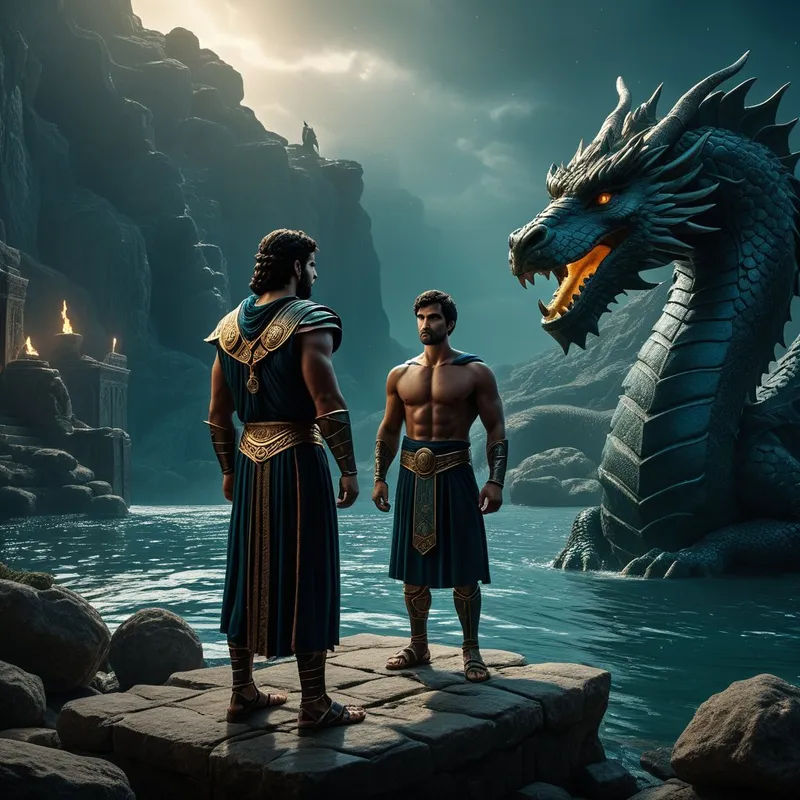
A Phoenician prince, searching for his sister, slays a dragon and sows its teeth, birthing a warrior race and founding the great city of Thebes.
The Tale of Cadmus
Hear now the tale of Cadmus, son of Agenor, whose story begins not with a crown, but with a loss that would echo through the ages. His sister, Europa, was taken from the sun-drenched shores of Tyre, carried across the wine-dark sea on the back of a magnificent, gleaming bull—none other than Zeus himself in disguise. The king, Agenor, mad with grief and fury, commanded his sons: "Go! Wander the earth until you find her, and never return to see my face unless you bring her home."
So Cadmus journeyed, a prince without a kingdom, a seeker with an impossible quest. He traversed foreign lands, consulting the cryptic oracle at Delphi. The Pythia, wreathed in sacred vapors, did not speak of Europa. Instead, her voice echoed from the stone: "Forget the heifer. Follow a cow with a moon-shaped mark. Where she lies down from weariness, there you shall found a city."
Guided by this bovine omen, Cadmus followed a wandering cow across strange terrain until, in the land that would be called Boeotia, she sank to her knees in a grassy plain. Grateful, Cadmus sent his companions to fetch water from a nearby sacred spring for a sacrifice to Athena. But this spring was the guarded treasure of Ares, and its guardian was a monstrous dragon, a creature of coiled scales and venomous breath. One by one, Cadmus’s men did not return, their lifeblood staining the water.
Finding them slain, a righteous fury filled Cadmus. He seized a massive boulder and, with a strength born of grief and destiny, hurled it at the beast’s head. As the dragon reeled, he drove his spear deep into its scaled flank, pinning the serpent to an oak tree. The earth seemed to shudder at the death of the divine creature.
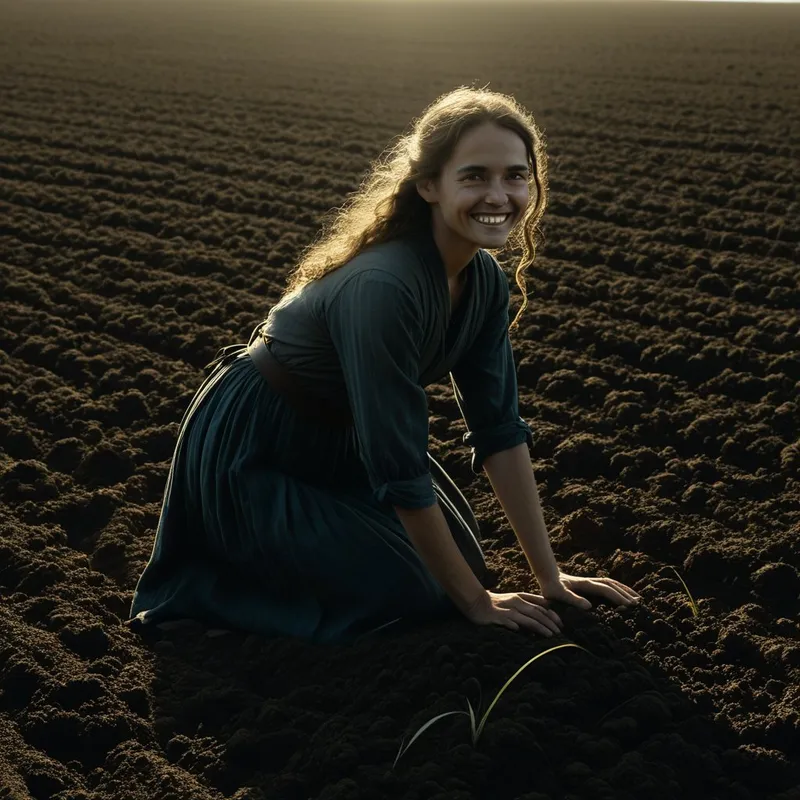
Then, a voice—the voice of Athena herself—spoke from the shimmering air. She instructed the stunned hero to pull the dragon’s teeth and sow them in the earth like seeds. With a heavy heart, Cadmus did as commanded, plowing a furrow and planting the terrible teeth. No sooner had the last tooth vanished into the dark soil than the earth began to heave. From the ground erupted armed men, the Spartoi, clashing in instant, murderous rage.
Cadmus watched in horror as the harvest of his deed turned the field into a battlefield. At Athena’s whispered urging, he threw a stone among them. Mistaking it for an attack from one of their own, the sown warriors turned their weapons on each other until only five remained, their fury spent. These five would become the noble ancestors of Thebes, and Cadmus, their king.
His reign was long, his city great, but the wrath of Ares is a debt that must be paid. For the slaying of the dragon, Cadmus and his wife Harmonia were cursed, their later years shadowed by tragedy. In the end, transformed into serpents, they were carried away to the Elysian Fields, their story complete: a founder born from a quest, a city born from a dragon, and a fate woven from both glory and grim repayment.
Cultural Origins & Context
The myth of Cadmus is a foundational narrative, a charter myth for one of Greece’s most powerful and storied city-states: Thebes. It exists in the liminal space between pre-Greek (Pelasgian) history and the classical Hellenic world, and its transmission is a tapestry woven from many threads. The primary sources are the epic poets, like Hesiod in his Catalogue of Women, and later systematizers like Apollodorus. Tragic playwrights, especially Euripides in his Bacchae, explored the later, cursed chapters of the Cadmean lineage.
Societally, the myth served multiple functions. It provided an etiological explanation for Thebes’s origins and the fierce, often fractious nature of its citizenry—sprung from the earth and from conflict. Crucially, it also encoded a profound cultural memory: the transmission of the alphabet. Cadmus, the Phoenician, is credited in history (via Herodotus) and legend with bringing the Phoenician script to Greece, which was adapted into the Greek alphabet. Thus, the myth celebrates not just the physical founding of a city, but the intellectual foundation of Greek literacy and civilization itself, a foreign gift that bore immense local fruit.
Symbolic Architecture
Cadmus is the archetype of the civilizing hero, but his path reveals that civilization is not a gentle act of ordering chaos, but a violent, sacred, and fateful engagement with it. The dragon at the spring is the untamed, instinctual power of a place—the genius loci—that must be confronted and integrated, not merely avoided.
To found a city of the soul, one must first slay the dragon of undifferentiated nature and sow its teeth in the plowed field of consciousness.
The dragon’s teeth are the seeds of potential, but they are martial potential, raw and aggressive. Sowing them represents the act of introducing a new, potent, and dangerous energy into the psychic soil. The immediate result is not harmony, but the Spartoi—the armed conflicts, the internal factions, and the shadow aspects that erupt when a new complex is integrated. The hero’s role is not to fight them all, but to catalyze their confrontation with each other, allowing the strongest, most viable aspects (the five survivors) to become the foundational pillars of the new order. The marriage to Harmonia, daughter of Ares (Strife) and Aphrodite (Love), is the ultimate symbol: lasting order is not the absence of conflict, but the sacred marriage of conflict and harmony.
The Dreamer's Resonance
When the pattern of Cadmus stirs in the modern dreamer, it signals a profound process of inner foundation. The dreamer may be on a seemingly futile "search for Europa"—a quest for a lost, idealized aspect of the self or relationship. The oracle’s redirection marks a critical turning point in the psyche: the call to stop looking outward and to instead build something new within.
Dreams of confronting a serpent or dragon at a water source point to a necessary engagement with deep, instinctual energies blocking access to the vital waters of emotion or creativity. The subsequent dream imagery of sowing seeds that turn into fighting figures reveals the somatic truth of integration: new commitments, ideas, or life changes do not arrive peacefully. They initially manifest as inner conflict, competing voices, and internal warfare. The dreamer is in the field, witnessing the battle of their own potentials. The resolution comes not from taking a side, but from introducing a neutral, catalytic element (the stone) that allows the conflicts to resolve themselves, leaving a core, resilient identity.
Alchemical Translation
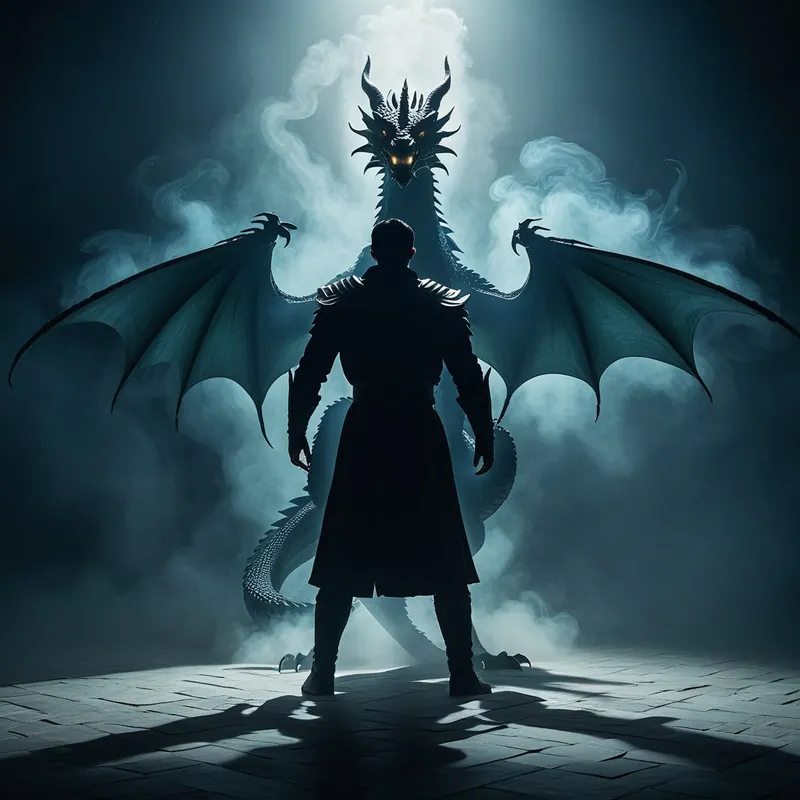
The Cadmus myth is a precise alchemical map for the process of psychic transmutation, or individuation. The prima materia is the lost sister and the father’s curse—a state of fractured wholeness and exiled longing. The first operation, the nigredo, is the long, arid search and the confrontation with the dragon at the dark spring: the confrontation with the shadow in its most terrifying, autonomous form.
Slaying the dragon is the necessary separatio, distinguishing the ego-consciousness from the devouring unconscious. But the work is not done. The albedo, the whitening, is the sowing of the teeth—the conscious, intentional planting of that conquered power back into the fertile unconscious (the earth). This is the critical phase moderns often skip: we defeat a complex but fail to "sow its teeth," leaving its energy unused or repressed.
The dragon’s power is not to be discarded, but planted. The chaos that sprouts is the ferment of transformation.
The battling Spartoi represent the citrinitas, the yellowing or fermentation, where integrated contents violently reorganize the psyche. The ego, like Cadmus, must hold the tension without premature intervention. Finally, the five surviving founders represent the rubedo, the reddening or creation of the lasting "city"—a coherent, resilient, and dynamic psychic structure capable of enduring its own inherent conflicts. The subsequent curse and serpent transformation remind us that individuation is not a static achievement of perfection, but a lifelong process that ultimately transcends the human perspective, leading to a more cosmic, symbolic existence—the serpentine wisdom of the Elysian Fields.
Associated Symbols
Explore related symbols from the CaleaDream lexicon: