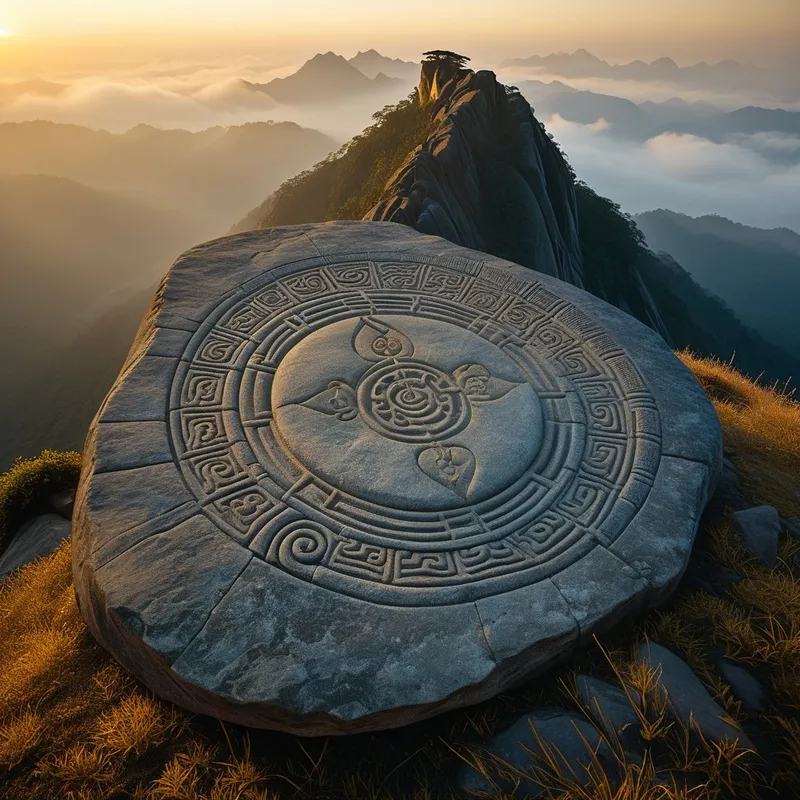
Buddhapada Myth Meaning & Symbolism
The sacred footprint of the Buddha, a cosmic map left not in stone but in the psyche, marking the path from wandering to awakening.
The Tale of Buddhapada
Listen. Before the words, there was the step. Before the temple, there was the path. Before the doctrine, there was the impression.
In the time after the Great Awakening, the one known as the Tathagata walked the dusty roads of the Ganges plain. His feet, calloused from years of ascetic wandering and now grounded in ultimate truth, touched the earth not as a man walks, but as a principle imprints itself upon reality. Where he passed, the air hummed with a profound silence; where he rested, the very ground seemed to remember.
He came to a place of crossroads, where the way divided into many paths—some leading to bustling villages, others into the deep, whispering forest. Here, he paused. He did not speak a sermon. He did not perform a miracle of light or sound. Instead, he simply placed his foot upon a broad, flat stone beside the path. And as he lifted it, the stone did not remain blank.
It held, not a mere indentation, but a universe in miniature. Upon that sacred sole—the Buddhapada—the cosmos bloomed. A thousand-spoked Dharmachakra appeared at the heel, its spokes fine as spider-silk, promising the turning of the law. At the fore, the triumphant banner of victory unfurled. Between them swam the golden fishes of freedom, the lotus of unstained purity, the endless knot of interconnected fate, and the treasure vase of inexhaustible grace. The conch of the teaching’s far-reaching sound spiraled beside the svastika, that hook of eternity.
This was no mere footprint. It was a cartography of awakening, a seal pressed not into rock, but into the fabric of the world. The Buddha moved on, leaving no body to enshrine, but this: a step made permanent. When the first disciples found it, they did not kneel before an idol. They knelt before a path. They saw not a god’s mark, but a human possibility made absolute—a guide that said, “Here, a foot was placed. Here, one walked from confusion to clarity. You may follow.”
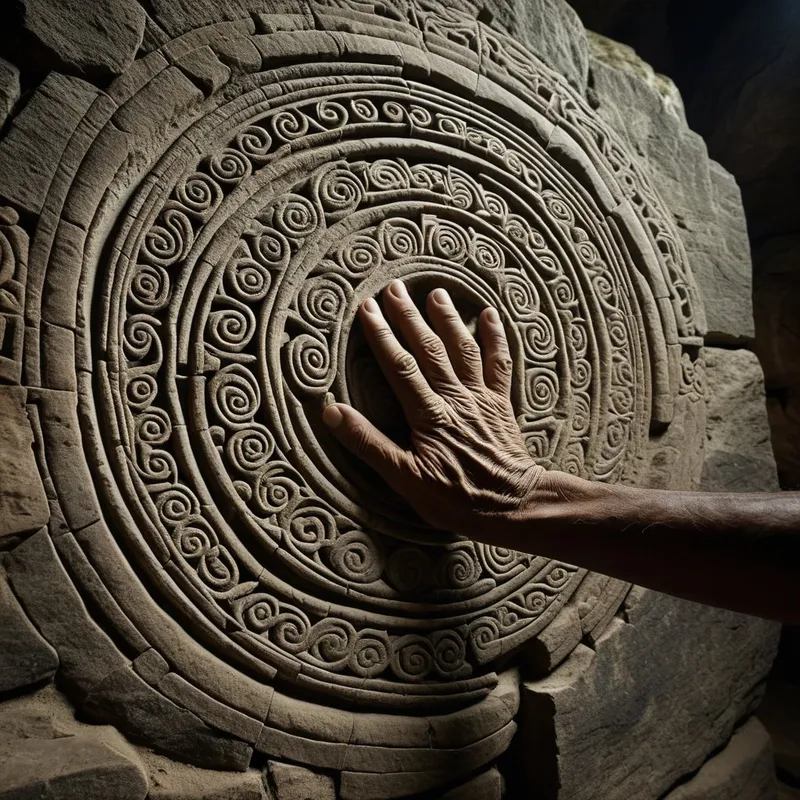
The stone became a shrine without walls. Rain filled the symbols with sky. Wind swept them clean of dust. Pilgrims came, not to see the walker, but to see the walking. They placed their own feet within the vast impression, feeling the cool stone, tracing the ridges of the carved cosmos, and in that act, their own journey began.
Cultural Origins & Context
The Buddhapada is an aniconic symbol of profound significance, emerging in the centuries following the Buddha’s Parinirvana. In early Theravada tradition, which was hesitant to depict the Buddha in human form, the footprint served as a powerful, non-idolatrous focus for veneration. It was a presence through absence, a representation that pointed beyond representation.
These symbols were carved into stone slabs, often at sacred sites, crossroads, or mountain passes—places of transition. They functioned as devotional objects, meditation aids, and pedagogical tools. The intricate Mangala etched within the footprint’s outline served as a visual catechism, encoding core teachings of the Dharma. For the layperson and the monk alike, it was a tangible connection to the Teacher, a reminder that his path was literal before it was metaphysical. The proliferation of these footprints along trade routes also speaks to their role in the cultural and religious geography of ancient Asia, marking the landscape as “awakened” territory.
Symbolic Architecture
The Buddhapada is a masterful synthesis of cosmology, psychology, and soteriology. It is not a portrait, but a blueprint for consciousness.
The footprint does not say, "Worship here." It whispers, "The path is here. Walk."
Psychologically, it represents the indelible impression of the archetype of awakening upon the human psyche. The Buddha is not portrayed as a distant god, but through the evidence of his passage—the archetypal Human who completed the journey. The footprint is the “shadow” or trace of the enlightened mind, left behind for those still in the light of ignorance.
Its symbolic architecture is deliberate:
- The Footprint Itself: Symbolizes grounding, foundation, and the practical, step-by-step nature of the path (Magga). It is the antithesis of abstract, disembodied spirituality.
- The Dharmachakra at the Heel: The point of impetus, the teaching that sets the whole journey in motion. The heel is where weight is borne, symbolizing the Dharma as the support for all.
- The Lotus: Purity arising from the mud of samsaric existence. It signifies the potential for enlightenment inherent in the very conditions of suffering.
- The Endless Knot: The interconnectedness of all phenomena (Pratityasamutpada) and the intertwinement of wisdom and compassion.
- The Svastika: The harmonious motion of the spiritual journey around a stable, eternal center—the unmoving mover of Nirvana.
Collectively, these symbols transform the foot from a body part into a mandala of transformation, mapping the microcosm of the practitioner’s effort onto the macrocosm of universal law.

The Dreamer's Resonance
When the image of a vast, symbolic footprint appears in modern dreams, it often signals a critical moment of psychic orientation. The dreamer is not encountering a religious icon, but the deep psyche’s own imprint of the Self—the totality of the conscious and unconscious mind.
This dream motif arises when the individual is seeking direction, feeling lost on their life’s path, or grappling with the need for a foundational principle. The somatic resonance is key: the dream may involve the feeling of stepping into a space that fits perfectly, or the awe of discovering a path laid down by a wiser, earlier part of oneself. Conversely, it might manifest as the anxiety of a footprint too large to fill.
The dream-Buddhapada is the psyche’s way of presenting a sacred map. It says: “Here is the structure. Here are the symbols that matter. Your journey is not into uncharted chaos, but follows a pattern left by all who have achieved wholeness before you.” It calls for grounding, for examining the “footprint” one is currently leaving on the world, and for aligning one’s personal steps with a greater, more harmonious pattern.

Alchemical Translation
The alchemical process modeled by the Buddhapada myth is that of Nigredo to Lapis: the transformation of the leaden, wandering ego into the golden, grounded Self. It is the individuation journey made literal as a walk.
The first step of the alchemical work is to find the imprint left by the Self. The final step is to realize you are the one who left it.
- The Prima Materia (The Unmarked Stone): The initial state is the undifferentiated life, the “dusty road” of unconscious existence. The seeker feels the imprint of suffering but sees no pattern in it.
- Impressio (The Pressing): The encounter with the archetype—through crisis, insight, therapy, or art—presses upon the psyche, creating the initial, often disturbing, impression of a higher order. This is the call to the path.
- Ornamentum (The Carving of Symbols): This is the long work of analysis and integration. Each symbol on the footprint—the wheel, the lotus, the knot—corresponds to a complex of the psyche that must be understood and harmonized (e.g., integrating shadow, anima/animus, confronting the Self).
- Inhabitare (The Inhabiting): The pilgrim places their own foot within the print. This is the stage of Aham Brahmasmi (“I am the Absolute”) in Jungian terms: the ego does not worship the Self as other, but consciously aligns with it. The personal journey is seen as an instance of the eternal journey.
- Iter (The Walking On): The final stage is not static veneration. The true alchemy is to internalize the map so completely that one walks away from the stone, leaving one’s own awakened footprint on the world. The external symbol becomes an internal reality. The seeker becomes the path, and their every step becomes an expression of the integrated, symbolic order they once beheld from the outside.
Thus, the Buddhapada transcends its Buddhist origins to become a universal metaphor. It is the sacred trace that proves the journey is possible, the map etched not on parchment, but in the very ground of being, waiting for the pilgrim’s foot to find its way home.
Associated Symbols
Explore related symbols from the CaleaDream lexicon: