Brer Rabbit the Trickster Myth Meaning & Symbolism
A cunning rabbit outsmarts stronger foes, embodying the trickster's wit as a tool for survival and psychological liberation in the face of oppression.
The Tale of Brer Rabbit the Trickster
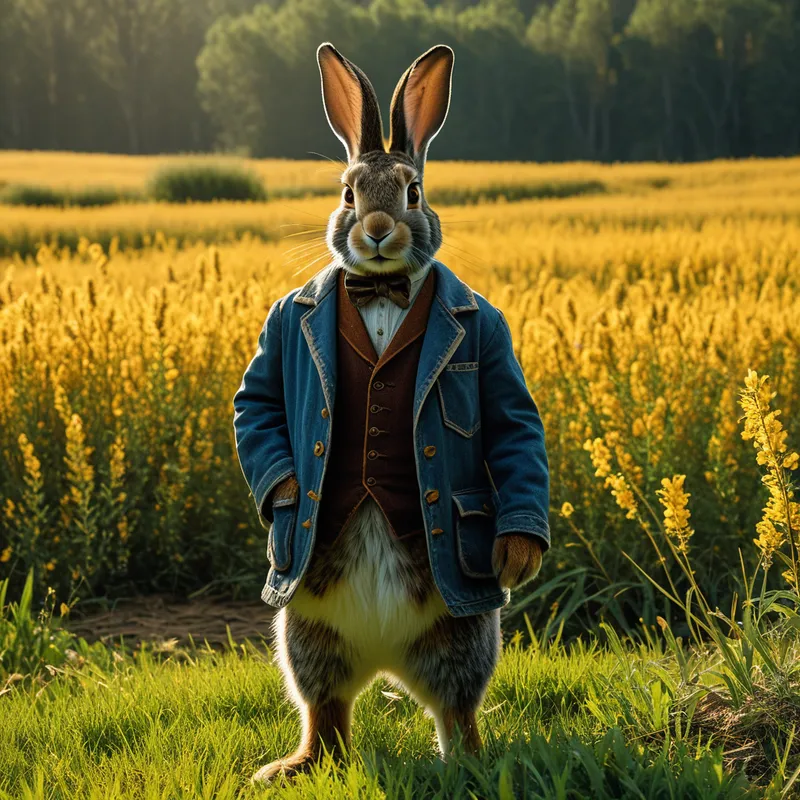
Listen now, child, to the tale spun in the golden heat, in the space between the rows where the dust hangs heavy and the cicadas scream. This is the story of the Brer Rabbit, he who walks on two legs and speaks with the tongue of a man, whose strength is not in his muscle but in the quickness of his mind and the cleverness of his heart.
In the deep woods and the sun-baked clearings, there lived a community of creatures. There was Brer Fox, sleek and powerful, with teeth like splinters of moonlight. There was Brer Bear, vast as a landslide, with a rumble for a voice. And there was Brer Rabbit, small and gray, his eyes two polished buttons of perpetual thought. He lived not by their law, but by his own wit, and this made the strong ones simmer with a slow, resentful rage.
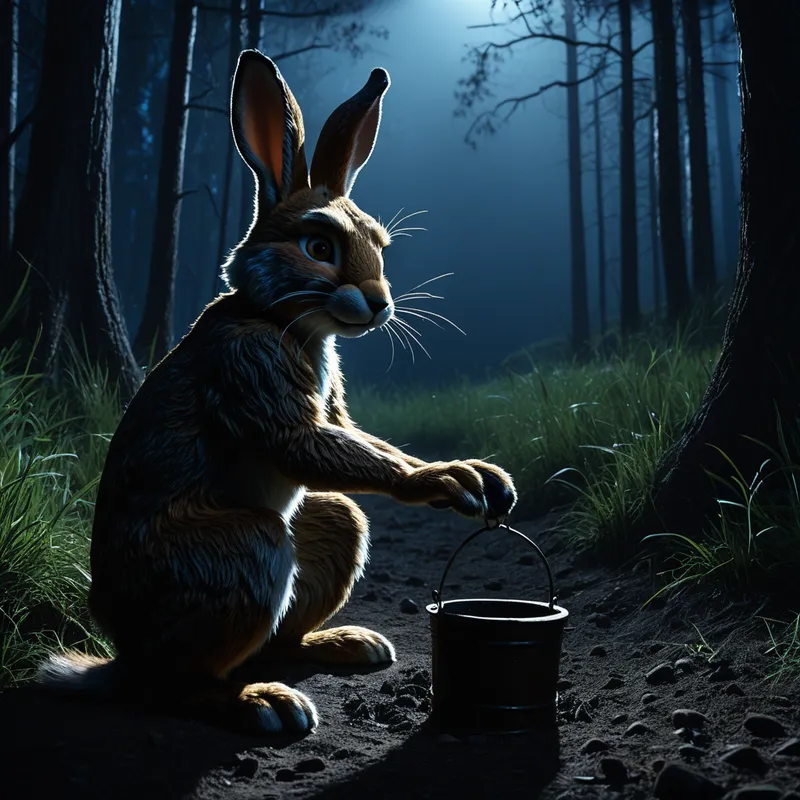
One day, Brer Fox’s patience snapped like a dry twig. Tired of the rabbit’s clever thefts and mocking laughter, he resolved to catch him. He fashioned a thing of wicked cleverness himself: a Tar Baby. He set it by the side of the dusty road, a silent, sticky sentinel, and hid himself in the brush, breath held.
Along came Brer Rabbit, hopping light on his feet, humming a tune to the sky. He saw the figure. "Mornin’!" he called. No reply. "I said good mornin’!" The silence grated. Annoyed, Brer Rabbit poked the figure. His paw stuck fast. "Let go of me or I’ll hit you!" he cried, and struck with his other paw. It, too, was captured. He kicked, he butted with his head, until he was fully entangled, a prisoner of his own escalating frustration.
From the shadows, Brer Fox slunk, his smile a sickle moon. "Well, well. What do we have here?" He gloated, listing the terrible fates in store—roasting, boiling, hanging. Brer Rabbit, stuck fast, went still. His frantic energy cooled into a terrifying calm. Then he spoke, his voice a model of pitiful resignation. "Do what you will, Brer Fox. Roast me, hang me, drown me. But please, please, don’t fling me into that Briar Patch."
The Fox paused. The Briar Patch? That tangle of thorn and razor vine? "Is that the worst you can think of?" he scoffed. "Oh, yes!" wept the Rabbit, a masterful tremor in his voice. "Anything but the Briar Patch! Have mercy!" A cruel light dawned in the Fox’s eyes. To inflict the punishment his victim feared most—what sweeter victory? With a mighty heave, he flung the sticky rabbit deep into the heart of the thorny thicket.
There was a moment of silence. Then, a rustling. Then, from the far side of the patch, a clear voice called out, "Born and bred in the briar patch, Brer Fox! Born and bred!" And with a flick of his tail, Brer Rabbit was gone, free, leaving only his laughter tangled in the thorns where his enemy could not follow.
Cultural Origins & Context
The tales of Brer Rabbit are not mere children's stories; they are vessels of memory and strategy, born in the crucible of the transatlantic experience. Their deepest roots reach into the trickster cycles of West and Central Africa, featuring figures like the clever spider Anansi. Uprooted and transplanted to the plantations of the American South, these narratives did not die. They adapted, finding new expression in the oral tradition of enslaved Africans.
Told in the quarters after sundown, in the rhythmic cadence of work songs and spirituals, Brer Rabbit became a crucial psychological tool. In a world where direct confrontation with the "Brer Fox" of the plantation system meant certain destruction, the rabbit modeled an alternative form of agency. He represented the intellect, the guile, and the resilient spirit that could not be chained. The stories were a covert education in survival, a way to affirm that the weak could outmaneuver the strong through cunning, to nurture a sense of inner freedom even amidst external bondage. They were collected and published by folklorists like Joel Chandler Harris in the late 19th century, capturing—though often filtering through a problematic lens—a vital strand of African American cultural expression.
Symbolic Architecture
Brer Rabbit is the archetypal Trickster in extremis. He is not a hero of strength, but a hero of mind. His small size and lack of conventional power symbolize the condition of the disenfranchised, while his legendary wit represents the indomitable human spirit and the strategic intelligence necessary for survival.
The trickster does not break the walls of the prison; he convinces the jailer that the walls are, in fact, the outside world.
The Tar Baby is a masterful symbol of systemic and psychological traps. It does not attack; it merely is. It ensnares through the target's own projected aggression and frustration. To fight it directly is to be completely consumed. The Briar Patch is the ultimate symbol of alchemical reversal. It represents that which appears as punishment to the powerful but is, in truth, the native element of the cunning. It is the marginalized space that the oppressor cannot understand or penetrate, which becomes a sanctuary and a source of strength.
The Dreamer's Resonance
When the pattern of Brer Rabbit arises in modern dreams, it signals a confrontation with a "Tar Baby" situation. The dreamer may feel stuck in a job, a relationship, or a mental loop—ensnared by a passive-aggressive system, a bureaucratic trap, or their own reactive anger. The somatic feeling is one of sticky frustration, of wasted effort, of being caught in a bind not of outright violence but of maddening inertia.
The appearance of the Trickster energy in this dreamscape is the psyche's attempt to problem-solve outside the conventional, exhausted frameworks. It asks the dreamer: Where are you using force where wit would serve? What perceived punishment or difficult space (your "Briar Patch") might actually contain the seeds of your liberation? The dream invites a shift from frontal assault to lateral thinking, from powerlessness to a clever re-framing of the very rules of the game.

Alchemical Translation
The journey of Brer Rabbit is a precise map for individuation under constraint. It begins with the ego (Brer Rabbit) encountering the shadow of the oppressive complex (Brer Fox/Tar Baby). Initially, the ego reacts with its standard, frustrated patterns—it fights the sticky trap directly and becomes more ensnared. This is a necessary step, the recognition of imprisonment.
Psychic transmutation occurs not when we escape our condition, but when we realize our perceived weakness is the raw material of our strategy.
The alchemical miracle is the volte-face, the dramatic reversal. The ego, in its moment of utmost stuckness, must perform a profound act of self-awareness and cunning. It must identify its own core nature and present its truth as a false vulnerability. To be "flung into the Briar Patch" is to be thrown by life's circumstances back into one's own difficult, thorny, but authentic nature—the complex, painful history, the neuroses, the unique wounds. The trickster’s wisdom is in recognizing that this, and not the open field of conventional success, is where he is "born and bred." It is the integration of the shadowy, complicated self that ultimately grants freedom. The triumph is not over the fox, but over the ego's own limited perception of where its strength truly lies.
Associated Symbols
Explore related symbols from the CaleaDream lexicon:
- Trickster — The archetypal embodiment of Brer Rabbit, representing cunning, boundary-crossing, rule-breaking, and the intelligence that subverts rigid power structures.
- Rabbit Burrow — Symbolizes the trickster's hidden sanctuary, the subconscious mind where strategies are formed, and the safe retreat for the marginalized to regroup and plan.
- Trick — The core action of the myth, representing non-linear problem-solving, psychological reframing, and the use of intellect as a primary weapon and tool for survival.
- Forest — The liminal world where the drama unfolds, representing the complex, untamed realm of the unconscious and the social wilderness where different rules apply.
- Mirror — Reflects the function of the Tar Baby, showing the trickster (and the dreamer) their own reactive anger and frustration, which is the true source of their entrapment.
- Door — Symbolizes the Briar Patch as a paradoxical threshold; what appears as a prison door to the oppressor is the exit to freedom for the cunning.
- Shadow — Represents the repressed cunning, wit, and subversive intelligence within the individual, which must be integrated to navigate oppressive systems.
- Key — The trickster's wit itself, which is not a physical tool but a mental and spiritual key that unlocks traps by understanding the psychology of the jailer.
- Chaos — Embodied by the Briar Patch, it is the disordered, painful, yet creative space that the established order fears but where the adaptable spirit thrives.
- Rebirth — The moment Brer Rabbit emerges from the Briar Patch, symbolizing psychological liberation and a new identity forged through cunning and self-knowledge.