
Blue Jeans Myth Meaning & Symbolism
A myth of indigo cloth and copper rivets, telling of a garment born from necessity that became a vessel for the soul of a continent.
The Tale of Blue Jeans
Listen, and hear the tale woven not in silk, but in twill; dyed not in royal purple, but in the deep, dreaming indigo of the worker’s sky. It begins in the belly of the earth, in the clamor and dust of a place called The Gold Rush. Here, men of fire and hunger tore at the rock, their dreams as heavy as the ore they sought. But their bodies were betrayed by the very fabric of their ambition—their trousers, weak and yielding, split at the seams under the weight of their toil, a silent laughter from the earth itself.
From this rupture emerged a figure, a Weaver-Artificer. He saw not just torn cloth, but torn spirits. He listened to the lament of the laborer: “Give us a skin that does not break.” In his hands, he took the rugged sailcloth of ships, the very fabric that braved oceans. He baptized it in vats of indigo, a blue so deep it drank the light, the color of twilight holding the promise of dawn. But the magic was not yet complete.
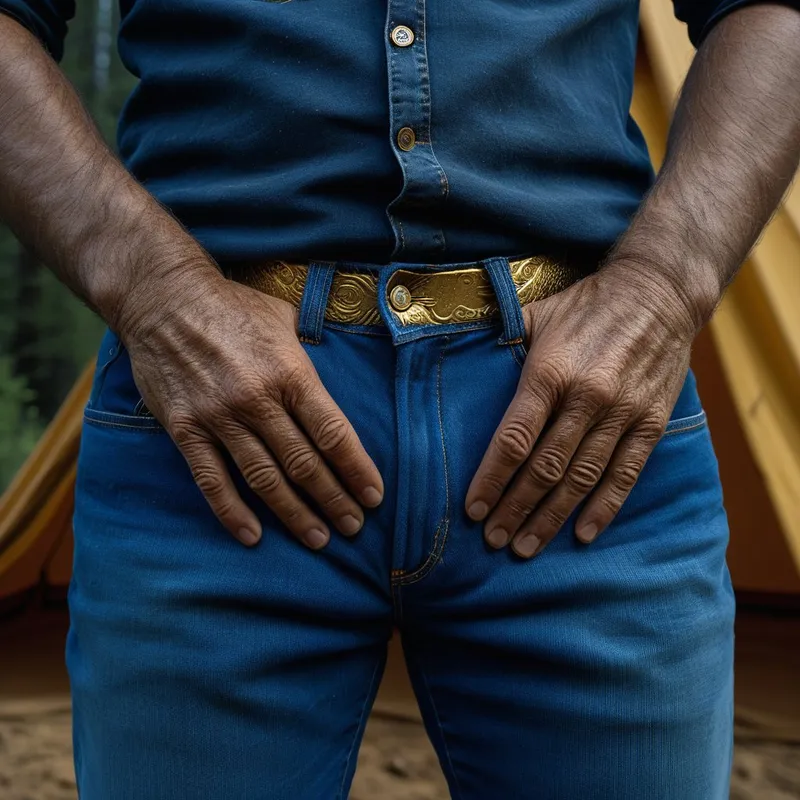
The Weaver-Artificer took copper, the metal of pennies and telegraph wires, the vein of the new world. He forged it into tiny, unyielding shields—rivets. At the points of greatest strain, at the pocket corners where dreams of nuggets were carried, and at the base of the fly, the gate of generation, he placed these copper sentinels. He stitched with orange thread, the color of furnace glow and desert rock, in a pattern like the meandering path of a river or a life.
Thus, the Waist Overalls were born. They were stiff as a board, cold as a mountain stream, and as demanding as the land itself. To wear them was a pact. The miner, the cowboy, the rail-layer—they donned this blue hide. Through their sweat, their falls, their journeys across rivers and under suns, the garment softened. It molded to the unique topography of each body, recording every scrape on knee, every stretch across thigh, fading at the stress points into maps of memory. The blue deepened in some folds, lightened on the high plains of the thigh, becoming a living biography in indigo and white. The garment did not just endure; it transformed with the wearer, a second skin earned, not given.
Cultural Origins & Context
This is a modern myth, born not in the fires of Olympus but in the furnaces of industry and the crucible of westward expansion. Its primary bards were not poets, but laborers, cowboys, farmers, and later, rebels and artists. The myth was passed down not through epic verse, but through pragmatic use and visual culture. It was authored collectively by the anonymous masses who lived and died in them, and later canonized by figures in film, music, and protest.
Its societal function was profoundly democratic. Unlike the silks and velvets that denoted static, inherited status, the blue jean’s value was conferred by action. Its prestige lay in its fading, its tears, its repairs. It was the great equalizer—the rancher and the mechanic, the artist and the activist could all share in its symbolic language. It served as both uniform of the working class and, later, a banner of defiance against the very establishment that uniform once served. The myth was maintained through a feedback loop between utility and image, between the physical reality of hard work and the cinematic ideal of the American rugged individual.
Symbolic Architecture
At its core, the myth of Blue Jeans is an alchemical narrative of the Individuation of the common soul. The raw, stiff denim represents the unformed, potential Self—tough but inflexible, full of latent strength but without character. The indigo dye symbolizes the nigredo stage, the initial immersion in the primal, dark waters of experience and toil.
The rivet is the Ego’s necessary fortification, placed where the psyche is most vulnerable to bursting from the pressure of its own contents.
The transformative agent is the life lived—the sweat, struggle, and journey. This process, the wear, is the albedo. It softens the rigidity, wearing away the dogmatic, unyielding persona to reveal the unique form beneath. The fading and creasing are not decay, but the emergence of a sacred pattern, a mandala of personal history. The repaired tear, often with a contrasting patch, symbolizes the integrated Shadow—a wound transformed into a mark of strength and individuality.
The jean becomes a fetish of lived experience, a container for the animating spirit (anima mundi) of democratic struggle and personal authenticity. It represents the triumph of the earned over the bestowed.

The Dreamer's Resonance
When the myth of Blue Jeans surfaces in the modern dream, it often signals a somatic or psychological process related to grounding, authenticity, and the integration of one’s labor—physical, emotional, or creative—into the sense of Self.
To dream of stiff, new, uncomfortable jeans suggests the dreamer is confronting a new, challenging role or identity that feels rigid and unnatural. The psyche is in the initial, difficult stage of shaping itself to a new demand. Dreaming of perfectly worn, soft, familiar jeans indicates a comfort and alignment with one’s authentic life path; the Self feels lived-in and true. A dream of jeans tearing can point to a fear of psychological overwhelm or a sense that one’s current “container” (lifestyle, job, relationship) is insufficient for the pressures being placed upon it. Conversely, mending a tear in jeans is a powerful image of active shadow-work and self-repair.
The most profound dream image may be finding a pair of old, faded jeans that map perfectly to one’s own body, yet are not one’s own. This speaks to the discovery of an ancestral or collective pattern of resilience—a recognition of fitting into a larger, enduring human story of endurance.
Alchemical Translation
For the modern individual, the myth models the psychic transmutation from a state of collective, mass-produced identity to one of sacred individuality. We all begin “off the rack”—shaped by family, culture, and expectation into a standard size. The alchemical work is the living.
Our struggles, our failures, our journeys—these are the elements that perform the sacred abrasion. The copper rivets are the conscious principles and boundaries we must deliberately forge and place at our points of greatest vulnerability—our values, our “no’s,” our core commitments that prevent us from splitting apart under pressure.
The goal is not to remain pristine, but to achieve a holy fade, where the essential color of the soul is revealed precisely where life has touched it most.
The process of individuation, like the breaking-in of jeans, is not always graceful. It is often uncomfortable, demanding, and leaves marks. Yet, through this very process, the generic becomes specific. The soul’s garment becomes a perfect fit, a testament not to its original manufacture, but to the unique life that shaped it. The myth ultimately teaches that our value and our beauty are functions of our endurance, our adaptability, and the honest map of experience we allow to be etched upon us. We are not born authentic; we wear ourselves into authenticity, one difficult, glorious day at a time.
Associated Symbols
Explore related symbols from the CaleaDream lexicon: