
Bile Myth Meaning & Symbolism
A myth of the bitter essence, Bile, whose journey through fire and vessel transforms primal poison into the elixir of profound self-knowledge.
The Tale of Bile
Listen, and I will tell you of the substance that was no substance, the king who was no king. In the beginning, before the first fire was lit in the first furnace, there was only the Prima Materia—a chaos of potential, dark and sweet. And from this womb, the four humors were born. But one was born screaming.
His name was Bile. Not the yellow fire of anger, but the black, the deep, the bitter. He was the child the universe did not wish to hold. He congealed in the cold corners of creation, a viscous shadow, a poison in the veins of the world. He was heaviness where there should be light, stagnation where there should be flow, a gnawing truth where comforting lies were preferred.
The other humors—Sanguis the joyful, Choler the fierce, Phlegma the calm—danced in the great hall of the body, weaving health and vitality. Bile watched from the cracks in the stone, a pariah. His touch turned wine to vinegar, laughter to sighs, gold to lead. He was cast out, condemned to the Vas, the sealed glass prison of the alchemist’s art. "Let the fire have him," they said. "Let him be consumed."
And so the fire came. Not a cleansing blaze, but the Athanor's slow, relentless heat. For days that were years, Bile boiled. He raged against the glass, throwing himself against the walls that reflected only his own darkness. He screamed his bitterness until his voice was a hiss, condensed, and fell back upon himself as a corrosive rain. This was the Nigredo, the blackening. He did not burn away; he became pure blackness, a starless midnight in a flask.
Then, a silence. From the absolute black, a strange thing began. A peacock’s tail of colors shimmered on the surface of his despair—Albedo. He was not changing; he was being seen. The fire was not his enemy but a relentless mirror. In that stillness, he saw his own nature not as a flaw, but as a fact. The bitterness was not evil; it was a density of experience. The heaviness was not sloth, but the weight of unspoken truths.
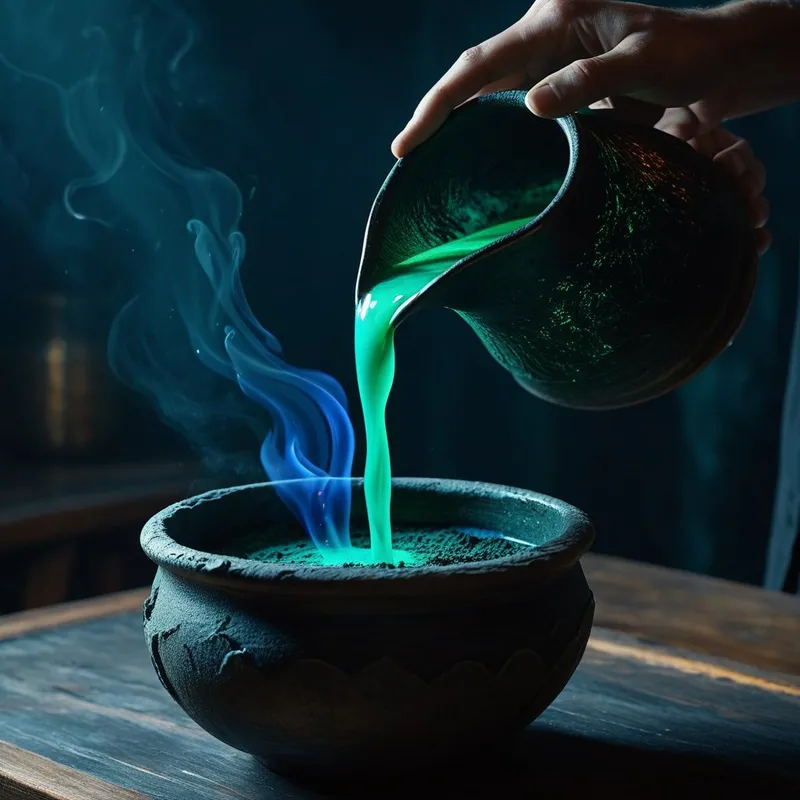
And then, the final fire. The heat intensified, not to destroy, but to marry. The blackness began to glow from within. A fierce, red-gold light—Citrinitas, flowing into Rubedo. The poison crystallized. The bitterness distilled. From the heart of the blackened king emerged a single, radiant drop. It was the Elixir Vitae. Not sweet, but profoundly potent. The thing that had been cast out as waste had become the cornerstone of the work. Bile was gone. In his place remained the Lapis Philosophorum—not a stone, but a knowing. The vessel was unsealed. The essence within did not flee; it simply was, a quiet, green-gold light in the palm of the world.
Cultural Origins & Context
The myth of Bile is not found in a single grimoire but is woven through the fabric of Medieval alchemical thought. It is the narrative hidden within the Mutus Liber, the "silent book" of laboratory procedures. This was an oral tradition, passed in whispers between master and apprentice in the soot-stained laboratories of monasteries and royal courts, from the 12th-century translations of Arabic texts in Spain to the flourishing of Hermeticism in the Renaissance.
Its tellers were not bards, but natural philosophers like Paracelsus, who saw in the four humors a map of both the cosmos and the human condition. The myth served a critical societal function: it provided a sacred, symbolic container for the experience of melancholy, which was simultaneously feared as a cause of madness (the "black dog") and revered as the mark of genius and deep contemplation. By mythologizing Melancholia, alchemy gave the medieval mind a way to engage with depression, bitterness, and existential weight not as moral failings to be purged, but as necessary, transformative ingredients in the opus of the soul. It was a psychodrama written in the language of sulfur, salt, and mercury.
Symbolic Architecture
At its core, the myth of Bile is the story of the rejected part. Bile symbolizes the psychic content we exile: our bitterness, our resentment, our chronic dissatisfaction, our deep, inarticulate sadness—the "black bile" of the humoral system. He is the Shadow, not as a villain, but as a deposed king.
The poison you cast out is the very substance of your cure. The throne of the self cannot be whole while its rightful king languishes in the dungeon.
His imprisonment in the Vas represents the act of repression or conscious containment—we seal away what we cannot bear. The Nigredo is the inevitable, painful confrontation with this material. It is the dark night of the soul, depression, or a crisis of meaning where everything turns black. This is not a mistake in the process; it is the process. The subsequent colors—the Albedo and Rubedo—symbolize the gradual integration and transmutation of this shadow. The bitter essence, when fully faced and "cooked" by the heat of conscious attention, does not disappear. It changes state. Its corrosive power becomes discerning insight. Its heaviness becomes gravitas. Its isolation becomes the capacity for profound self-containment.

The Dreamer's Resonance
When this myth stirs in the modern dreamer, it announces a profound somatic and psychological process: the Coniunctio with the bitter essence. You may dream of being trapped in a small, hot room; of swallowing a thick, foul medicine that later makes you strong; of finding a precious gem in a pile of refuse or mud.
Somatically, this can feel like a dense pressure in the chest or gut, a literal "heaviness." Psychologically, it is the onset of a melancholic phase, not necessarily pathological, but deeply introspective. It is the psyche's insistence on digesting unlived life, unexpressed grief, or unacknowledged anger. The dream ego is being subjected to the Athanor's heat. The process feels like a putrefactio—a rotting of old, naive identities. The dreamer is in the vessel, and the work, however uncomfortable, is proceeding. To dream of Bile is to dream of the alchemy already underway in the basement of the soul.

Alchemical Translation
For the modern individual seeking Individuation, the myth of Bile provides a non-pathologizing map for psychic transmutation. Our culture often demands constant optimism, urging us to "fix" or "positive-think" our way out of bitterness. Alchemy suggests the opposite: invite the bitterness in. Seat it at the table. Subject it to the steady fire of your attention.
The goal is not to become sweet, but to become whole. The elixir is not the absence of bitterness, but its mastery.
The first operation is Containment (the Vas). Instead of acting out resentment or drowning in sadness, one consciously holds the feeling. This is the "sealed vessel" of therapy, journaling, or mindful witness. The second is Calcination (the Nigredo). Allow the heat of this confrontation to blacken your old certainties. Let the comforting stories burn away. This is the necessary despair, the feeling that "everything is ruined." The third is Distillation (the Albedo to Rubedo). In the silence after the storm, watch for the peacock's colors—the insights, the moments of clarity rising from the mess. Slowly, through repeated cycles of heat and observation, the bitter narrative transforms. What was a story of victimhood ("I was cast out") becomes a story of density and value ("I am the concentrated essence"). The rejected part is recognized not as a flaw, but as the very catalyst for depth, wisdom, and authentic compassion. You do not get rid of your Bile. You, at long last, grant him his crown. And in doing so, the base lead of a fragmented self is transmuted into the gold of an integrated one.
Associated Symbols
Explore related symbols from the CaleaDream lexicon: