Baphomet Myth Meaning & Symbolism
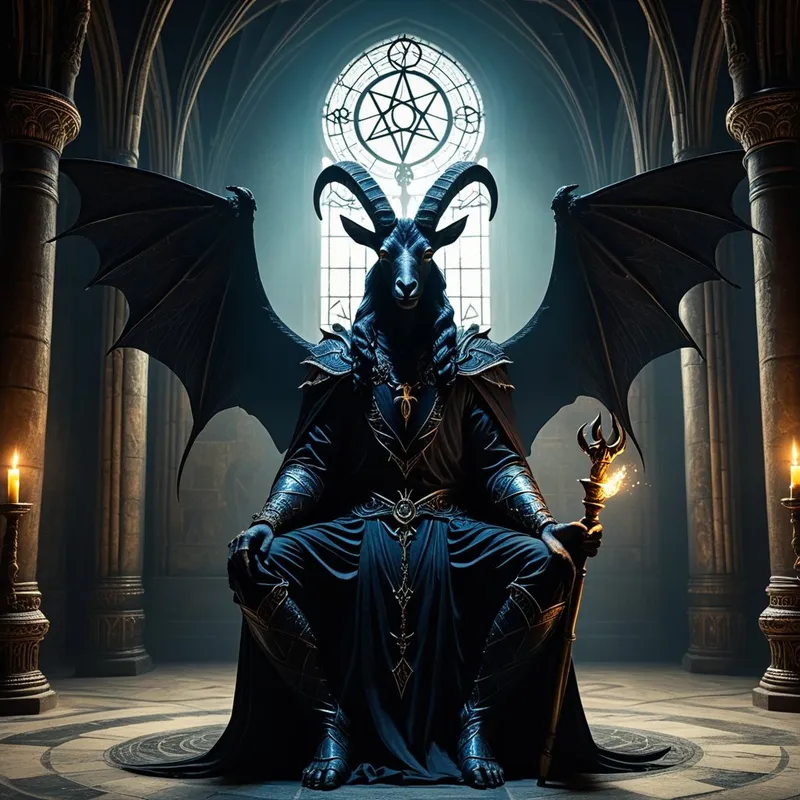
A mysterious idol born from accusation and fear, Baphomet is the shadow of the faith, a composite symbol of everything the orthodox mind sought to exile.
The Tale of Baphomet
Listen, and hear a tale not carved in sacred stone, but whispered in the cold corridors of fear and forged in the fires of accusation. It begins not in heaven, nor in hell, but in the tense silence between heartbeats, in the year when faith grew fangs and turned upon its own defenders.
The setting is the twilight of an age. The great orders of warrior-monks, the Knights Templar, stand as pillars of Christendom, yet shadows cling to their immense wealth and secretive rites. From the highest chambers of royal power and papal authority, a chill wind begins to blow. Whispers take shape—terrible, sibilant things. They speak of initiation ceremonies conducted in deepest secret, of rites performed not before the cross, but before a strange and silent watcher.
This watcher has a name, given to it by its accusers: Baphomet. It is said to be an idol, a head, perhaps bearded, perhaps possessing the grim visage of a goat. The air in these whispered chapels is thick with incense of a strange, acrid scent. Initiates, it is murmured, are brought before this effigy. They are told to deny the Christ who led them to battle. The required kiss is not one of peace, but of obscenity—placed not on a relic, but on the base of the spine, the navel, the lips of the cold idol itself. Some tales speak of a cat, sleek and demonic, that appears in their midst. Others tell of cords worn around the waist, touching this idol, becoming sacred and then profane.
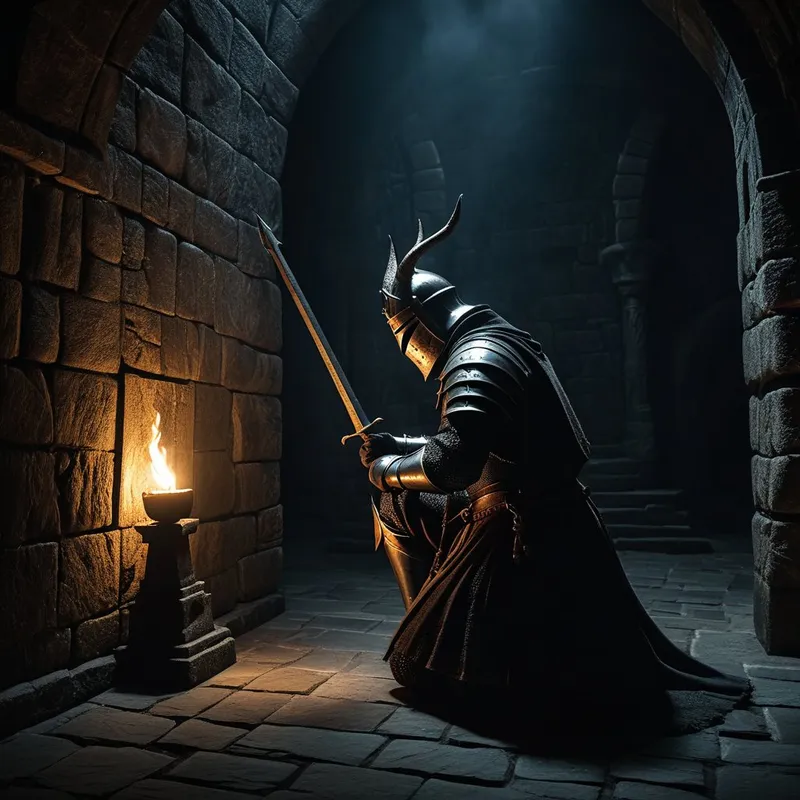
The conflict is not of clashing armies, but of shattered oaths. The mighty Templars, who vowed poverty, chastity, and obedience, are accused of spitting on the cross, of engaging in sodomy, of worshipping this grotesque figure in the dark. The rising action is the slow, inexorable crush of the inquisition. Men of God and war are taken in the night. They are questioned in rooms where the stones themselves seem to weep. Under torture, the whispers solidify into "confessions." The idol gains features: it is made of wood, of metal, sometimes a mere painted head. It is a giver of wealth, a granter of fertility to the lands of the order. It speaks, they say. It answers.
The resolution is written in ash and blood. The Order is dissolved, its Grand Master burned at the stake. But as the smoke clears, the idol does not vanish. It slips from the pages of trial transcripts and escapes into the fertile soil of the European imagination. The church, in crafting its enemy, had given birth to a new myth. Baphomet ceases to be merely an alleged idol and becomes something far more potent—the embodied shadow of the faith itself, a silent, horned witness to everything orthodoxy had tried to suppress, now haunting the edges of its dreams forever.
Cultural Origins & Context
The myth of Baphomet is unique; it is a heresy manufactured by a powerful institution, which then took on a life of its own. Its primary cultural origin is the suppression of the Knights Templar between 1307 and 1314 by King Philip IV of France and Pope Clement V. The accusations—idolatry, apostasy, sodomy—were likely politically and financially motivated. The name "Baphomet" itself is a puzzle, possibly a corruption of "Mahomet" (Muhammad), framing the Templars as secret Muslims, or derived from the Greek words baphe and metis, meaning "absorption of knowledge."
This myth was not passed down by bards but by inquisitors and clerks. Its societal function was dual: first, to provide a tangible, monstrous focus for the destruction of a rival power structure. By painting the Templars as devil-worshippers, their elimination became a holy act. Second, and more profoundly, it served as a projection vessel. Baphomet became the repository for all the unconscious, forbidden, and heterodox impulses that medieval Christendom could not acknowledge within itself: esoteric knowledge, sexual ambiguity, the worship of nature and the flesh, the reconciliation of opposites. It was the "container" for the cultural shadow.
Symbolic Architecture
Baphomet, as crystallized by 19th-century occultist Éliphas Lévi, is not a demon but a profound symbolic glyph of completion. Every element is a dialectic.
The androgynous body represents the union of male and female, a transcendence of binary gender toward a primordial wholeness. The human torso with animal limbs (the goat's head, the avian wings) signifies the integration of the human with the instinctual and the spiritual. One arm points up, the other down, articulating the hermetic axiom "As above, so below"—the macrocosm reflected in the microcosm. The torch between the horns illuminates the balancing of the intellect (the horns, often symbols of power and thought) with the fire of spirit and desire.
Baphomet is the self the orthodox psyche had to exile in order to define its boundaries; thus, it holds everything the conscious identity claims it is not.
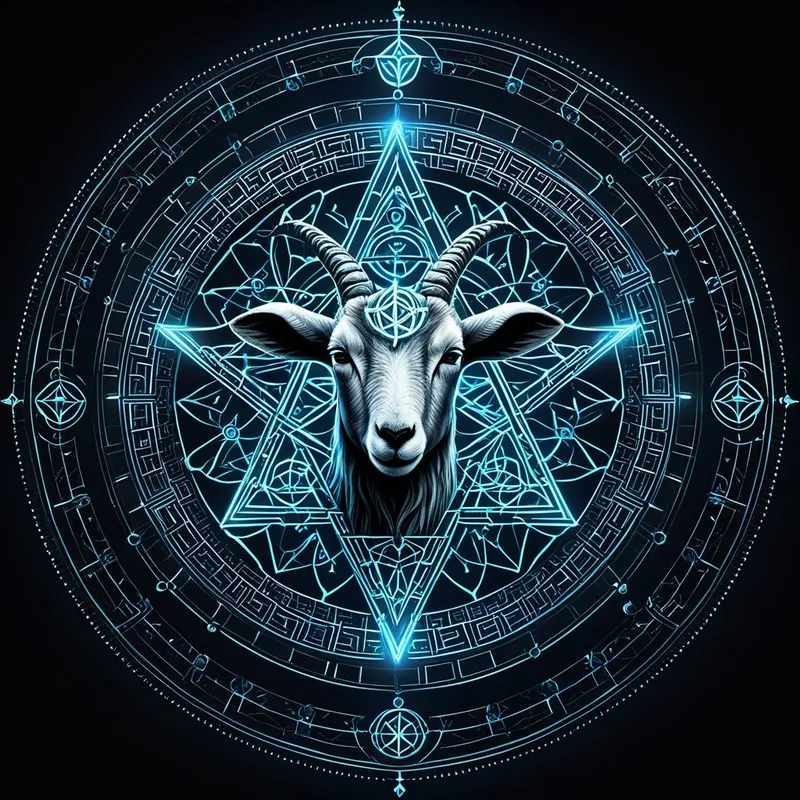
The pentagram on its forehead is the symbol of the microcosm, the human being ruling over the four elements. Crucially, it is often inverted, which in Lévi's system does not signify evil but the descent of spirit into matter, the incarnation of the divine in the tangible world—the very mystery Christianity holds at its core in the figure of Christ. Baphomet, therefore, becomes the shadow twin of Christ: one representing spirit perfected in spirit, the other representing spirit realized and reconciled through matter and contradiction.
The Dreamer's Resonance
When Baphomet appears in the modern dream, it is rarely as a medieval idol. It manifests as a profound encounter with the shadow and the call to integration. The dreamer may be faced with a terrifying yet fascinating composite creature, a room containing opposing symbols (a cross and a pentagram, a dove and a serpent), or a guide who is both repulsive and wise.
Somatically, this dream often accompanies a feeling of deep inner conflict or a life phase where rigidly held identities (career, gender roles, moral codes) are breaking down. The psyche is presenting its own "heresy trial." The fear in the dream is the ego's terror of being dissolved, of admitting that what it has condemned as "evil" or "wrong" within contains vital, life-giving energy. The psychological process is one of reclaiming projection. The monstrous "other" in the dream is, in truth, a disowned part of the self seeking recognition.
Alchemical Translation
The myth of Baphomet models the alchemical opus contra naturam—the work against nature, which is really the work against one's own partial, "natural" state of being. The initial state is the pure, undifferentiated, but unconscious wholeness (the Templar Order in its early, idealized power). Then comes the nigredo, the blackening: the accusations, the splintering, the torture. This is the necessary crisis where the conscious attitude is shattered, and the shadow contents (Baphomet) are violently brought to light.
The long period of the myth's evolution—from medieval heresy to occult symbol—represents the albedo, the whitening, where these contents are purified of their purely horrific, projected quality and begin to be seen for their symbolic value. Finally, Lévi's depiction is the rubedo, the reddening, the creation of the Philosopher's Stone: the conscious synthesis.
The individuation journey demands we sit in the seat of Baphomet, holding the tension of our own opposites, until the torch between our horns ignites a new, uniting consciousness.
For the modern individual, the "trial" is any profound inner conflict. The "idol" is the rejected complex—perhaps one's wild creativity labeled laziness, one's anger labeled unholiness, one's sensuality labeled sin. The alchemical work is to cease projecting this complex onto external enemies (the heretics, the corrupt institution) and instead to "worship" it—that is, to give it sacred attention, to decipher its symbols, and to integrate its energy. The triumph is not the victory of one side over the other, but the birth of a third, transcendent position: the conscious self that can contain both the saint and the heretic, the spirit and the flesh, the above and the below, and in doing so, becomes truly whole.
Associated Symbols
Explore related symbols from the CaleaDream lexicon: