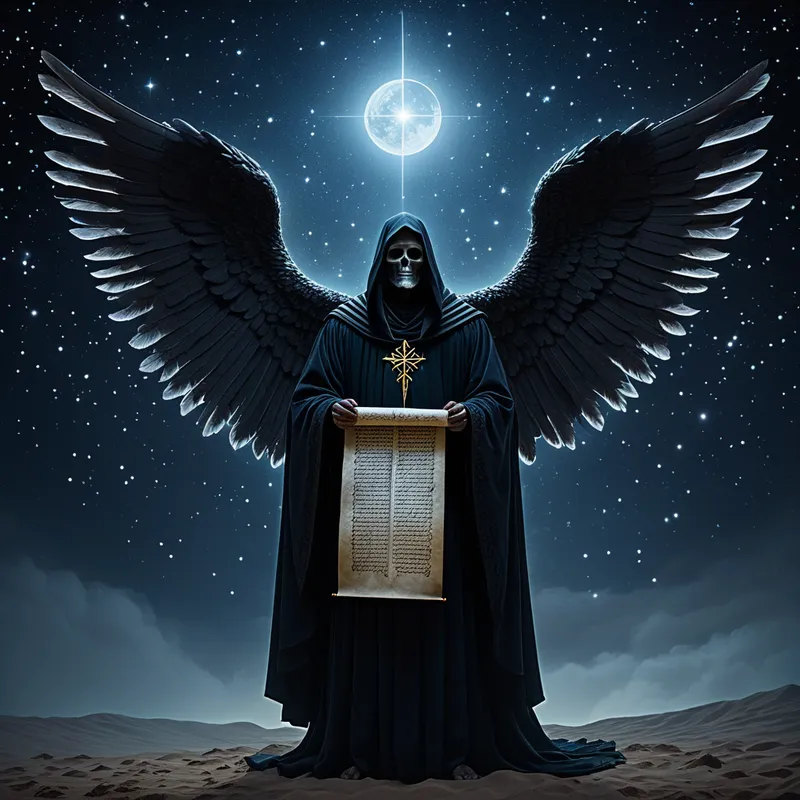
Azrael Angel of Death Myth Meaning & Symbolism
The story of Azrael, the angelic psychopomp who serves divine will, guiding souls from earthly life with compassion and unyielding purpose.
The Tale of Azrael Angel of Death
Listen, and hear the tale not of an end, but of a sacred turning.
In the silence before the first dawn, when the world was a thought in the mind of the Most High, the host was assembled. Among the seraphim of fire and the cherubim of knowledge stood one whose purpose was yet unspoken, a stillness within the celestial choir. His name was Azrael, “Whom God Helps.”
The command came not as thunder, but as a deepening of silence: “To you, I give the final seal. You will be the scribe of souls and the guide of their passage. From every life, you will take a drop of earth from the place where their body will rest, and upon this, you will know them. When their name is called from the scroll of their days, you will go.”
And so Azrael descended, not to the world of sun and stone, but to the realm just beyond the veil, a corridor of whispers. There, he keeps the great ledger. His library is not of parchment and ink, but of substance and memory—a grain of soil from a mountain pass, a speck of dust from a quiet room, a fragment of clay from a riverbank. Each is a soul’s anchor and its summons.
He does not come as a thief, but as a solemn envoy. The sages say that when a person’s time is full, Azrael stands at the head of their bed. To the righteous, he appears as a beautiful friend, his presence a comfort that loosens the knot of the spirit from the body as gently as untying a sandal. To the wicked, he may seem terrible, for they see reflected in him their own resistance to the divine order. His sword is not of steel, but of separation itself, cutting the silver cord that binds spirit to flesh. He does not cause the death; he is its appointed witness and conductor, the usher at the threshold.
His work is perpetual, a rhythm as constant as the tide. He receives the soul, tenderly, and delivers it to the next stage of its journey—to judgment, to peace, to waiting. He is the hinge of the great door, the necessary shadow that gives shape to the light of life. He acts not from malice, but from perfect obedience, the ultimate servant of a will that understands both the first breath and the last.

Cultural Origins & Context
The figure of Azrael, while a prominent angel of death in Islamic tradition, occupies a more nuanced and esoteric space within Hebrew thought. He is not named in the canonical Hebrew Bible (Tanakh), where the agency of death is typically attributed directly to God or to a vague malakh ha-mavet (angel of death). Azrael emerges distinctly in later Jewish mystical literature, particularly within the Zohar and other Kabbalistic texts.
Here, he is elaborated not as a grim reaper, but as a high-ranking, compassionate archangel with a specific divine office. This development reflects a cultural and theological shift towards personifying and understanding the various mechanisms of the divine plan. By giving this role a name and a character—Azrael, the helper—the mystics transformed the terror of death into a process administered by a celestial being of order and, ultimately, mercy. His story was passed down through rabbinic commentary and mystical circles, serving to comfort and philosophically frame the most universal human experience. It taught that death was not a chaotic accident, but a deliberate, sacred transition overseen by a servant of God, thereby integrating even life’s end into a cosmos governed by meaning and law.
Symbolic Architecture
Azrael represents the archetypal principle of necessary ending, the agent of fate that facilitates transformation. He is not death itself, but its angelos—its messenger. This is a critical distinction. He symbolizes the psychological function that severs outworn attachments, identities, and stages of life so that new growth can occur.
He is the psychological scissors that cut the umbilical cord to a former self, an act that feels like annihilation from the perspective of that self, but is liberation from the perspective of the soul.
His scroll and his collection of earth symbolize the absolute specificity of destiny. Every life, every phase of consciousness, has its unique duration and conclusion. The drop of earth signifies our rootedness in the temporal world, and the releasing of that grain back to the earth completes the cycle. Azrael’s dual appearance—beautiful to some, terrible to others—mirrors our own inner relationship to change. We project onto the force of ending our own readiness or resistance. To accept life’s transitions is to see the guide; to fight them is to see the monster.

The Dreamer's Resonance
When the pattern of Azrael visits a modern dream, it rarely manifests as a literal angel. Instead, one may dream of a profound, silent figure waiting at a crossroads; of a crucial, unalterable letter arriving; of a beloved room being gently but firmly cleared out; or of standing before a vast, official ledger where one’s name is being inscribed or erased.
Somnatically, this can accompany feelings of deep, quiet pressure, a sense of a chapter closing, or a poignant mixture of grief and relief. Psychologically, this dream motif signals that a major phase of the dreamer’s life—a relationship, a career, an identity, a long-held belief—has reached its natural terminus. The unconscious is personifying the inner force that is executing this ending. The process is one of psychic surrender, of releasing control to a larger, impersonal order within the psyche. The anxiety or peace in the dream reflects the ego’s current stance toward this necessary inner death.

Alchemical Translation
The alchemical journey of individuation requires repeated cycles of mortificatio—the symbolic death of outmoded attitudes. Azrael is the archetypal operator of this stage. His myth models how to engage with personal fate and necessary endings not as failures, but as sacred rites of passage administered by a deeper aspect of the Self.
To integrate Azrael is to become the compassionate scribe of one’s own soul, acknowledging the expiration dates on our personal constructs with solemnity instead of panic.
The struggle is the ego’s rebellion against the scroll’s decree. The triumph is in the conscious alignment with this inner ordinance—recognizing that the “death” of a persona, a ambition, or a way of being is not a punishment, but the precondition for rebirth. We are invited to move from being the victim of fate to collaborating with it, to take up our own “drop of earth”—the truth of our mortal, temporal nature—and offer it up. In doing so, we transmute the lead of loss into the gold of meaning, discovering that the angel who ends one world is the same who ushers us into the next.
Associated Symbols
Explore related symbols from the CaleaDream lexicon:
- Death — The universal transition that Azrael facilitates, representing not an end but a profound change of state and the dissolution of form for the sake of spirit.
- Door — The threshold over which Azrael guides the soul, symbolizing the passage from one state of consciousness or existence to another.
- Scroll — The divine ledger Azrael keeps, representing fate, destiny, and the recorded totality of a soul's allotted time and purpose.
- Angel — Azrael's essential nature as a divine messenger and servant, embodying the intersection of the transcendent will with the processes of the mortal world.
- Destiny — The unalterable course charted by the divine, which Azrael serves as an executor, highlighting the theme of a purposeful, pre-ordained journey.
- Earth — The material substance Azrael collects, symbolizing the soul's connection to the physical, mortal plane and the body that is returned to dust.
- Journey — The core action of the myth: Azrael is the psychopomp guiding the essential self on its ultimate voyage from life through death.
- Shadow — The aspect of the divine and the psyche that encompasses endings, the unseen, and that which we often fear or reject, yet which performs a necessary function.
- Key — Azrael's role as the one who holds the authority to unlock the final transition, opening the way for the soul's departure.
- Soul — The eternal essence that is the subject of Azrael's care, the immortal identity that is separated from the body and escorted onward.
- Order — The fundamental principle Azrael upholds, representing the cosmic law and divine structure that governs even the moment of death.
- Rebirth — The implicit promise on the other side of Azrael's duty, as every guided ending contains the seed of a new beginning in the soul's continuum.