
'Aumakua Myth Meaning & Symbolism
The Hawaiian 'Aumakua are ancestral guardian spirits, often manifesting as animals, who guide, protect, and connect the living to the sacred lineage of the past.
The Tale of 'Aumakua
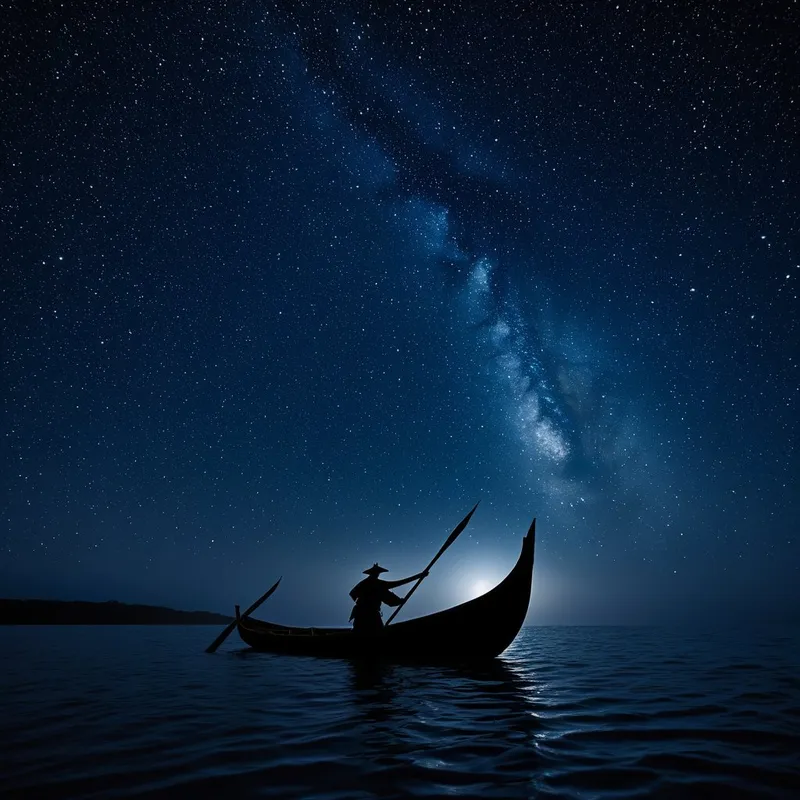
Listen. The wind does not just blow; it carries the breath of those who came before. The ocean does not just crash; it speaks with the voice of the deep past. In the time when the world was woven from chant and fire, when the great voyagers had found these islands after navigating the star roads, a profound covenant was made. It was not written on paper, but etched into the very bones of the land and the blood of the people.
A great chief, weary from a voyage that tested the soul, stood on the black sand of a newborn shore. His people were scattered, their canoes battered, their stores depleted. The gods of the sea and sky seemed silent. In his despair, he walked into the forest, seeking a sign, a whisper from the unseen world. For three days and nights, he fasted and prayed, his voice growing hoarse, his body becoming a vessel for silence.
On the third night, as the moon hung like a pearl in a bowl of obsidian, a shadow descended. It was not a menacing shadow, but one of immense, quiet presence. An ʻio, its wingspan wide enough to blot out stars, landed on a lava rock before him. It did not speak with a human tongue, but its eyes held the depth of a thousand generations. In that gaze, the chief saw not a bird, but the essence of his own grandfather, a famed navigator. He saw the stern love, the protective fury, the guiding knowledge of the stars.
Simultaneously, from the phosphorescent surf, a sleek, powerful form emerged. A manō rested in the shallows, its eye fixed on the chief. In its steady, ancient gaze, he saw the spirit of his grandmother, a healer who knew the secrets of the ocean's herbs. The ʻio let out a piercing cry that split the night. The manō slapped its tail once upon the water, a sound like a drumbeat. In that synchronized moment, the covenant was sealed. The chief understood. These were not mere animals. They were the aumakua, the familial guardians. They would watch over his lineage—guiding fishermen to schools of fish, warning of approaching storms, protecting children who wandered too near the cliffs. In return, the family would honor them, never harming their kind, leaving offerings, and speaking their names with reverence.
From that night forth, the chief’s people thrived. Their fishermen were the most successful, their children the healthiest, their navigators the most accurate. They knew they were never alone. The shadow of the ʻio on the mountain trail, the dorsal fin of the manō pacing their canoe—these were not omens of fear, but signs of an abiding, ancestral love, a whispered promise from the other side of the veil that separates the living from the beloved dead.
Cultural Origins & Context
The concept of the ʻaumakua is not a singular "myth" in the sense of a story with one beginning and end, but rather the living, breathing core of traditional Hawaiian spiritual ecology and kinship. It is a foundational belief system passed down through the ohana (family) via moʻolelo (histories, stories) and oli (chants). These narratives were not mere entertainment; they were the sacred vessels of identity, law, and connection.
The knowledge of a family's ʻaumakua was guarded and taught by the kāhuna and elders. It functioned as a profound social and environmental regulator. If your ʻaumakua was the honu (green sea turtle), your family would be its fierce protectors, ensuring its survival. This created a reciprocal relationship with the natural world, where conservation was a spiritual duty. The ʻaumakua served as a bridge between the visible (kino) and invisible (ʻuhane) worlds, between the living and the ʻaumākua (the plural, ancestral spirits). In a culture with a deep genealogical consciousness, tracing back to the gods and the land itself (<abbr title="The earth mother goddess">Papahānaumoku</abbr>), the ʻaumakua personalized this vast lineage, making it intimate and immediate.
Symbolic Architecture
At its heart, the ʻaumakua represents the psyche's innate connection to its own ancestral and instinctual foundations. It is the symbolic embodiment of the guiding, protective aspect of the unconscious—not the chaotic, shadowy unconscious, but the wise, patterned, and deeply rooted part.
The ʻaumakua is the soul's memory of its own lineage, the instinct that knows the way home when the conscious mind is lost at sea.
The specific animal form is profoundly symbolic. The shark (manō) represents potent protection, navigation through emotional depths, and ruthless clearing of obstacles. The hawk (ʻio) symbolizes lofty perspective, clarity of vision, and the messenger between heaven and earth. The owl (pueo) is linked to wisdom, mystery, and seeing through deception. The octopus (heʻe) embodies adaptability, intelligence, and the mystery of the hidden. Each form is a mirror, reflecting a specific quality or strength inherent within the family lineage, waiting to be recognized and integrated by the individual.
Psychologically, the ʻaumakua symbolizes what Carl Jung might call a positive familial complex or a guiding archetype of the Self. It is the internalized voice of benevolent authority and inherited wisdom that aids in orientation and decision-making. The relationship is not one of subservience, but of respectful partnership. The human must acknowledge and honor; the ʻaumakua guides and protects. This models a healthy ego-Self axis, where the conscious mind does not arrogantly dominate, nor does it helplessly submit, but rather engages in a conscious dialogue with the deeper, guiding intelligence of the psyche.
The Dreamer's Resonance
When the pattern of the ʻaumakua emerges in modern dreams, it often signals a profound process of seeking guidance from within, a longing for rootedness, or a call to acknowledge one's inherent strengths and instincts. The conscious ego may feel adrift, disconnected from purpose or source.
Dreaming of a specific animal that feels profoundly familiar, protective, or communicative—especially if it recurs or appears in a moment of dream-crisis—can be the psyche's way of introducing or re-introducing the ʻaumakua archetype. You might dream of a wolf guiding you through a dark forest, an owl delivering a message you can understand, or a whale carrying you safely through a stormy sea. The somatic feeling is often one of deep relief, awe, or a chilling, sacred recognition. This is not a random animal symbol from a dictionary; it is one that arrives with the emotional weight of family, of "this is mine, this is for me."
The psychological process is one of re-attunement. The dreamer is being invited to connect with an inner resource they have neglected or forgotten—perhaps their own intuition (the hawk), their capacity for protective boundaries (the shark), or their resilient adaptability (the octopus). The dream ʻaumakua appears to correct a course, to offer strength from the deep past of the personal and collective unconscious, helping the dreamer navigate a waking-life challenge that requires more than just logic and will.
Alchemical Translation
The alchemical process modeled by the ʻaumakua myth is that of coniunctio—the sacred marriage—between the individual's present consciousness and the ancestral, instinctual wisdom of the deep Self. The modern individual's journey of individuation often begins with a sense of orphanhood, cut off from tradition, nature, and inner guidance. The ʻaumakua represents the discovery that one is not, and never was, truly orphaned.
Individuation is not about becoming someone new, but about remembering who you have always been, across the long lineage of your being. The ʻaumakua is the memory-keeper.
The "struggle" in this myth is the initial human condition of feeling alone and unsupported, facing the vast, intimidating wilderness of life. The "triumph" is the realization of an abiding partnership. The alchemical translation for the modern seeker involves several stages:
First, the Call of the Void (The Chief's Despair): Feeling disconnected, purposeless, or facing a crisis that ego-based solutions cannot fix.
Second, The Offering of Silence (The Fast & Prayer): Creating the interior space—through meditation, reflection, or engaging with the unconscious via dreams or active imagination—to listen. This is the crucial, humble step of acknowledging you do not have all the answers.
Third, The Emergence of the Form (The Arrival of the ʻio and manō): Paying attention to what arises from that silence. What instinctual pattern, what inner voice, what recurrent symbol in your life or dreams feels like a guide? This is the recognition of your personal "form" of inner wisdom.
Fourth, The Reciprocal Covenant (The Sacred Agreement): Integrating this guidance into daily life. It means honoring that inner hawk by seeking higher perspective before decisions, or honoring that inner shark by defending your emotional boundaries. You feed it with your attention and respect; it guides you with its innate wisdom. This transforms the psyche from a state of isolation to one of embedded, guided belonging, completing the alchemical cycle of making the unconscious conscious and finding the gold of the Self within one's own ancestral psychic soil.
Associated Symbols
Explore related symbols from the CaleaDream lexicon: