Ashe Life Force in Yoruba Diaspora
Ashe, the vital life force in Yoruba belief, traveled with enslaved Africans, evolving into new forms while retaining its core spiritual power across the diaspora.
The Tale of Ashe Life Force in Yoruba Diaspora
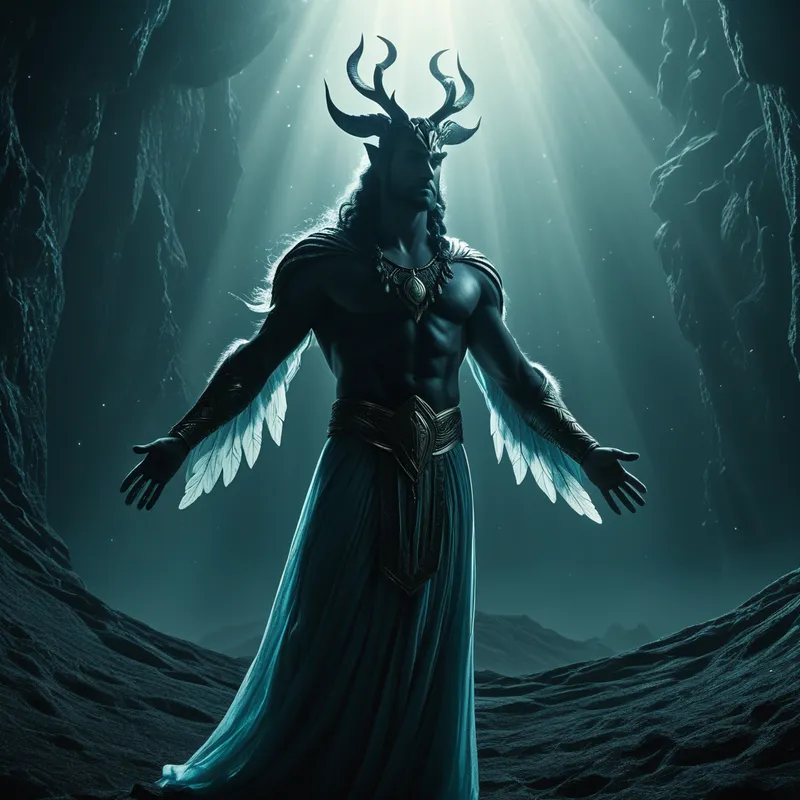
The story begins not with a single event, but with a rupture—a violent sundering of earth from sky, of root from soil. It is the story of a people, the Yoruba, whose cosmology was woven from the very breath of the Supreme Creator, Olodumare. From this divine source flowed Ashe, the sacred animating force that coursed through kings and cobwebs, through incantations and the silent growth of the iroko tree. Ashe was the authority of truth, the efficacy of prayer, the vitality in a newborn’s cry. It was the world, alive and speaking.
Then came the Great Unmaking. The Middle Passage was not merely a journey across water; it was a descent into a realm where the familiar constellations were stolen, where the drums were silenced, and where the very names that carried Ashe were drowned in the salt sea. Enslaved, the carriers of this tradition were thrust into alien lands—Brazil, Cuba, Haiti, Trinidad, the American South. Here, the old gods had no temples, the sacred groves were replaced by cane fields, and the language of ritual was forbidden under the lash.
Yet, Ashe could not be drowned. It traveled in the marrow, in the rhythm of a heartbeat that remembered the talking drum, in the turn of a phrase that held a proverb’s ghost. It hid itself, becoming a master of disguise. In the Catholic saints, the people saw the visages of the Orishas: Our Lady of Charity became Oshun, Saint Barbara became Shango. The Ashe that once flowed openly in communal festivals now moved through clandestine ceremonies in forest clearings, whispered in work songs that mapped the path to freedom, and pulsed in the ring-shout, where shuffling feet etched sacred circles into the earth of a new world. Ashe did not die; it learned to breathe different air. It became the sustaining power of survival, the invisible thread connecting the living to the ancestors left on the distant shore, and the spark of rebellion in a gaze that refused to break.
Cultural Origins & Context
In its West African homeland, Yoruba cosmology presents a universe saturated with consciousness and power. Ashe is the foundational energy emitted by Olodumare, delegated to the Orishas, and distributed to all things—human, animal, mineral, and spoken word. It is not a passive “energy” in a vague, New Age sense; it is active, communicative power. A king (Oba) rules by Ashe, a herbalist heals by it, a sculptor imbues it into an icon. It is both a gift and a responsibility, requiring alignment with divine order (Iwa) for its proper use.
This system was holistic, embedded in language, governance, art, and daily life. The diaspora experience, born of the transatlantic slave trade, constituted a profound cosmological crisis. The institutions that regulated and channeled Ashe—the priesthoods, the kingdoms, the geographic sacred sites—were violently dismantled. The carriers of the tradition faced a dual oppression: physical bondage and a systematic spiritual genocide aimed at erasing their memory of this power.
Symbolic Architecture
The architecture of Ashe in the diaspora is one of profound adaptation, a spiritual ingenuity born of necessity. It represents the ultimate resilience of meaning. The core symbolic structure shifted from one of centralized, public display to one of coded, interiorized potency.
Ashe in the diaspora became a secret language, written not in texts but in the body’s memory, in the inflection of a song, and in the syncretic fusion of symbols. Its power lay in its ability to be recognized by the initiated while remaining invisible to the oppressor.
The primary vessel for Ashe became the human community itself—the “nation” or house within traditions like Santería (Lukumi), Candomblé, and Vodou. The ritual space (Ilé) replaced the royal court as the axis mundi. Here, through dance, drumming, and possession, Ashe is summoned, concentrated, and directed. The altar (Peji) became a portable homeland, a microcosm where the forces of the universe could be arranged and engaged.
The concept of the ancestor (Egungun) gained even more critical importance. In exile, the ancestors became the primary anchors to a lost geography and the guarantors of cultural continuity. Feeding the ancestors through libations and offerings became a fundamental act of maintaining the flow of Ashe across the abyss of the Atlantic.

The Dreamer's Resonance
To engage with Ashe is to engage with the dream of wholeness in the face of fragmentation. For the dreamer in the modern world—of any background—the myth of Ashe’s diaspora journey speaks to the psychological reality of carrying a vital, inner truth through landscapes that are hostile or indifferent to it.
It resonates with the experience of the cultural unconscious—those inherited, often non-verbal patterns of being and knowing that persist beneath the surface of assimilation. Ashe represents the libido, the vital life force of the psyche, which must find new forms of expression when its original channels are blocked by trauma, societal pressure, or personal crisis. The diaspora story mirrors the individual’s journey of integrating disparate parts of the self: the old world of instinct and heritage with the new world of conscious adaptation.
The tension in the myth reflects the inner tension between authenticity and survival, between the pure expression of one’s essence and the necessary camouflage one must wear in different environments. To work with this myth is to ask: What is the unkillable life force within me? How has it disguised itself to survive? And how can I, like the practitioners in the forest clearings, create a sacred space where it can speak its true name again?

Alchemical Translation
The alchemy of Ashe across the Atlantic was a process of transmutation under pressure. The base materials of European Catholicism and indigenous Amerindian practices were not merely mixed with Yoruba tradition; they were subjected to the intense heat of suffering and the imperative to survive, producing a new spiritual alloy.
This was not syncretism as mere blending, but as strategic re-coding. The Catholic crucifix became a staff of power, holy water became river water from Oshun, the Eucharist became food for the gods. The form changed to preserve the function—the conduction of Ashe.
The most profound alchemical translation was of the self. In a system designed to reduce a person to chattel, the reactivation of Ashe through ritual was an act of re-personalization and re-sanctification. To be mounted by an Orisha in possession was to have one’s body reclaimed as a vessel of divine authority, directly countering the narrative of the body as mere laboring flesh. The “talking” in tongues (Anago) during ceremonies was the re-emergence of a sacred language, an alchemical recovery of logos from the silence of oppression.
This translation continues today. Ashe flows into the cadence of hip-hop, the fervor of a Pentecostal service, the communal ethics of the Black church, and the academic pursuit of African diasporic studies. Its alchemy is ongoing, forever transforming the leaden weight of history into the gold of cultural and spiritual vitality.
Associated Symbols
Explore related symbols from the CaleaDream lexicon:
- Life — The fundamental state of being that Ashe animates; the very condition of vitality, growth, and consciousness that the force sustains and empowers.
- Force — The raw, dynamic power inherent in Ashe; the capacity to effect change, to move, to influence, and to manifest will within the fabric of reality.
- Ancestors — The vital link in the chain of Ashe; the departed who remain active, guiding forces, connecting the living to the source of power and cultural memory.
- River — A symbol of Ashe’s flow, its cleansing, sustaining, and life-giving properties, often associated with specific Orishas like Oshun and Yemoja.
- Drum — The heartbeat of Ashe in ritual; the instrument that calls down the divine, alters consciousness, and maps the sacred rhythms of the cosmos.
- Altar — The concentrated point of Ashe in diaspora practice; a microcosmic universe where the forces of nature and divinity are arranged, fed, and engaged.
- Mask — The necessary disguise of Ashe in hostile environments; representing both the strategic syncretism that protected the tradition and the transformative “mask” of the Orisha in possession.
- Ocean — The traumatic yet transformative passage of the Middle Passage; the grave of millions and the enduring, amniotic symbol of connection between Africa and its diaspora.
- Root — The deep, unseen source of Ashe that persists beneath foreign soil; the connection to origin, to the foundational cosmology that nourishes all subsequent growth.
- Transformation Cocoon — The entire diaspora experience as a state of necessary metamorphosis; a period of hidden, pressured restructuring where an old form dissolves so a new, resilient one can emerge.
- Bridge — The spiritual and psychological link Ashe maintains between worlds: Africa and the Americas, the living and the dead, the human and the divine.
- Fire — The transformative, purifying, and often militant aspect of Ashe as seen in Shango; the spark of rebellion, the light of truth in darkness, and the heat of ritual sacrifice.