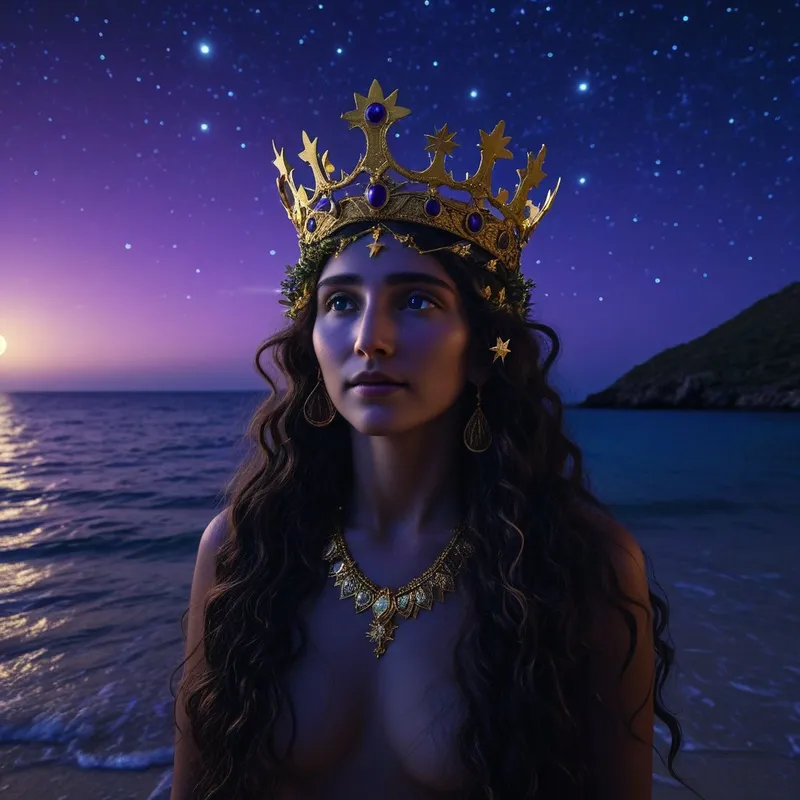
Ariadne's Crown Myth Meaning & Symbolism
A mortal princess betrayed by a hero is found by a god, her bridal crown transformed into a constellation of eternal, radiant wholeness.
The Tale of Ariadne's Crown
Hear now the tale not of the hero, but of the one he left behind. It begins in the deep, stone belly of Crete, where the air was thick with the scent of damp earth and primal fear. Here walked Theseus, prince of Athens, a mortal coil of muscle and dread, destined to face the bull-headed horror. And here waited Ariadne, daughter of the king, her heart a captive bird fluttering against the cage of her duty.
She saw in him not just a sacrifice, but a possibility—a thread leading out of her own gilded labyrinth. In the silent dark, she offered him the means of his salvation: a simple ball of thread. "Fasten this to the entrance," she whispered, her voice the only soft thing in that hard place. "Unwind it as you go. It will be your memory made tangible, your path back to the light." Her gift was an act of treason against her father and her land, a severing woven from love, or perhaps from a desperate hope for her own escape.
The deed was done. The monster slain. Theseus emerged, painted not in glory, but in the grime and gore of the underground, Ariadne’s thread clinging to him like a silken umbilical cord. In the frantic exodus that followed, she fled with him, the salt spray of the sea washing away the dust of Crete. She believed she clung to her liberator, her future king.
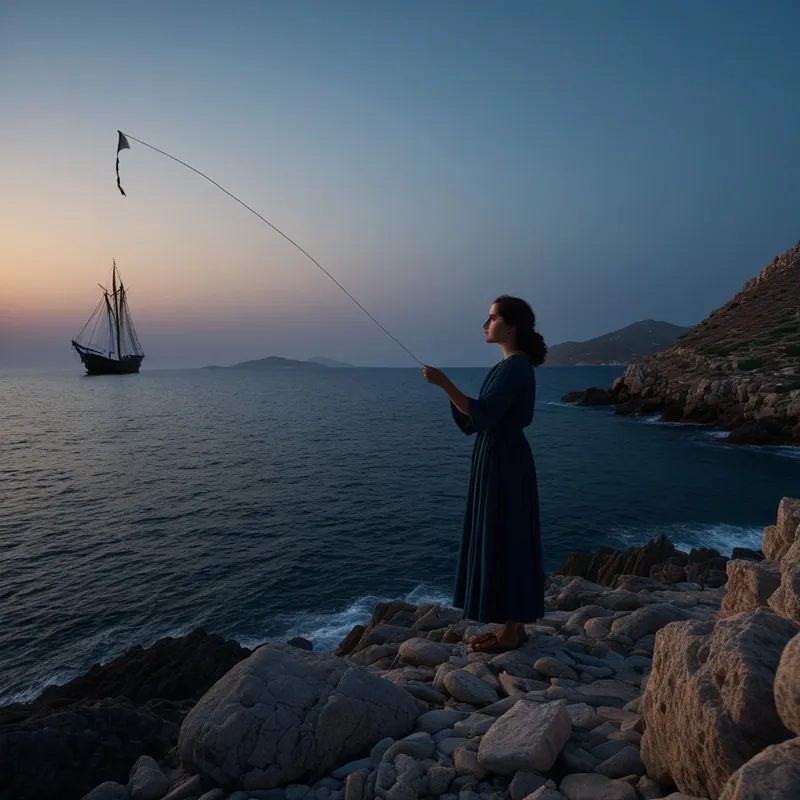
But the story turns on the rocky shore of Naxos. Perhaps she slept, exhausted by flight and hope. Perhaps she wandered, picking shells while he made ready. The accounts vary, but the wound is singular. She looked up, or she awoke, to see the sail of his ship—her ship—a shrinking white scar on the vast blue skin of the sea. The thread had run out. He had taken her betrayal and left her own in return, a discarded key on a foreign shore. The despair was absolute, a hollowing out more profound than any labyrinth.
Yet, the gods watch. And one in particular moves to the rhythms of ecstasy and madness. As Ariadne’s mortal hope dissolved into tears, a new presence filled the air—the scent of ivy and crushed grape, the sound of unseen flutes and rustling fawnskin. Dionysus arrived. Not as a conquering hero, but as a god who knows the depths of abandonment and the frenzy of transformation. He saw not a used woman, but a soul at the threshold of dissolution, ripe for a different kind of marriage.
His love was not a mortal compact; it was a divine claiming. In a ceremony that shook the island with unearthly joy, he wed her. As his ultimate gift, he took the bridal crown from her brow—a delicate circlet of gold, perhaps gifted by Theseus, now a relic of a broken promise. Dionysus hurled it into the vault of the night sky. There it caught, its gold transmuting into celestial fire. The stars themselves bent to its form, etching the Corona Borealis into the cosmos. A mortal woman’s betrayal and abandonment were alchemized, not undone, into an eternal symbol of sacred union and radiant, fixed beauty. Where the thread ended, the crown began.
Cultural Origins & Context
The myth of Ariadne’s Crown is a mosaic, its pieces found in the works of Hesiod, Homeric hymns, and later poets like Ovid. It was never a single, canonical text but a fluid narrative passed down by bards and woven into the fabric of Greek religious practice and star lore. The story served as a powerful aition—a mythic explanation for a natural phenomenon, giving the constellation Corona Borealis a divine and human history.
Culturally, it functioned at a crossroads. It was a cautionary tale about the fickleness of heroic glory (Theseus’s flaw of forgetfulness is a recurring theme) and the peril of trusting a mortal promise over divine order. More significantly, it was integrated into the ecstatic worship of Dionysus. Followers of the god, particularly women known as Maenads, would have seen in Ariadne a mirror: a woman who, through a shattering personal crisis, was liberated from her old life and reborn into a state of divine communion and eternal fame. Her story validated the Dionysian path—one that often began with a brutal dismantling of the social self before achieving transcendent unity.
Symbolic Architecture
At its core, this is a myth of radical recontextualization. Every key symbol undergoes a profound shift in meaning, guided by the intervention of the divine.
The Thread begins as a tool of linear, logical navigation. It represents the cunning intellect, the plan, the clear path from A to B. It is the hero’s method. Yet, it leads Ariadne not to freedom, but to abandonment. Its utility is exhausted.
The Abandonment on Naxos is the central psychological crisis. It is the experience of the foundation giving way. All contracts—filial, romantic, social—are nullified. This is the desert of the soul, where the ego’s projects lie in ruins. It is not a punishment, but a brutal, necessary clearing.
The labyrinth is the problem the ego can solve. The empty shore is the mystery it cannot.
Dionysus represents the archetypal force that meets us in that clearing. He is not order, but the sacred disorder that precedes a higher reordering. He is the god of the unmade self, the spirit that dissolves boundaries and intoxicates with a reality far larger than personal tragedy.
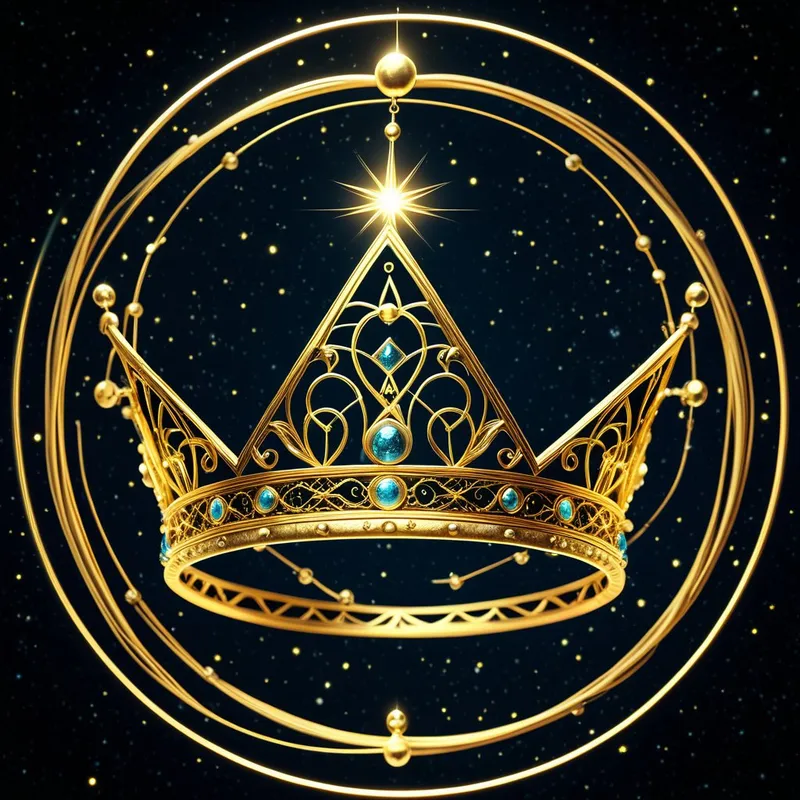
The Crown is the ultimate symbol of transmutation. A piece of mortal jewelry, a token of a broken betrothal, is thrown away—into the sky. It does not vanish; it is re-contextualized on a cosmic scale. The crown, a circle, symbolizes wholeness and sovereignty. Its placement as a constellation eternalizes this wholeness, making the personal, painful story a permanent fixture of the universal order. The crown is no longer about a mortal queen, but about the archetypal journey from betrayal to divine recognition.
The Dreamer's Resonance
When this myth stirs in the modern unconscious, it often manifests in dreams of profound abandonment or betrayal, followed by enigmatic, numinous encounters. You may dream of being left behind on a station platform as a train departs, or of a crucial contract dissolving in your hands. The somatic feeling is one of hollow dread, a vacuum in the chest.
This is the psyche’s enactment of the Naxos moment. It signifies that a foundational identity structure—often built around a role (the helper, the lover, the loyal one), a relationship, or a cherished plan—has reached its expiration. The "Theseus" figure in the dream, the one who leaves, represents that outgoing, goal-oriented, heroic aspect of your own psyche that has served its purpose and must now move on, even if it feels like a catastrophic loss.
The subsequent dream imagery—the sudden appearance of revelrous figures, inexplicable music, or most potently, a gift of stunning beauty like a jewel or a light in the darkness—signals the approach of the Dionysian principle. The psyche is initiating its own alchemical process, moving from the agony of personal loss toward a more impersonal, archetypal re-framing of the experience. The dream is the inner Dionysus finding you on your own Naxos.
Alchemical Translation
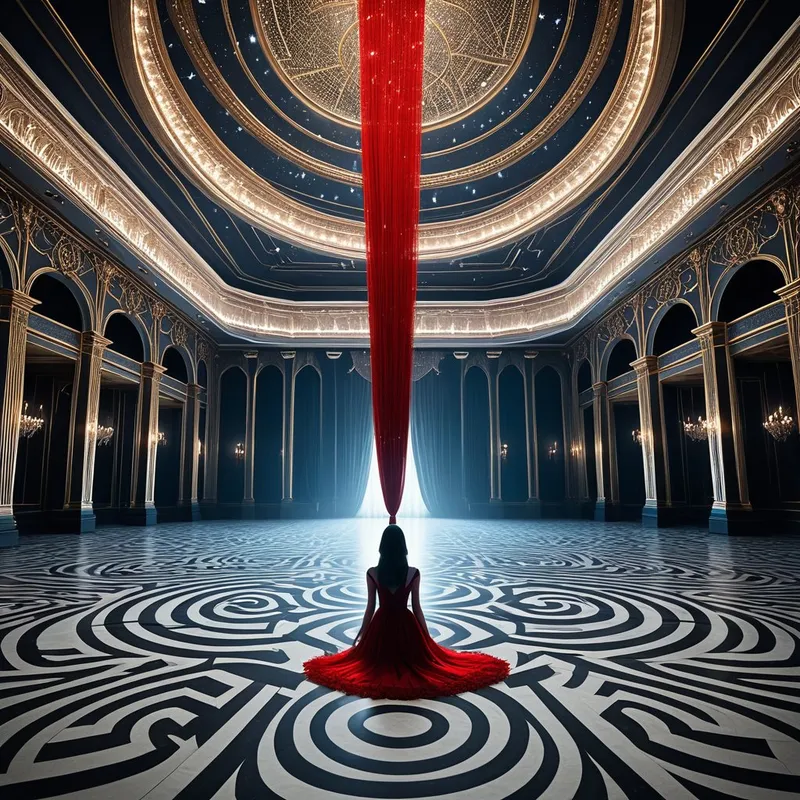
The alchemy of Ariadne’s Crown models the process of individuation not as a heroic conquest, but as a sacred recovery through dissolution. Our modern "labyrinths" are the complex problems of our lives—careers, relationships, personal ambitions. We enter them with our "threads": our intellect, our strategies, our will to succeed (the Theseus energy). Sometimes, we succeed in our quest, only to find ourselves spiritually marooned on an island of our own making, feeling betrayed by the very success we sought.
The myth instructs us that this abandonment is not the end of the journey, but the essential beginning of a deeper one. It is the nigredo, the blackening, where all that was familiar is taken away. The ego’s plans have culminated in ashes.
The alchemical fire is not kindled by the will, but by the surrender of the will to a greater pattern.
The arrival of the Dionysian force is the psyche’s capacity for enthusiasm (literally, "having the god within"). It is the eruption of irrational creativity, deep feeling, or a connection to nature and the body that pulls us out of sterile despair. This force does not comfort the old identity; it weds the soul to something vaster. It demands we let go of the personal narrative of victimhood ("I was abandoned") and allow our experience to be re-contextualized into a universal story of transformation.
Finally, the Crown is the lapis, the philosopher’s stone of this inner work. It represents the moment of integration where our deepest wound, our most humiliating failure, is seen not as a flaw, but as the very signature of our unique journey. It is fixed in the heavens of the self—a permanent, guiding constellation. We achieve sovereignty not by avoiding betrayal and loss, but by allowing those experiences to be transmuted into the unshakeable, radiant core of our being. We are no longer the one who was left with the thread. We become the one around whom the stars themselves form a crown.
Associated Symbols
Explore related symbols from the CaleaDream lexicon: