
Aphrodite's Beauty Rituals Myth Meaning & Symbolism
A myth of divine allure, where beauty is not vanity but a sacred, terrifying force of creation and dissolution, forged in the sea's dark heart.
The Tale of Aphrodite's Beauty Rituals
Hear now a tale not of conquest or thunder, but of a softer, more terrifying power. It begins not on Olympus, but in the churning, primal dark. From the severed flesh of Ouranos, cast into the salt-wine sea, a foam began to gather. Not the gentle froth of a shore, but a seething, pearlescent whirlpool, churned by the grief of the world. And from that radiant, aching foam, she was born.
Aphrodite rose, perfect and fully formed, standing upon a giant scallop shell. The sea itself held its breath. The Horai, the daughters of Themis, were waiting at the shore. They did not greet her with words, but with sacred oils pressed from eternal flowers, and with finely woven robes the color of dawn and twilight. This was her first ritual: the anointing of the newborn divine. They clothed her not to conceal, but to consecrate.
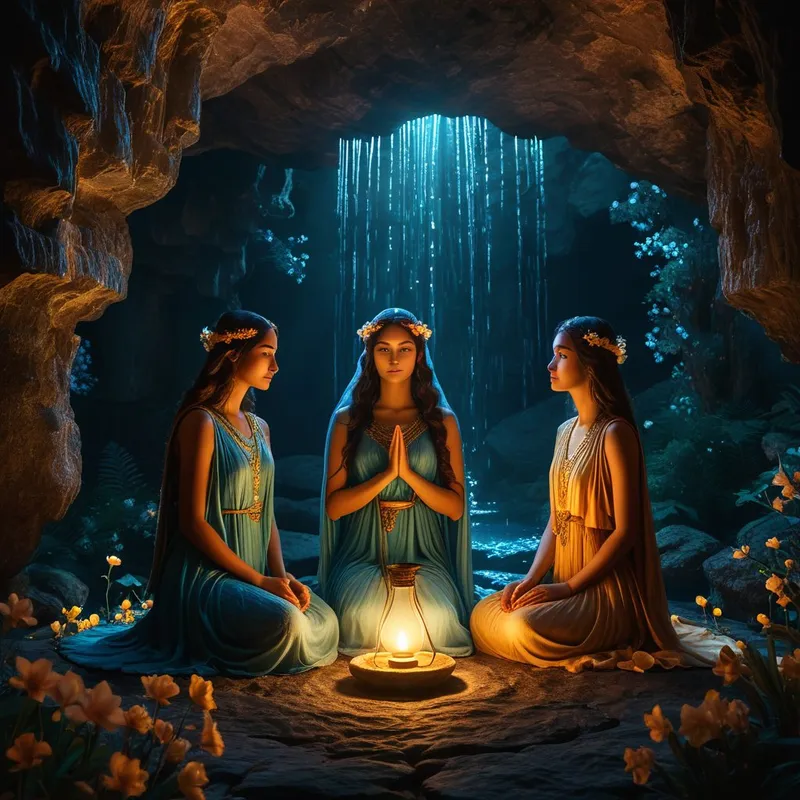
Her beauty was not a passive state, but a dynamic force. To maintain its terrible, world-shaping resonance required a liturgy. Each dawn, before the sun chariot of Helios crested the horizon, she would retreat to a hidden grotto where a spring of pure, sweet water flowed. Here, the Charites attended her. They would bathe her not with water alone, but with the essence of roses that knew no thorn, and myrtle that held the memory of sacred vows. They combed her hair with a golden keteis, and as each strand fell into place, it seemed to capture and slow the very light.
But the core of her ritual was the girdle. This was no mere adornment. Woven by Hephaistos himself, it was a masterpiece of enchantment. Within its threads were sewn desire, whispered longing, and the sweet, debilitating ache of attraction. To fasten it about her hips was to arm herself. When she wore it, even the sternest gods—Zeus himself—and the wisest, like Athena, could feel their resolve soften into yearning. This ritual of adornment was her aristeia, her moment of supreme power, as potent as any warrior’s rage.
The conflict was inherent. This beauty, this crafted allure, was a force of both creation and chaos. It could spark marriages and birth nations, as with the heroes of old. Yet it could also unravel minds, spark jealous wars, and bend wills toward ruin, as the tale of Paris would later attest. Her ritual was the steadying of this nuclear force, the conscious channeling of a power that, left untended, could burn the world or leave it in sterile ice. The resolution was not an end, but an eternal return to the spring, to the oils, to the girdle—a perpetual rebirth of the force that connects all things.
Cultural Origins & Context
The myths of Aphrodite’s origins and her rituals are primarily woven from the threads of Hesiod’s Theogony and the Homeric Hymns. Hesiod, an 8th-century BCE poet, provides the canonical account of her birth from the sea-foam (aphros), explicitly linking her power to a primal act of violence and separation. Homer and the anonymous authors of the Hymns elaborate on her nature as a potent, often disruptive, Olympian force.
These stories were not mere entertainment. In a culture that practiced highly ritualized bathing, anointing, and adornment—from the gymnasium to the symposium—Aphrodite’s rituals provided a divine template. They sacralized the human acts of preparing the body for love, for marriage, for sacred rites, and for war. Her festivals, like the Aphrodisia, involved ritual baths and processions, mirroring her mythic routines. The myth functioned as a cultural container, acknowledging the tremendous social power of attraction and beauty, while simultaneously framing it as a divine, and therefore dangerous, art that required respect and careful management.
Symbolic Architecture
At its core, this myth is not about superficial glamour, but about the conscious cultivation and ethical bearing of one’s inherent attractive force—be it physical, emotional, creative, or spiritual.
Beauty, in the Aphroditic sense, is the visible signature of the life force itself, the irresistible pull towards connection, creation, and complexity.
The Sea-Foam Birth symbolizes origin in chaos and fragmentation. She emerges not from unity, but from a wound in the cosmos (Ouranos). Her beauty is therefore inseparable from trauma, representing the astonishing, life-giving potential that can be born from painful severance and dissolution.
The Ritual Bathing represents purification and renewal. It is the daily re-consecration of the self, the washing away of the psychic residue of the world’s projections and engagements. The sweet water spring is the source of one’s own untouched, essential nature.
The Golden Girdle (Kestos Himas) is the central symbol of focused, wielded power. It is the difference between raw, unconscious allure and conscious charisma. It represents the craft of relationship, the art of weaving one’s inherent qualities into a presence that can intentionally influence the emotional field. Its danger lies in its potential for manipulation; its divinity lies in its capacity to foster union.
The Dreamer's Resonance
When this myth pattern stirs in the modern unconscious, it often surfaces in dreams of profound, sometimes anxious, self-preparation. To dream of meticulously bathing in a strange, beautiful pool; of being adorned by silent, attentive figures; or of discovering a dazzling, powerful piece of jewelry (especially a belt or girdle) points to a psyche undergoing an Aphroditic process.
Somatically, this may feel like a heightened sensitivity to one’s own skin, a preoccupation with appearance, or a deep, urgent pull towards creating beauty in one’s environment. Psychologically, it signifies a stage where the dreamer is grappling with their own "attractive force." This could relate to stepping into a new role that requires personal magnetism (leader, artist, lover), recovering a sense of desirability after a period of neglect or trauma, or confronting the shadow side of using charm or beauty to navigate the world. The dream asks: What power are you preparing to wield? And to what end?

Alchemical Translation
The alchemical journey modeled here is the transmutation of aphros—the chaotic, frothy potential born from a primal wound—into the kestos himas—a refined, conscious instrument of connection. It is the path of the Lover archetype towards individuation.
Individuation requires not the rejection of one’s allure, but the sacred responsibility for it. To integrate Aphrodite is to become both the nurtured and the nurturer, the work of art and the artist attending to it.
The first stage is Acknowledging the Foam-Birth: Accepting that one’s core creative or attractive energies are often rooted in experiences of fragmentation, loss, or deep longing. There is no pristine origin, only powerful genesis from life’s cuttings.
The second is The Daily Grotto: Establishing a non-negotiable ritual of self-consecration. This is the psychological "grotto"—a protected inner space for reflection, self-care, and reconnection with one’s source. It is where one washes off the expectations of others and remembers one’s essential nature.
The final, ongoing stage is Forging the Girdle: The conscious work of integration. This is where we take our raw materials—our talents, our vulnerabilities, our history—and consciously weave them into our persona, not to deceive, but to skillfully and ethically engage with the world. It is the development of personal integrity (integer: whole) where our inner reality and outer presentation are aligned with purpose. The goal is not to make everyone desire us, but to wield our connective power with clarity, creating bonds that foster growth, beauty, and life, rather than dependency or destruction. We become, like Aphrodite, a conscious vessel for the terrifying and glorious force of Eros itself.
Associated Symbols
Explore related symbols from the CaleaDream lexicon: