Ant People Myth Meaning & Symbolism
A Hopi myth where humanity survives world-ending floods by descending into the earth, guided by humble Ant People who teach survival and spiritual order.
The Tale of Ant People
Listen. The world is not as solid as you believe. It has been unmade before.
In the First World, Tokpela, people forgot the song of their making. They turned from Taiowa’s harmony, and discord grew like a weed in the cornfield. So it was that the world grew heavy with forgetting. The skies, once clear as a hawk’s eye, darkened with the weight of wrong-doing. Then came the rains—not the gentle rains that bless the crops, but a great, drowning deluge that swallowed the mountains and silenced the rivers. The First World was washed clean, returned to the primal waters from which it came.
But not all was lost. For in the heart of the chaos, there were those who still remembered the old ways. They listened. And from below, a whisper came—not through the air, but through the very bones of the earth. It was a call of humility, an invitation to descend.
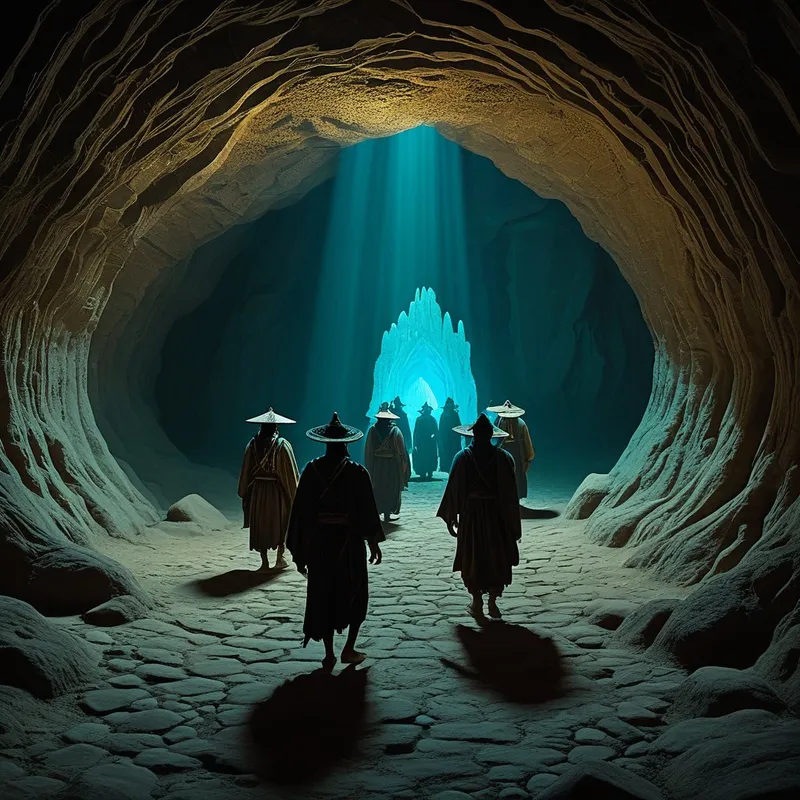
Guided by spiritual wisdom, these people found openings in the earth: sipapus, the navel of the world. With fear and faith in their hearts, they left the drowning light and entered the dark embrace of the underworld. This was not a place of death, but of profound shelter. Here, in the Second World, Tokpa, they met their saviors.
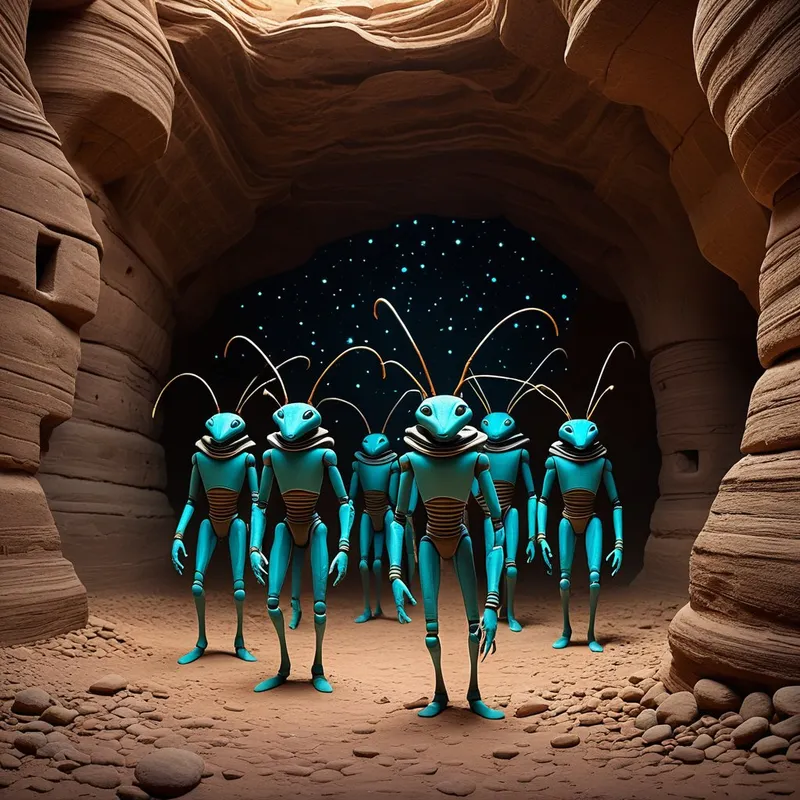
The Ant People. They were not monstrous, but ministers of mercy. Small, industrious, moving with a purposeful grace that spoke of endless cycles. Their world was a labyrinth of earthen halls, warm, dry, and safe from the chaos above. "Live as we live," they taught, not with words, but with the example of their existence. The people had to shrink their stature, to walk hunched in the low tunnels. They had to learn to eat simply, to store meager grains of corn with meticulous care, to move in harmony with the colony’s silent rhythm.
For generations, they lived thus. The great dramas of the surface—the flood, the wind, the fire—were but distant echoes. In the amber glow of their subterranean refuge, they were remade. The arrogance of the First World was scoured away by the gritty reality of survival in close quarters, by the necessity of utter cooperation. They learned the discipline of the ant: patience, preparation, and the profound truth that the individual survives only through the care of the whole. When the waters finally receded and the sun called them back to the surface, they emerged not as the people who had descended, but as the Hopi—the Peaceful People—carrying the wisdom of the ants in their bones and the memory of the dark, nurturing womb in their collective soul.
Cultural Origins & Context
This narrative is a cornerstone of the Hopi cosmology of emergence. It is not merely a story but a sacred history, a map of spiritual and physical migration. Passed down orally through generations by elders and ceremonial society members, it is woven into rituals, petroglyphs, and the very orientation of Hopi life on the mesas.
Its function is multifaceted. It is an etiological myth, explaining the Hopi’s origins and their covenant to live a life of humility, cooperation, and respect for the delicate balance of nature. It serves as a moral compass, reinforcing the values that ensure community survival in a harsh desert environment. Most profoundly, it is a cosmogonic narrative that connects the present-day Hopi to a timeless, cyclical understanding of creation, destruction, and rebirth. The myth validates their worldview, where cataclysm is followed by renewal, guided by humble, non-human teachers.
Symbolic Architecture
The myth’s power lies in its stark, elegant symbolism. The Ant People represent the archetypal guides of the deep unconscious. They are not dazzling gods of Olympus, but creatures of the underworld—the psychological basement where our most basic instincts for survival, community, and order reside.
The guide we need is often found not in the soaring eagle, but in the humble insect that knows the secret pathways of the earth.
The flood symbolizes the overwhelming tide of psychic chaos—a crisis of meaning, a collapse of old values, or a personal cataclysm that washes away the familiar landscape of the ego. The descent is the critical, involuntary journey into the unconscious, a regression for the sake of progression. The subterranean world is the nurturing, restrictive womb of the psyche where transformation occurs in darkness. Here, the ego must "make itself small," surrendering its grandiosity to learn the fundamental disciplines of the soul.
The blue corn, often associated with this myth, is more than sustenance. It is the germ of potential, the compact, stored wisdom that must be carefully preserved and rationed through the "long winter" of the psyche.
The Dreamer's Resonance
When this myth pattern stirs in the modern dreamer, it often signals a necessary psychological descent. Dreams of crawling through tunnels, finding hidden rooms underground, or encountering insectoid beings—especially if they are helpful—point to this archetypal process.
Somatically, this may manifest as a feeling of constriction, pressure, or a desire to curl up and retreat from the world. Psychologically, it is the ego’s experience of being humbled. Perhaps one’s career, relationships, or self-image has faced a "flood." The dream is not a sign of failure, but an instinctual enactment of survival. The psyche is guiding the dreamer inward, away from the storm of external circumstances, to reconnect with the foundational, ant-like instincts of resilience, patience, and communal support (even if that "community" is the integrated parts of one’s own self). The Ant People in dreams are personifications of this innate, guiding intelligence of the unconscious, leading us to the resources we have stored but forgotten.
Alchemical Translation
The journey of the Ant People is a perfect allegory for the alchemical nigredo and the Jungian process of individuation. The cataclysmic flood is the prima materia—the shocking, often painful crisis that initiates the work. The conscious personality is dissolved.
Individuation begins not with expansion, but with contraction. Not with finding one’s greatness, but with accepting one’s smallness within the great colony of the Self.
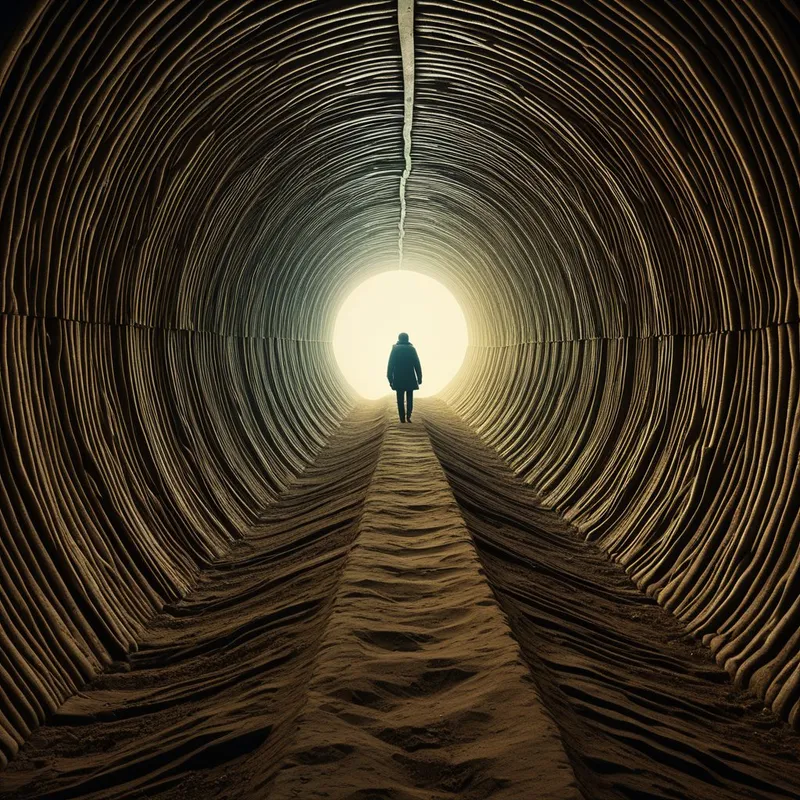
The descent into the ant world is the nekyia, the night sea journey into the unconscious. Here, in the dark (nigredo), the grandiose elements of the persona are stripped away. One must learn to live on "grains of corn"—to find sustenance in simple, core truths and to practice the meticulous, often tedious inner work of observing one’s patterns, storing insights, and building psychic structure.
The Ant People themselves are symbols of the transcendent function. They mediate between the drowned world of the old ego and the potential for a new, grounded consciousness. Their wisdom is the wisdom of the body, of instinct, of earthy pragmatism infused with spiritual purpose. To be guided by them is to allow the deep, non-rational intelligence of the psyche to lead.
Emergence into the next world represents the albedo and rubedo—the dawn and the culmination. The individual who emerges is not simply repaired, but transmuted. They carry the ant’s discipline within them: a humility that is not weakness but fierce resilience, a connection to the communal whole (the Self), and a profound respect for the hidden, nourishing darkness from which all conscious life must periodically draw its strength. They have learned that to survive the flood, one must sometimes become small, go deep, and learn the ancient, patient ways of the earth-dwellers.
Associated Symbols
Explore related symbols from the CaleaDream lexicon: