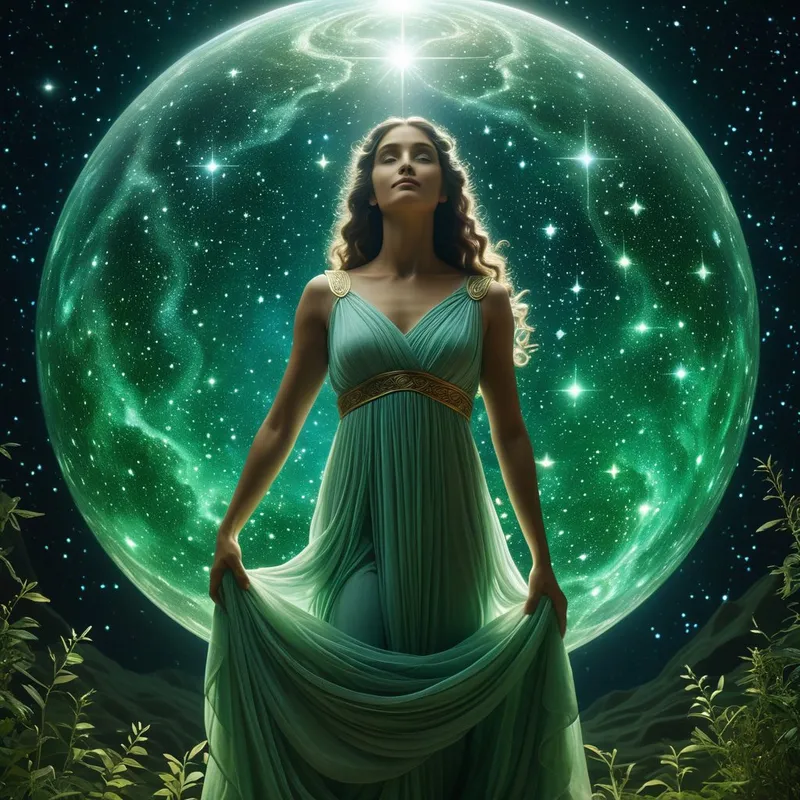
Anima Mundi Myth Meaning & Symbolism
The ancient Greek vision of a living, ensouled cosmos, where the divine breath weaves spirit into matter, binding all creation into a single, sacred being.
The Tale of Anima Mundi
Listen. Before the names of gods were fully formed on mortal tongues, before the first city raised its stone head, there was a breath. Not a wind, but the idea of wind, the first sigh in the throat of the void. This was the realm of Chaos, a yawning, silent potential. And from this potential, the great ancestors emerged: Gaia, broad and deep; Eros, the sweet, piercing arrow of desire; Erebus and Nyx, cloaked in starless dark.
They birthed the Titans, and the Titans warred, and from that cosmic strife, the Olympian order was forged. Yet, for all their splendor, the world they ruled was a magnificent corpse. The mountains were silent bones. The seas were vast, senseless pools. The forests were collections of wood and leaf, beautiful but asleep. The cosmos was a masterpiece of mechanics, a clockwork of celestial spheres turning in perfect, lonely silence.
Then came the whisper. It moved through the halls of Olympus like a forgotten melody. It was not a command, but an invitation. It spoke to the Hephaestus in the rhythm of his forge, to Athena in the logic of her loom, to Apollo in the harmonics of his lyre. The whisper said: It is not enough to make. You must ensoul.
And so, the greatest artisans of the divine turned their attention not to a weapon or a throne, but to the substance of reality itself. In a workshop at the edge of perception, where ether condenses into form, they gathered. They took the four root-stuff—the stubborn flesh of Earth, the fluid passion of Water, the quickening intellect of Air, and the transformative spirit of Fire. These were the body. But a body needs a breath.
From the deepest well of Mnemosyne, they drew the water of remembrance. From the boundless laughter of Dionysus, they captured the spark of frenzy. From the steadfast gaze of Hestia, they took the ember of centered calm. These, and a thousand other essences—the courage of the lion, the patience of the oak, the yearning of the migrating bird—were blended into a single, shimmering elixir.
Then, the moment of infusion. It was not an act of force, but of consummate intimacy, a divine marriage. The elixir was poured, not onto, but into the waiting matrix of the elements. And as it seeped into the core of every stone, the heart of every wave, the nucleus of every growing thing, the cosmos shuddered. Not with pain, but with a gasp of awakening.
The mountains began to dream slow, geological dreams. The seas learned to sing tides to the moon. The wind carried secrets from continent to continent. The world was no longer an it. The world became a Thou. A living, breathing, feeling entity—a vast, singular body with a singular, pervasive soul. They called it the Anima Mundi. And from that day forth, to walk upon the earth was to walk upon the skin of a slumbering god, to drink from a spring was to taste its thoughts, and to look at the stars was to meet the gaze of a conscious universe.
Cultural Origins & Context
The concept of the Anima Mundi as a formal philosophical doctrine finds its most eloquent voice not in the epic poets, but in the philosophers of the Platonic tradition. While the poetic, mythological sensibility of a living world permeates older Greek thought—in the nymphs of every grove and the gods in every river—it was Plato, in his dialogue Timaeus, who gave it a systematic, geometric soul.
Here, the Anima Mundi is presented not just as a pretty metaphor, but as a cosmological necessity. For Plato, a universe created by a benevolent Demiurge could not be less than perfect and alive. The World Soul was the intelligent, mathematical principle that mediated between the eternal realm of perfect Forms and the shifting realm of material sensation. It was the binding agent, woven from a blend of the indivisible (the realm of sameness) and the divisible (the realm of difference), and then stretched across the heavens, structuring the orbits of the planets—the "music of the spheres"—into a visible expression of divine reason.
This idea was carried forward by the Neoplatonists, like Plotinus, for whom the Anima Mundi was an emanation from the supreme The One, the active principle that breathes life and order into the cosmos. Its societal function was profound: it provided a philosophical basis for the sacredness of the natural world, for astrology, for the idea of cosmic sympathy (sympatheia), where every part affects the whole. It was the ultimate argument against a meaningless, mechanistic universe, asserting instead that to know the world was, in some way, to commune with a world-mind.
Symbolic Architecture
At its core, the Anima Mundi is the archetype of ultimate connection. It symbolizes the fundamental unity underlying all apparent diversity. The myth addresses the primal human wound of separation—the feeling of being a lonely consciousness trapped in a bag of skin, adrift in an indifferent universe.
The Anima Mundi is the psyche's intuition that the boundary between self and world is permeable, that the echo we hear in the forest is the forest itself recognizing us.
Psychologically, it represents the objective psyche—the transpersonal, collective layer of the unconscious that is not personal to us, but in which we participate. It is the sea in which our individual islands of consciousness arise. The act of the gods ensouling matter mirrors the psychological process of animation: we do not merely perceive objects; we can project life, meaning, and relationship onto them, and in doing so, we animate our own world, moving from a state of sterile observation to one of participatory enchantment.
The Anima Mundi is also the ultimate symbol of the feminine principle in its cosmic aspect—not as a gender, but as the principle of relatedness, containment, nurture, and embodied intelligence. It is the unus mundus (the one world) of the alchemists, the unified reality from which both psyche and matter spring.
The Dreamer's Resonance
When the Anima Mundi stirs in the modern dreamscape, it often manifests not as a grand figure, but as a profound quality of experience. The dreamer may find themselves in a landscape that is palpably alive and communicative—a forest where the trees hum with a low intelligence, a city where the buildings breathe, or an ocean that speaks in waves of emotion.
Common motifs include: discovering that one's own nervous system is wired into the roots of a great tree or the grid of a crystal city; hearing the "heartbeat of the earth" through the ground; or seeing luminous, connective filaments—like neural pathways or mycelial networks—linking all people, creatures, and objects in the dream. These are dreams of radical empathy and belonging. They often arise during periods of intense isolation, ecological grief, or a spiritual crisis of disconnection. Somatically, the dreamer may awaken with a sense of expansion, a tingling in the limbs, or a deep, resonant calm, as if the body has remembered it is not a separate entity but an organ of a larger body.
Such dreams signal the psyche's attempt to heal the Cartesian split between mind and world. They are an invitation from the deep unconscious to step out of the prison of the isolated ego and experience the Self that is coterminous with the world.

Alchemical Translation
The myth of the Anima Mundi provides a master blueprint for the alchemical process of psychic transmutation, the goal of which is not to escape the world, but to fully marry spirit to it—to achieve the unio mundi, the union with the world.
The initial prima materia, the leaden state of the soul, is the experience of alienation, of living in a dead, mechanical universe. The first operation, calcinatio, is the burning away of this cynical, disenchanted worldview. The solutio is the dissolution of the hard boundaries of the ego, allowing the individual to feel the fluid interconnectedness of all things. The coagulatio is the critical stage modeled by the myth: the careful, artful infusion of soul (anima) into one's own lived experience. This is the work of ensoulment.
Individuation is not about becoming more separate, but about becoming a more distinct and conscious node in the net of the Anima Mundi. The goal is to become who you are, in conscious relationship to the whole.
This means animating our daily lives—seeing our work, our relationships, our creative acts, and our encounters with nature as sacred exchanges with a living cosmos. It is to move from being a consumer of experiences to a participant in a ongoing, cosmic conversation. The final stage, the rubedo or reddening, is the achievement of a passionate, embodied, and compassionate life, where one feels the joy and suffering of the world as one's own, not as a burden, but as the natural expression of being part of a living body. One becomes, in a small but essential way, a co-artisan with the original Demiurge, tasked with the perpetual ensoulment of one's own corner of the world.
Associated Symbols
Explore related symbols from the CaleaDream lexicon: